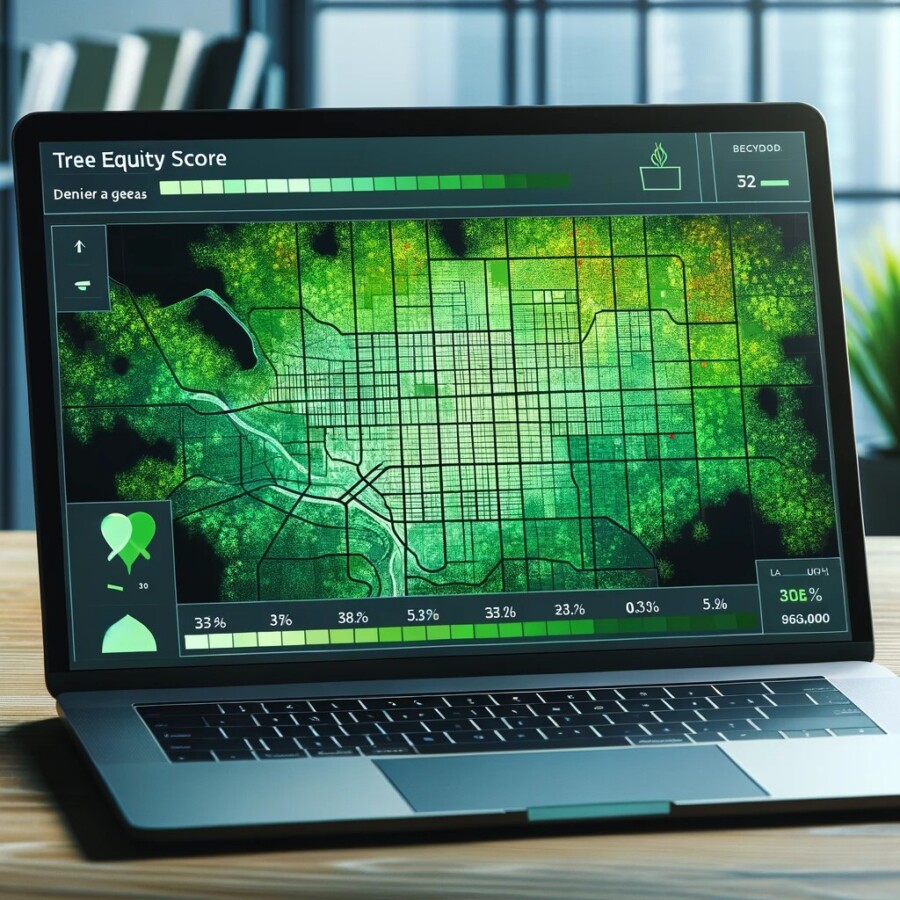
A new map has been made that shows how areas with fewer trees in cities have more pollution and worse air quality. The map was made by the Woodland Trust, American Forests, and the Centre for Sustainable Healthcare. It uses information from Google and other sources to give a "tree equity score" for different neighborhoods in the UK. This score shows how much more trees are needed in an area. The map shows that poorer areas have less trees and more pollution compared to richer areas. Places with more trees have less pollution and are cooler during hot weather.
It's a worry that there aren't enough trees in urban areas because it affects people's health and well-being. Trees are really important for making the air cleaner and reducing pollution. They also give shade and help keep things cooler when it's hot. But right now, richer areas have more trees and green spaces, which isn't fair. This makes social inequalities worse and means that people in poorer areas don't get the benefits of trees.
The people who made the map hope that it will make policymakers think about planting more trees in cities. They say that trees should be seen as important as things like electricity and water, and that everyone should have the right to have trees around them. In the US, a similar project called "tree equity" has led to trees being planted in poorer areas and creating jobs for local people.
Some councils in the UK, like Birmingham and Belfast, are already thinking about the link between trees and poverty in their plans. The people who made the map hope that the tree equity score will help all councils know where to plant trees first. The aim is to make a healthier and fairer environment for everyone.
At Lowfield Primary School in Sheffield, the kids have planted a rowan tree in their playground to help with air pollution. The students know how important trees are for making the air cleaner and they want to see more trees in their area. This is a small step in the right direction, but more needs to be done to make sure that all communities can enjoy the benefits of trees.
Original news source: Air pollution: map shows 'concrete jungles' more polluted (BBC)
🎧 Listen:
📖 Vocabulary:
Group or Classroom Activities
Warm-up Activities:
– News Summary
Instructions: Divide the class into pairs or small groups. Give each group a few minutes to read the article. Then, ask them to summarize the main points of the article in their own words. Each group can take turns sharing their summaries with the rest of the class.
– Vocabulary Pictionary
Instructions: Write down key vocabulary words from the article on separate index cards or pieces of paper. Divide the class into two teams. One person from each team comes to the front of the class and chooses a word. Without speaking, they have to draw a picture to represent the word while their team tries to guess what it is. The team that guesses correctly gets a point.
– Pros and Cons
Instructions: Divide the class into pairs or small groups. Give each group a few minutes to discuss and write down the pros and cons of planting more trees in urban areas. Then, ask each group to share their ideas with the rest of the class. Encourage a class discussion and debate about the benefits and potential drawbacks of increasing tree coverage in cities.
– Think-Pair-Share
Instructions: Ask the class to think about and write down their personal opinions on the importance of trees in urban areas. Then, have them pair up with a partner and share their thoughts. After a few minutes, ask a few pairs to share their opinions with the rest of the class. Encourage a respectful and open discussion about different viewpoints.
– Future Predictions
Instructions: Have the class imagine what their city or neighborhood would look like in the future if more trees were planted. Ask them to write or discuss their predictions, considering how the environment, air quality, and quality of life might change. After some time, ask a few students to share their predictions with the rest of the class.
🤔 Comprehension Questions:
🎧✍️ Listen and Fill in the Gaps:
A new map has been made that shows how areas with fewer in cities have more pollution and worse air quality. The map was made by the Woodland Trust, American Forests, and the Centre for Sustainable Healthcare. It uses information from Google and sources to give a "tree score" for different in the UK. This score shows how much more trees are needed in an area. The map shows that poorer areas have less trees and more pollution compared to richer areas. Places with more trees have less pollution and are cooler during hot . It's a worry that there aren't enough trees in urban areas because it affects people's health and well-being. Trees are really important for the air cleaner and reducing pollution. They also give shade and help keep things cooler when it's hot. But right now, richer areas have more trees and green spaces, which isn't fair. This makes social inequalities worse and that people in poorer areas don't get the of trees. The people who made the map hope that it will make policymakers think about more trees in . They say that trees should be seen as as things like electricity and water, and that everyone should have the right to have trees around them. In the US, a project called "tree equity" has led to trees being planted in poorer areas and creating jobs for local people. Some councils in the UK, like Birmingham and Belfast, are already thinking about the link between trees and poverty in their plans. The people who made the map hope that the tree equity score will help all know where to plant trees first. The aim is to make a healthier and fairer environment for everyone. At Lowfield School in Sheffield, the kids have a rowan tree in their to help with air pollution. The students know how important trees are for making the air cleaner and they want to see more trees in their area. This is a small step in the right direction, but more needs to be done to make sure that all communities can enjoy the benefits of trees.
💬 Discussion Questions:
1. What is a "tree equity score" and why is it important?
2. How do trees help make the air cleaner and reduce pollution?
3. Why is it unfair that richer areas have more trees and green spaces?
4. How do trees provide shade and help keep things cooler during hot weather?
5. Do you think everyone should have the right to have trees around them? Why or why not?
6. How do you think planting more trees in cities could improve people's health and well-being?
7. What do you think policymakers can do to ensure that trees are planted in all neighborhoods?
8. How do you think planting trees in poorer areas could create jobs for local people?
9. Do you think your city or town has enough trees? Why or why not?
10. How would you feel if a rowan tree was planted in your school or neighborhood to help with air pollution?
11. Do you like spending time in green spaces with trees? Why or why not?
12. How do you think having more trees in urban areas could improve the environment?
13. What do you think are some challenges in planting more trees in cities?
14. How could planting trees in poorer areas help reduce social inequalities?
15. Do you think it's important for schools to teach students about the importance of trees and the environment? Why or why not?
Individual Activities
📖💭 Vocabulary Meanings:
Click a dot next to a word, then click the dot next to its meaning to draw a line connecting them.
Words
Meanings
🔡 Multiple Choice Questions:
🕵️ True or False Questions:
📝 Write a Summary:
Write a summary of this news article in two sentences.
Check your writing now with the best free AI for English writing!