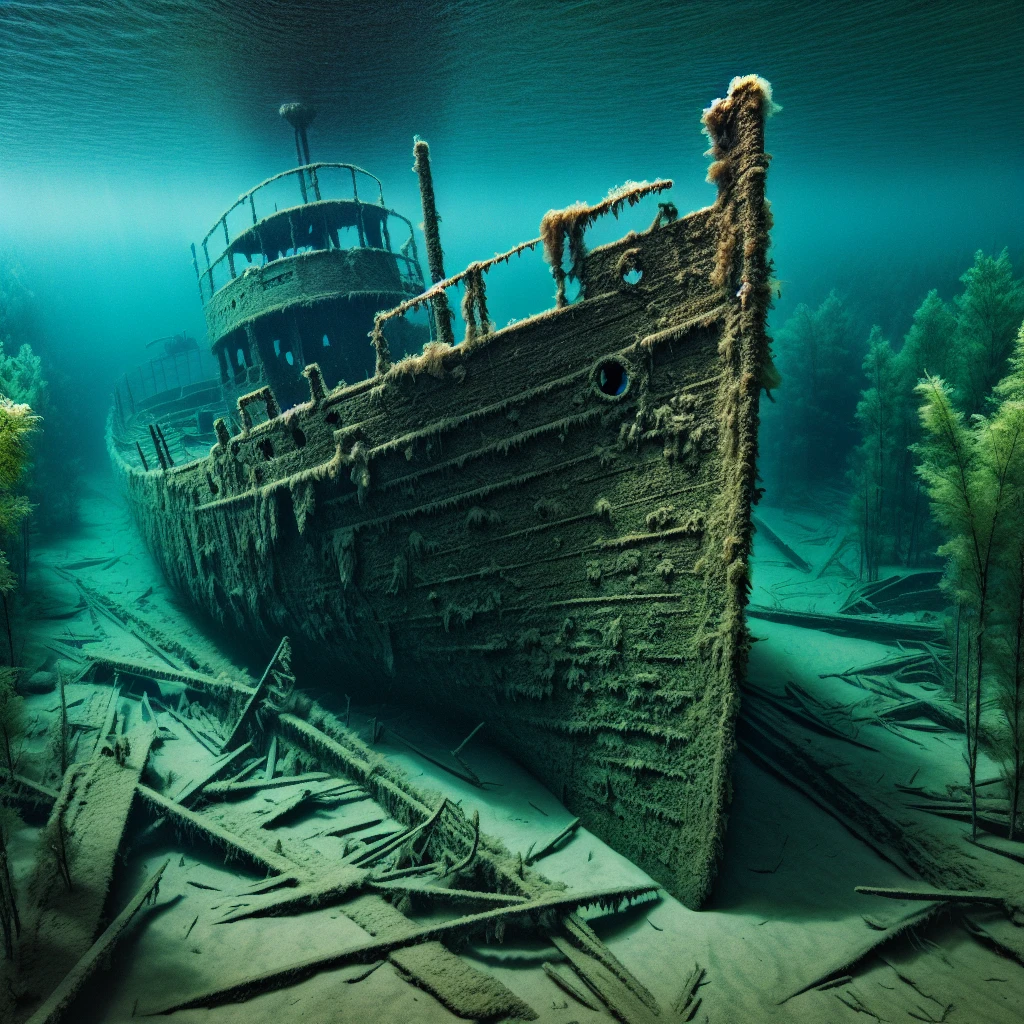
The filmmakers were just doing their research when they stumbled upon the shipwreck. It's a big deal because it gives us a peek into what life was like in the late 1800s and tells us about how people traded goods by boat.
Lake Huron has a lot of shipwrecks, and the filmmakers were hoping to find some mussels. But instead, they found the 'Africa' shipwreck, which is in really good condition. It's a reminder of how tough it was for sailors back then.
Experts are now studying the 'Africa' to learn more about it. This shipwreck is a reminder of the cool history of the Great Lakes region and all the stories that are hidden underwater. It shows us that exploring and finding unexpected things is important. And it reminds us to take care of historical artifacts so we can learn more about our past.
Original news source: Filmmakers discover 128-year-old shipwreck (BBC)
📖 Vocabulary:
Group or Classroom Activities
Warm-up Activities:
– Headline Creation
Instructions: In pairs or small groups, students will create a catchy headline for the article about the discovery of the 'Africa' shipwreck. Encourage them to be creative and use their knowledge of vocabulary and grammar to make the headline engaging and informative.
– Vocabulary Pictionary
Instructions: Divide the class into two teams. Give each team a set of vocabulary words from the article. One student from each team will come to the front of the class and draw a picture representing one of the words. The team members must guess the word based on the drawing. The team with the most correct guesses wins.
– Word Association
Instructions: Write the word "shipwreck" on the board. Ask the students to brainstorm as many words or phrases related to shipwrecks as they can in one minute. After the time is up, go around the class and have each student share one word or phrase. Encourage them to think of both positive and negative associations.
– Future Predictions
Instructions: In pairs or small groups, students will discuss and make predictions about what might happen next in the story. They should consider possible discoveries, research findings, or implications of finding the 'Africa' shipwreck. After the discussion, have each group share their predictions with the class.
– Opinion Spectrum
Instructions: Write the statement "Exploring and finding unexpected things is important" on the board. Ask the students to stand in a line, with one end representing "strongly disagree" and the other end representing "strongly agree." Read the statement aloud and have the students position themselves along the spectrum according to their opinion. Then, ask a few students to explain their position and have a class discussion about the statement.
🤔 Comprehension Questions:
They stumbled upon the shipwreck while looking for invasive mussels in Lake Huron, Canada.
It gives us a glimpse into what life was like in the late 1800s and tells us about how people traded goods by boat.
They were originally searching for invasive mussels.
It shows us the challenges sailors faced in the late 1800s and gives us a better understanding of history.
The good condition of the shipwreck means that we can learn more about it and gather valuable information about the past.
Experts are studying the shipwreck to learn more about it and uncover its history.
It reminds us of the rich history and stories that are hidden underwater in the Great Lakes region.
Taking care of historical artifacts allows us to preserve our past and learn more about our history.
🎧✍️ Listen and Fill in the Gaps:
Filmmakers Yvonne Drebert and Zach Melnick were looking for invasive mussels in Lake Huron, Canada when they accidentally found a really old shipwreck called the 'Africa.' The ship sank in 1895 and no one knew where it was until now. The filmmakers were just doing their research when they stumbled upon the shipwreck. It's a big deal because it us a peek into what life was like in the late 1800s and tells us about how people traded by boat. Lake has a lot of shipwrecks, and the filmmakers were hoping to find some . But instead, they found the 'Africa' , which is in really good condition. It's a reminder of how tough it was for sailors back then. Experts are now studying the 'Africa' to more about it. This shipwreck is a reminder of the cool of the Great region and all the stories that are hidden underwater. It shows us that exploring and finding things is important. And it reminds us to take care of historical artifacts so we can learn more about our past.
💬 Discussion Questions:
1. What do you think it would be like to explore a shipwreck?
2. How would you feel if you accidentally discovered something really important?
3. Do you think it's important to learn about history? Why or why not?
4. Have you ever found something unexpected? What was it and how did you feel?
5. What do you think the filmmakers were hoping to find when they were looking for mussels?
6. Do you like learning about the past? Why or why not?
7. If you could explore any shipwreck, which one would you choose and why?
8. How do you think the sailors felt when their ship sank?
9. What is a historical artifact? Can you think of any examples?
10. How do you think the 'Africa' shipwreck can teach us about life in the late 1800s?
11. Do you think it's important to preserve historical artifacts? Why or why not?
12. How do you think the filmmakers felt when they realized they had found the 'Africa' shipwreck?
13. What do you think the experts will learn from studying the shipwreck?
14. Have you ever been to a museum with historical artifacts? What was your favorite artifact?
15. Do you think there are more hidden stories underwater? Why or why not?
Individual Activities
📖💭 Vocabulary Meanings:
Click a dot next to a word, then click the dot next to its meaning to draw a line connecting them.
Words
Meanings
🔡 Multiple Choice Questions:
🕵️ True or False Questions:
📝 Write a Summary:
Write a summary of this news article in two sentences.
Check your writing now with the best free AI for English writing!