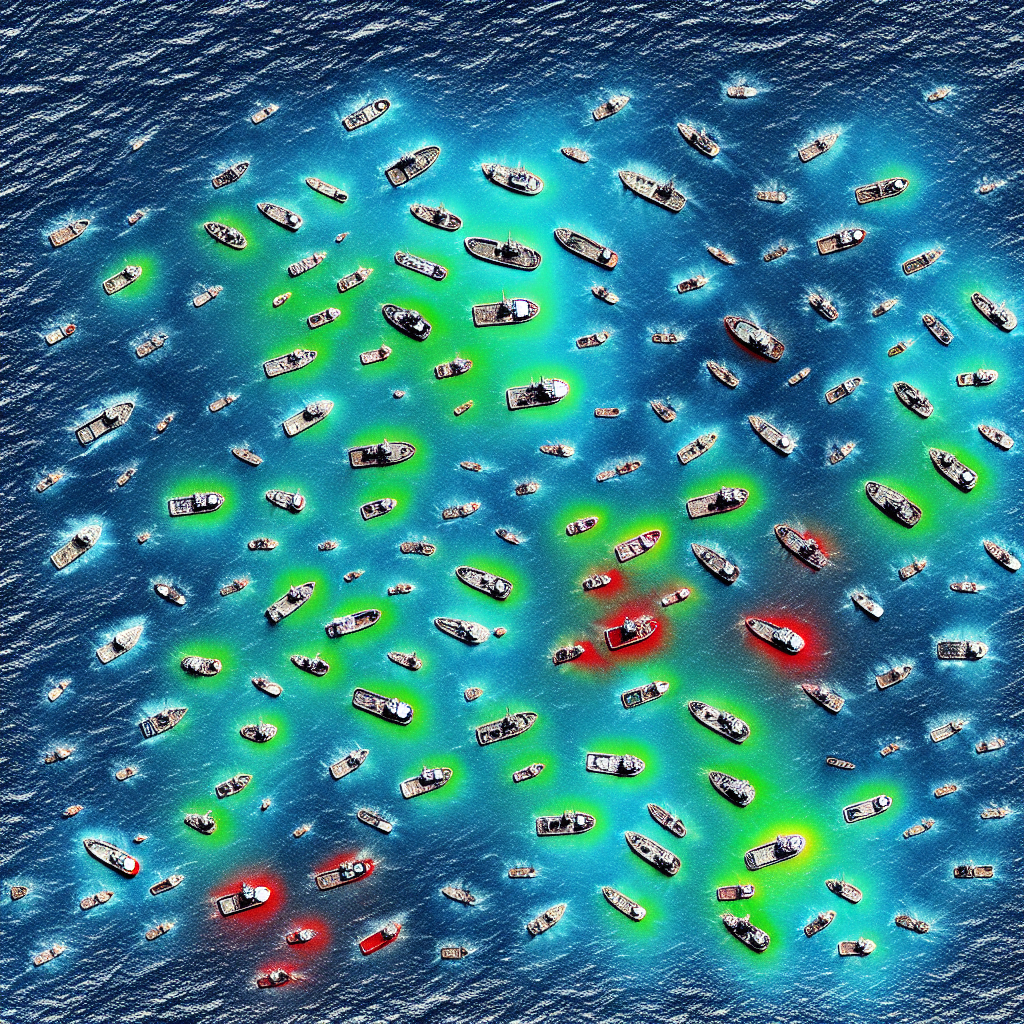
Illegal fishing is a big problem all over the world. About 20% of all fish caught are from illegal or unregulated fishing. This hurts the environment and leads to overfishing, where too many fish are caught and it's not sustainable. To fight against this, organizations like Global Fishing Watch are using artificial intelligence (AI) and satellite pictures to keep an eye on commercial fishing boats. They use AI to analyze data from the boats' automatic identification systems (AIS) and satellite pictures to find out which boats are doing illegal fishing.
Global Fishing Watch's AI software looks at lots of satellite pictures to find boats and offshore structures. It then checks this information with AIS data that anyone can see to find boats that aren't telling people where they are. The AI looks at things like how big the boat is, where it is, how many other boats are around, and the environment to figure out if a boat is probably fishing illegally. This technology has shown that three-quarters of the world's big fishing boats aren't telling people where they are, especially in places like Africa and South Asia. They're working on getting better pictures to find smaller fishing boats.
Besides using AI, there are other cool ideas to stop illegal fishing. For example, the University of Southampton and RS Aqua are working on a robot that can go underwater and use AI to listen for fishing sounds. This robot would send real-time information about fishing, especially in protected areas, to the authorities so they can do something about it. Right now, less than half of the protected areas in the world are fully protected from fishing, and the robot wants to help fix that by giving the authorities the right information.
Using AI and other new technologies is a good way to help stop illegal fishing, but it's not just up to the authorities and technology. We can all make a difference by making smart choices and supporting efforts to stop illegal fishing. By learning about the problem and choosing seafood that's caught in a sustainable way, we can help protect the environment and make sure fishing can keep going for a long time.
Original news source: How AI is being used to prevent illegal fishing (BBC)
🎧 Listen:
📖 Vocabulary:
Group or Classroom Activities
Warm-up Activities:
– News Summary
Instructions: Divide the class into pairs or small groups. Have each group read the article together and then summarize the main points in their own words. They can take turns sharing their summaries with the rest of the class.
– Keyword Taboo
Instructions: Write down a list of key words from the article on flashcards. Divide the class into two teams. One person from each team will come to the front of the class. Without saying the keyword, they must try to describe it to their team using synonyms or explanations. The team that guesses the keyword correctly gets a point. Continue until all the keywords have been used.
– Opinion Spectrum
Instructions: Create a spectrum on one side of the classroom, with "Strongly Agree" on one end and "Strongly Disagree" on the other end. Read out statements related to the article, such as "Using AI to stop illegal fishing is an effective solution." Have students stand at the point on the spectrum that represents their opinion on the statement. Allow students to explain their reasoning if they wish.
– Think-Pair-Share
Instructions: As a class, brainstorm different ways individuals can help stop illegal fishing. Then, have students pair up and discuss their ideas with their partner. After a few minutes, come back together as a class and have some pairs share their ideas with the rest of the class.
– Future Predictions
Instructions: In small groups, have students discuss and make predictions about the future of illegal fishing and efforts to stop it. What do they think will happen in the next 10 years? After discussing, have each group share their predictions with the rest of the class.
🤔 Comprehension Questions:
About 20% of all fish caught are from illegal or unregulated fishing.
Overfishing harms the environment because it leads to catching too many fish, which is not sustainable. It disrupts the balance of marine ecosystems and can cause the extinction of certain fish species.
Organizations like Global Fishing Watch use AI and satellite pictures to monitor commercial fishing boats. They analyze data from the boats' automatic identification systems (AIS) and satellite pictures to identify boats that are engaged in illegal fishing.
Global Fishing Watch's AI software looks at satellite pictures to locate boats and offshore structures. It then cross-references this information with AIS data to identify boats that are not reporting their location. The AI analyzes factors like the size of the boat, its location, the presence of other boats, and the surrounding environment to determine if a boat is likely fishing illegally.
The technology has shown that three-quarters of the world's big fishing boats are not reporting their location, especially in regions like Africa and South Asia.
One idea is the development of underwater robots that use AI to listen for fishing sounds. These robots can provide real-time information about fishing activities, especially in protected areas, to the authorities so that they can take appropriate action.
The robot being developed by the University of Southampton and RS Aqua is able to go underwater and use AI to listen for fishing sounds. It can then send this information in real-time to the authorities, helping them to address illegal fishing activities, particularly in protected areas.
Individuals can make a difference by making smart choices and supporting efforts to stop illegal fishing. They can educate themselves about the issue and choose seafood that is caught in a sustainable way. By doing so, they can help protect the environment and ensure the long-term viability of fishing.
🎧✍️ Listen and Fill in the Gaps:
Illegal fishing is a big problem all over the world. About 20% of all fish caught are from illegal or unregulated fishing. This the environment and leads to , where too many fish are caught and it's not sustainable. To fight against this, organizations like Global Fishing Watch are using artificial intelligence (AI) and pictures to keep an eye on commercial fishing boats. They use AI to analyze data from the boats' automatic systems (AIS) and satellite pictures to find out which boats are doing illegal fishing. Global Watch's AI software looks at lots of satellite to find boats and offshore structures. It then checks this information with AIS data that anyone can see to find boats that aren't telling people where they are. The AI looks at like how big the boat is, where it is, how many other boats are around, and the environment to figure out if a boat is probably fishing illegally. This has shown that three-quarters of the world's big fishing boats aren't telling people where they are, especially in places like Africa and South Asia. They're working on better pictures to find smaller fishing boats. Besides using AI, there are cool ideas to stop illegal fishing. For example, the of Southampton and RS Aqua are working on a robot that can go underwater and use AI to listen for fishing sounds. This robot would send real-time information about fishing, especially in protected areas, to the so they can do something about it. Right now, less than half of the protected areas in the world are fully protected from , and the robot to help fix that by giving the authorities the right information. AI and other new technologies is a good way to help stop illegal fishing, but it's not just up to the authorities and technology. We can all make a difference by making smart choices and supporting efforts to stop illegal fishing. By learning about the problem and seafood that's caught in a sustainable way, we can help protect the environment and make sure fishing can keep going for a long time.
💬 Discussion Questions:
1. What is illegal fishing and why is it a problem?
2. How do organizations like Global Fishing Watch use artificial intelligence and satellite pictures to combat illegal fishing?
3. Do you think it's important to protect the environment from overfishing? Why or why not?
4. How do you think AI technology can help in identifying boats that are fishing illegally?
5. What are some factors that the AI software looks at to determine if a boat is fishing illegally?
6. Why do you think many big fishing boats aren't telling people where they are?
7. How do you feel about the idea of using underwater robots with AI to listen for fishing sounds and report illegal fishing activities?
8. Why do you think less than half of the protected areas in the world are fully protected from fishing?
9. Do you think using AI and new technologies is an effective way to combat illegal fishing? Why or why not?
10. How can individuals make a difference in stopping illegal fishing?
11. Have you ever made a conscious choice to support sustainable fishing practices? If so, why? If not, why not?
12. How would you feel if you found out that the seafood you were eating was caught through illegal fishing practices?
13. Do you think it's important for everyone to learn about the problem of illegal fishing? Why or why not?
14. How do you think supporting efforts to stop illegal fishing can benefit the environment and future generations?
15. Why do you think it's important to ensure that fishing can continue for a long time?
Individual Activities
📖💭 Vocabulary Meanings:
Click a dot next to a word, then click the dot next to its meaning to draw a line connecting them.
Words
Meanings
🔡 Multiple Choice Questions:
🕵️ True or False Questions:
📝 Write a Summary:
Write a summary of this news article in two sentences.
Check your writing now with the best free AI for English writing!