

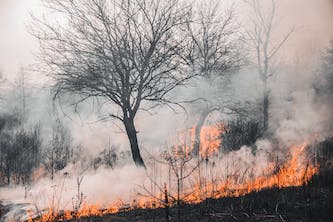
This year, Canada had a record-breaking fire season, with over 6,500 fires burning about 18 million hectares of forest and land. Smoke from these fires traveled to big cities in Canada and the US, and even all the way to Spain and Portugal. Most of the fires in the northern forests were started by lightning. A new map made using machine learning tools showed that 77% of the burned areas in these forests are because of lightning, unlike tropical regions where people starting fires is the main cause.
The study also predicts that the number of lightning strikes in intact northern forests could go up by 11-31% for every degree the Earth gets warmer, which could lead to more carbon emissions. These forests, often found in permafrost regions, are at risk because of the combination of a warmer, drier climate and more lightning strikes. While fires in tropical forests can be managed through education and intervention programs, stopping lightning fires is much harder.
The researchers say that we need to cut down on the gases that cause warming to stop more lightning strikes. They warn that the huge fire season in Canada should make us realize that we need to do something about the growing threat of wildfires in the world's cooling forests. Even though it's tough, experts believe we can still make a change and that forest fires should be a warning for us to act, not a reason to do nothing.
Original news source: Lightning fires threaten planet-cooling forests (BBC)
📖 Vocabulary:
Group or Classroom Activities
Warm-up Activities:
– News Summary
Instructions: Divide students into groups of three. Each group is given a few minutes to discuss the article and summarize the main points in three sentences. Afterward, each group presents their summary to the class. The class discusses any differing details and clarifies key information.
– Opinion Spectrum
Instructions: Pose a statement related to the article such as "Cutting down on gases that cause global warming is the most effective way to prevent forest fires." Students line up in a spectrum from "strongly agree" to "strongly disagree." Students then take turns to explain their position, providing reasons for their opinion.
– Vocabulary Pictionary
Instructions: Write down key terms from the article (e.g., lightning strikes, carbon emissions, wildfires, permafrost, machine learning). Divide the class into two teams. Members from each team take turns drawing the terms on the board without speaking or writing any words, while their team guesses the term within a set time limit.
– Future Predictions
Instructions: Students work in pairs to discuss and write down their predictions on the future of forest wildfires if global warming continues at its current pace. They should consider the impact on wildlife, human life, and the global environment. Each pair then shares their predictions with another pair and discusses the similarities and differences in their views.
– Mind Map
Instructions: Ask students to create a mind map on a large piece of paper, starting with the phrase "Climate Change and Wildfires." They should branch out into all the related topics mentioned in the article, such as "lightning strikes," "carbon emissions," "global warming," and "forest management." Encourage them to include any solutions or preventative measures discussed in the article. After completion, each group can present their mind map to the class.
🤔 Comprehension Questions:
Climate change could cause more lightning strikes in the forests of the northern hemisphere, which might lead to more wildfires.
These forests are important because they capture carbon emissions, which helps to slow down climate change.
When lightning starts fires in these forests, it releases carbon dioxide, which can make storms and lightning happen more often.
The number of fires worldwide has gone down in the last 20 years, but heavily forested areas outside the tropics have seen a big increase in wildfires.
Canada had a record-breaking fire season with over 6,500 fires burning about 18 million hectares of forest and land. The smoke from these fires traveled to big cities in Canada and the US, and even all the way to Spain and Portugal.
The new map showed that 77% of the burned areas in these forests are because of lightning.
The number of lightning strikes in intact northern forests could go up by 11-31% for every degree the Earth gets warmer, which could lead to more carbon emissions. These forests, especially in permafrost regions, are at risk because of the warmer, drier climate and more lightning strikes.
Researchers suggest we need to cut down on the gases that cause warming to prevent more lightning strikes. They warn that the huge fire season in Canada should make us realize that we need to do something about the growing threat of wildfires in the world's cooling forests.
🎧✍️ Listen and Fill in the Gaps:
A new study suggests that could cause more lightning strikes in the forests of the northern hemisphere, which might lead to more wildfires. These forests are important for capturing carbon emissions and helping to slow down climate change. But when lightning fires in these forests, it releases carbon dioxide, making storms and lightning happen more often. While the number of fires worldwide has gone down in the last 20 , heavily forested areas outside the tropics have seen a big increase in wild. This year, Canada had a record-breaking fire season, with over 6,500 fires burning about 18 million hectares of forest and land. Smoke from these fires traveled to big cities in Canada and the US, and even all the way to Spain and Portugal. Most of the fires in the northern were started by . A new map made using machine tools showed that 77% of the burned areas in these forests are because of lightning, unlike tropical where people starting fires is the main cause. The study also that the number of lightning in northern forests could go up by 11-31% for every degree the Earth gets warmer, which could lead to more carbon emissions. These forests, often found in permafrost regions, are at risk because of the combination of a warmer, drier climate and more lightning strikes. While fires in tropical forests can be managed through education and intervention programs, stopping lightning fires is much harder. The say that we need to cut down on the gases that warming to stop more lightning strikes. They warn that the huge fire season in Canada should make us realize that we need to do something about the growing threat of wildfires in the world's cooling forests. Even though it's , believe we can still make a change and that forest fires should be a warning for us to act, not a reason to do nothing.
💬 Discussion Questions:
1. What is climate change, and how do you think it affects our planet?
2. Have you ever experienced a wildfire or seen one on the news? How did it make you feel?
3. Why do you think forests are important for our environment?
4. Do you think wildfires are a natural part of forest life or a big problem? Why?
5. How would you feel if a wildfire happened close to where you live?
6. What do you think could be done to prevent wildfires caused by lightning?
7. Do you think technology like machine learning can help us understand wildfires better? Why or why not?
8. Why do you think people start fires in tropical regions?
9. What is your opinion on the fact that the number of fires has decreased worldwide but increased in heavily forested areas?
10. Do you think it's surprising that smoke from fires can travel to faraway places? Why or why not?
11. How do you think we can cut down on gases that cause warming?
12. What is permafrost, and why do you think forests in permafrost regions are at risk?
13. Do you think it's harder to stop fires caused by lightning than those caused by people? Why or why not?
14. Do you believe that we can still make a change to reduce the threat of wildfires? What makes you think that?
15. Why do you think forest fires should be a warning for us to act? What actions do you think we should take?
Individual Activities
📖💭 Vocabulary Meanings:
Click a dot next to a word, then click the dot next to its meaning to draw a line connecting them.
Words
Meanings
🔡 Multiple Choice Questions:
🕵️ True or False Questions:
📝 Write a Summary:
Write a summary of this news article in two sentences.
Check your writing now with the best free AI for English writing!