

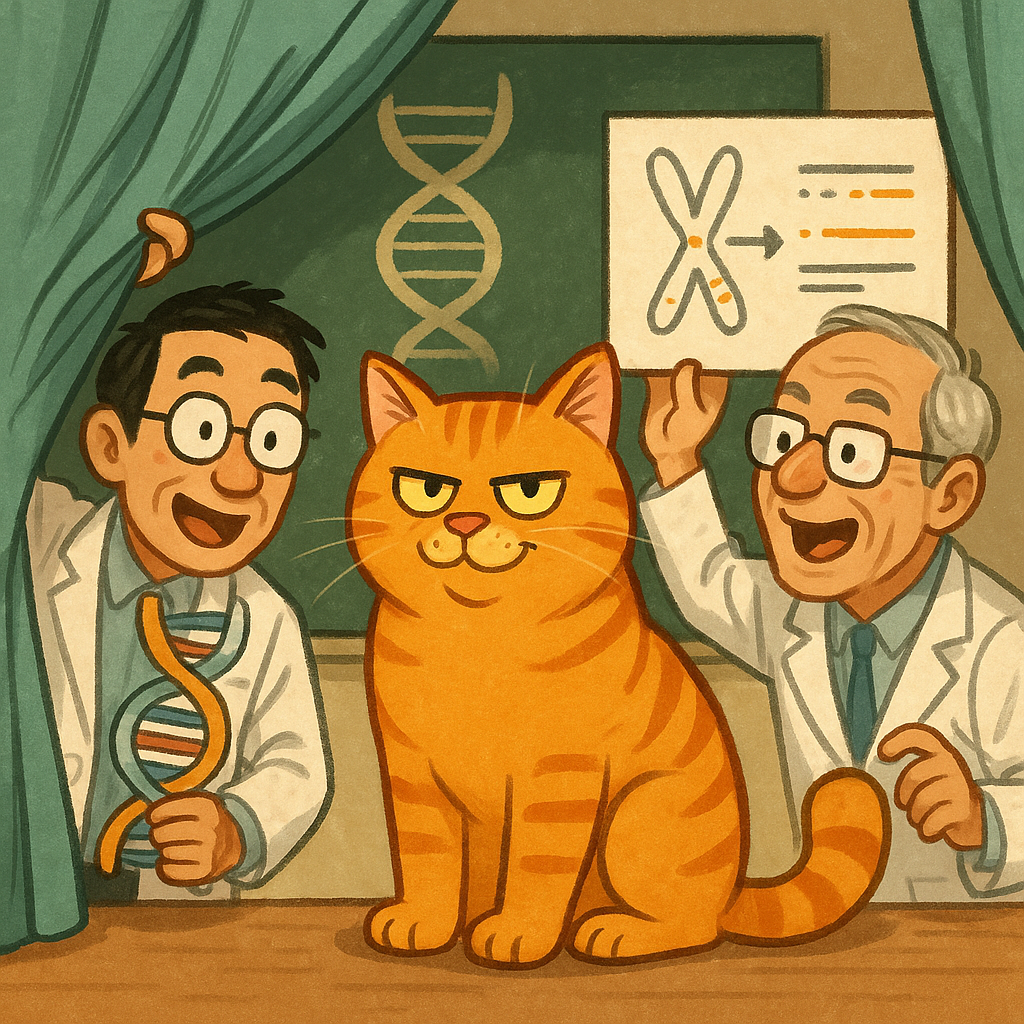
Scientists from Japan and the United States have recently solved a mystery about why ginger cats are orange. Famous characters like Garfield and Puss in Boots have made these cats popular, but researchers have had a hard time figuring out what causes their unique color. In their research, they found that male ginger cats are missing a specific part of their DNA that helps create the pigments in their skin, eyes, and fur. This discovery is exciting not just for scientists but also for cat lovers who helped fund the study.
For a long time, it was known that genes play an important role in the color of orange tabby cats. However, the exact part of the genetic code responsible for this color was unknown until now. The teams from Kyushu University and Stanford University published their results at the same time, showing that a gene called ARHGAP36 is much more active in the cells that create color. By looking at the DNA of different cats, they discovered that ginger cats have a missing piece in the ARHGAP36 gene, which causes them to produce more pigment.
Another interesting finding is that most ginger cats are male. This is because the gene is located on the X chromosome. Male cats have one X and one Y chromosome, so if the X chromosome is missing the DNA segment, they can still be fully ginger. On the other hand, female cats have two X chromosomes, so both need to be missing the segment for them to be completely ginger, which often leads to mixed colors instead.
The study started as a passion project for Professor Hiroyuki Sasaki, who wanted to learn more about the genetics of orange cats even after retiring. He received support from cat lovers who donated over 10 million yen to help with the research. This shows how science and community can work together, as many people wanted to help understand more about cat health. The findings about the ARHGAP36 gene could also relate to other health issues or behaviors in cats, opening up new areas for research into how genetics affects our furry friends.
Original news source: Decades-long mystery of ginger cats revealed (BBC)
🎧 Listen:
📖 Vocabulary:
Group or Classroom Activities
Warm-up Activities:
– CHARADES
Instructions: Divide the class into small groups. Each group will take turns acting out terms related to the article (e.g., ginger cat, DNA, pigment) without speaking, while the other groups guess the term. This will help reinforce vocabulary and comprehension of the article.
– OPINION POLL
Instructions: Present the class with a statement based on the article, such as “Ginger cats are more interesting than other cats.” Students will move to different areas of the classroom to show their agreement or disagreement with the statement. Afterward, facilitate a discussion about their opinions and reasons.
– SKETCH IT
Instructions: Have each student draw a quick sketch of a ginger cat and include elements that represent the findings in the article (like DNA strands or the gene ARHGAP36). After they finish, students will share their drawings with a partner and explain their illustrations.
– HEADLINE CREATION
Instructions: In pairs, students will create a catchy headline for the article that captures its main findings. After they come up with their headlines, they can share them with the class, and discuss which ones they think best represent the essence of the research.
– THINK-PAIR-SHARE
Instructions: Pose a question related to the article, such as “How do you think understanding cat genetics can impact pet care?” Students will first think about their answer individually, then discuss their thoughts with a partner, and finally share their insights with the whole class.
🤔 Comprehension Questions:
Scientists discovered that male ginger cats are missing a specific part of their DNA that helps create the pigments in their skin, eyes, and fur, particularly linked to the ARHGAP36 gene.
They are mentioned to highlight the popularity of ginger cats and how they have captured the public's interest, making the research on their genetics even more relevant.
Researchers looked at the DNA of different cats and found that the ARHGAP36 gene is much more active in the cells that create color, and they discovered that ginger cats have a missing piece in this gene.
Most ginger cats are male because the gene responsible for their color is located on the X chromosome. Males have one X and one Y chromosome, so they can be fully ginger with just one missing DNA segment, unlike females who need both X chromosomes to be missing the segment.
Professor Sasaki was motivated by a personal interest in the genetics of orange cats, even after retiring, and wanted to learn more about them.
The community contributed by donating over 10 million yen to support Professor Sasaki's research, showing that many people wanted to help understand more about cat health.
The findings could relate to other health issues or behaviors in cats, opening up new areas for research into how genetics affects their overall health.
The study shows how community support can help scientists conduct research, as cat lovers contributed funding to help uncover important genetic information about ginger cats.
🎧✍️ Listen and Fill in the Gaps:
Scientists from Japan and the United have recently solved a mystery about why ginger cats are orange. Famous characters like Garfield and Puss in Boots have made these cats popular, but researchers have had a hard time out what causes their unique . In their research, they found that male ginger cats are missing a specific part of their DNA that helps the pigments in their skin, eyes, and fur. This discovery is exciting not just for scientists but also for cat lovers who helped fund the study. For a long time, it was known that genes play an important role in the color of orange tabby cats. However, the exact part of the genetic code responsible for this color was unknown until now. The teams from Kyushu and University published their results at the same time, that a gene called ARHGAP36 is much more active in the cells that create color. By at the DNA of different cats, they discovered that ginger cats have a missing piece in the ARHGAP36 gene, which causes them to produce more pigment. Another interesting is that most cats are male. This is because the gene is located on the X chromosome. Male cats have one X and one Y chromosome, so if the X chromosome is missing the DNA segment, they can still be fully ginger. On the other hand, female cats have two X chromosomes, so both need to be missing the segment for them to be completely ginger, which often leads to colors instead. The started as a passion project for Professor Hiroyuki Sasaki, who wanted to learn more about the genetics of orange cats even after retiring. He support from cat who donated over 10 million yen to help with the research. This how science and community can work together, as many people wanted to help understand more about cat health. The findings about the ARHGAP36 gene could also relate to other health issues or behaviors in cats, opening up new areas for research into how genetics affects our friends.
💬 Discussion Questions:
1. What is your favorite type of cat and why do you like it?
2. How would you feel if you discovered that your pet had a unique genetic trait?
3. Do you think it's important for scientists to study animal genetics? Why or why not?
4. Have you ever had a pet that was a different color than you expected? What was it like?
5. What is a characteristic you think makes animals special?
6. How do you feel about the idea of donating money for scientific research?
7. Why do you think ginger cats are so popular in movies and cartoons?
8. Do you think knowing more about a pet's genetics can help with their health? Why?
9. How would you react if you found out that your favorite cartoon character was based on real science?
10. What is a unique trait you have that you think makes you special?
11. Do you think there are any downsides to studying animal genetics? Why or why not?
12. How do you feel about the idea of community support for scientific projects?
13. What do you think is the most interesting thing about cats?
14. Have you ever participated in a project or cause you were passionate about? What was it?
15. Do you think more people should learn about the science behind pets? Why or why not?
Individual Activities
📖💭 Vocabulary Meanings:
Click a dot next to a word, then click the dot next to its meaning to draw a line connecting them.
Words
Meanings
🔡 Multiple Choice Questions:
🕵️ True or False Questions:
📝 Write a Summary:
Write a summary of this news article in two sentences.
Check your writing now with the best free AI for English writing!