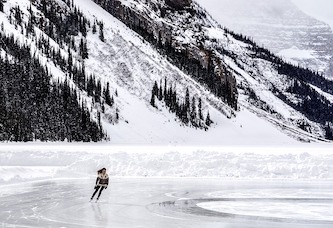
There's a video of them skating on the ice, and it looks amazing. They're gliding around on the ice, and you can see the beautiful frozen landscape all around them. Mehl, who teaches people about the outdoors, said it was really exciting and felt like a dream. The "ice window" let them see what was under the frozen lake, which is something most people don't get to see.
This kind of thing is super rare. It only happens once every ten years because the weather has to be just right. The ice has to be really thin and see-through. It's a really cool sight because you can skate on the lake and still see what's below. People from all over the world have seen the video and think it's amazing. They want to see it for themselves and think it's brave of the couple to skate on such delicate ice.
This experience shows us how awesome nature can be. It reminds us that we should take care of the Earth and appreciate these rare things. The "ice window" in Alaska's Alpine lakes is something that people will remember for a long time.
Original news source: Skating on a once-in-a-decade 'ice window' in Alaska (BBC)
📖 Vocabulary:
Group or Classroom Activities
Warm-up Activities:
– News Summary
Instructions: Divide the class into small groups. Each group must summarize the article in their own words, focusing on the main points: the rare "ice window" phenomenon, the experience of Luc Mehl and his wife, and the significance of this event. Afterward, each group will present their summary to the class.
– Opinion Spectrum
Instructions: Line up the students on an 'opinion spectrum' from one side of the room to the other based on how much they agree or disagree with a statement about the article. For example, "Skating on thin ice is worth the risk to experience rare natural phenomena." Students move to a spot on the line that represents their opinion, then discuss their position with the person next to them.
– Keyword Taboo
Instructions: Write down keywords from the article (e.g., Alaska, ice window, skate, rare, nature, Earth) on separate pieces of paper. Students take turns drawing a word and describing it to the class without using the word itself or any variations of it. The other students have to guess the word.
– Future Predictions
Instructions: Have the students work individually or in pairs to make predictions about the future of natural phenomena like the "ice window." They should consider climate change, human activity, and natural cycles. Students can share their predictions with the class and discuss the implications for the environment.
– Think-Pair-Share
Instructions: Pose a question related to the article, such as "What does the 'ice window' tell us about the importance of preserving natural wonders?" Students first think individually about their answer, then pair up with a classmate to discuss their thoughts, and finally, share their conclusions with the wider class.
🤔 Comprehension Questions:
A super rare "ice window" event happened where the ice froze in a way that made it see-through.
Luc Mehl is a guy who teaches ice rescue, and he and his wife got to skate on the clear, see-through ice of Rabbit Lake.
The "ice window" occurs once every ten years.
The ice was see-through because the weather was very cold and dry when winter started, which caused the ice to freeze without snow or bubbles, making it clear.
They could see what was beneath the frozen surface of the lake while they were skating.
The "ice window" is rare because it requires specific weather conditions to form thin, clear ice, which doesn't happen often.
People from around the world thought the video was amazing and expressed a desire to see the "ice window" for themselves, considering the couple brave for skating on such delicate ice.
The article suggests that we should take care of the Earth and appreciate these rare natural events.
🎧✍️ Listen and Fill in the Gaps:
Something really cool happened in Alaska's Alpine recently. A guy who people how to rescue others from ice, Luc Mehl, and his wife got to skate on something an "ice window." This is a super rare that only happens once every ten years. The ice on Rabbit Lake froze in a special way that made it see-through, so they could see through it while they skated. It was possible because the was really cold and dry when winter . There's a video of them skating on the ice, and it looks amazing. They're gliding around on the ice, and you can see the beautiful frozen landscape all around them. Mehl, who teaches people about the , said it was really and felt like a dream. The "ice window" let them see what was under the frozen lake, which is some most people don't get to see. This kind of thing is super rare. It only happens once every ten years because the weather has to be just right. The ice has to be really thin and see-through. It's a really cool because you can on the lake and still see what's below. People from all over the have seen the and it's amazing. They want to see it for themselves and think it's of the couple to skate on such delicate ice. This experience us how awesome nature can be. It reminds us that we should take care of the Earth and appreciate these rare things. The "ice window" in Alaska's Alpine lakes is something that people will remember for a long time.
💬 Discussion Questions:
1. What is an "ice window" and have you ever seen something like it?
2. How would you feel if you had the chance to skate on crystal-clear ice?
3. Do you like to go ice skating? Why or why not?
4. Do you think it's brave to skate on thin ice, even if you can see through it?
5. Have you ever experienced something in nature that made you feel like you were dreaming?
6. What's the most amazing natural event you've ever seen or heard about?
7. Why do you think people are so fascinated by rare natural phenomena?
8. If you could visit Alaska to see the "ice window," would you go? Why or why not?
9. How important do you think it is to protect rare natural sights like the "ice window"?
10. Have you ever seen a video of a natural wonder that made you want to visit that place?
11. What kind of weather do you think is needed to create an "ice window"?
12. Do you think activities like skating on a frozen lake are safe? Why or why not?
13. Can you think of any other activities that allow you to see nature in a unique way?
14. What's the coolest thing you've ever done or want to do in the winter?
15. Why do you think people should appreciate and take care of the Earth?
Individual Activities
📖💭 Vocabulary Meanings:
Click a dot next to a word, then click the dot next to its meaning to draw a line connecting them.
Words
Meanings
🔡 Multiple Choice Questions:
🕵️ True or False Questions:
📝 Write a Summary:
Write a summary of this news article in two sentences.
Check your writing now with the best free AI for English writing!