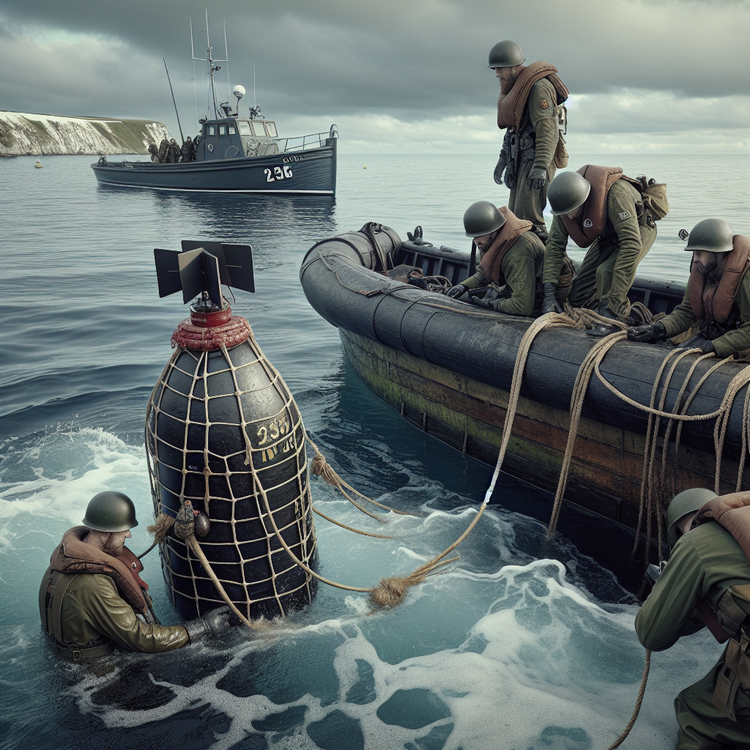
A bomb from World War Two was found in the ocean near Denmark. It weighed 130kg and was discovered by a fisherman who told the authorities right away. To safely get rid of the bomb, experts from the Danish navy put it back in the water and attached a smaller bomb to it. They exploded it 15 meters below the surface.
The bomb was found near Langeland, a Danish island in the south of the country. It got stuck in the fisherman's net, so he asked for help. The Danish navy acted quickly and did what they needed to do to make sure the bomb was exploded safely.
They exploded the bomb in a controlled way to make sure no one got hurt and nothing got damaged. By putting the bomb back in the water and attaching a smaller bomb to it, they were able to control the explosion and make sure it happened at a safe depth. This way, they got rid of the bomb without causing any harm to people or things.
This shows that World War Two still has an impact today and there are still bombs that haven't exploded. It also shows how important it is for people to report things like this right away and for everyone to work together to deal with them. The Danish navy responded quickly and knew what to do, so everything turned out okay.
Original news source: World War Two bomb detonated off coast of Denmark (BBC)
🎧 Listen:
📖 Vocabulary:
Group or Classroom Activities
Warm-up Activities:
– News Summary
Instructions: Divide the class into pairs. Each pair will have two minutes to read the article together. After the two minutes, one student will summarize the article to their partner in their own words. Then, the roles will switch and the other student will summarize the article. After both students have summarized, they can compare their summaries and discuss any differences.
– Opinion Poll
Instructions: Divide the class into small groups. Give each group a list of questions related to the article, such as "Do you think it is important for people to report dangerous items they find?" or "How do you think the Danish navy handled the situation?" Each group will discuss the questions and record their group's opinions. After a designated time, each group will share their opinions with the class and facilitate a class discussion.
– Keyword Taboo
Instructions: Write a list of key vocabulary words from the article on the board. Divide the class into two teams. One student from each team will come to the front of the class. The teacher will choose a word from the list and show it to the two students. The students must describe the word to their team without using the actual word or any derivatives of it. The first team to guess the word correctly gets a point. Continue with different words and rotate the students at the front.
– Vocabulary Pictionary
Instructions: Divide the class into small groups. Give each group a set of vocabulary words from the article. One student from each group will choose a word and draw a picture to represent it, without using any letters or numbers. The other students in the group must guess the word based on the drawing. The student who drew the picture can give hints or gestures, but cannot speak. The group that guesses the most words correctly wins.
– Future Predictions
Instructions: In pairs, have the students discuss and make predictions about the future impact of World War Two bombs. They should consider questions like "Will more bombs be found in the future?" or "How will countries continue to deal with unexploded bombs?" After the discussion, pairs can share their predictions with the class and engage in a class discussion about the topic.
🤔 Comprehension Questions:
The bomb was found in the ocean near Denmark.
The bomb weighed 130kg.
The bomb was discovered by a fisherman who told the authorities right away.
The Danish navy put the bomb back in the water and attached a smaller bomb to it, then exploded it.
They attached a smaller bomb to the original bomb to control the explosion and ensure it happened at a safe depth.
The bomb was exploded 15 meters below the surface of the water.
They exploded the bomb in a controlled way to make sure no one got hurt and nothing got damaged.
This incident shows that World War Two still has an impact today and there are still bombs that haven't exploded. It also highlights the importance of reporting dangerous things promptly and working together to deal with them.
🎧✍️ Listen and Fill in the Gaps:
A bomb from World War Two was found in the ocean near . It weighed 130kg and was by a fisherman who told the authorities right away. To safely get rid of the bomb, experts from the navy put it back in the water and attached a smaller bomb to it. They exploded it 15 below the surface. The bomb was found near Langeland, a Danish island in the of the country. It got stuck in the fisherman's net, so he for help. The Danish navy acted quickly and did what they needed to do to make sure the bomb was safely. They exploded the bomb in a way to make sure no one got hurt and nothing got damaged. By the bomb back in the and attaching a smaller bomb to it, they were able to control the explosion and make sure it happened at a safe depth. This way, they got rid of the bomb without any harm to or things. This shows that World War Two still has an impact today and there are still that haven't exploded. It also how it is for people to report things like this right away and for everyone to work together to deal with them. The Danish navy responded quickly and knew what to do, so everything out okay.
💬 Discussion Questions:
1. What is a bomb from World War Two?
2. How do you think the fisherman felt when he found the bomb in his net?
3. Have you ever found something unusual or dangerous? How did you react?
4. Do you think it was a good idea for the fisherman to ask for help? Why or why not?
5. How would you feel if you found a bomb in the ocean while fishing?
6. Do you think the Danish navy made the right decision by exploding the bomb underwater? Why or why not?
7. What do you think would have happened if the bomb hadn't been discovered and exploded safely?
8. How important do you think it is for people to report dangerous things they find? Why or why not?
9. Have you ever had to work together with others to solve a problem? What was the problem and how did you solve it?
10. Do you think it's surprising that there are still bombs from World War Two that haven't exploded? Why or why not?
11. How do you think the Danish navy felt after successfully exploding the bomb without causing harm?
12. What do you think are some other ways that World War Two still has an impact today?
13. Do you think the fisherman should receive any recognition or reward for finding the bomb? Why or why not?
14. How do you think the fisherman's life might have been different if he hadn't found the bomb in his net?
15. What safety precautions do you think the Danish navy took to ensure the controlled explosion?
Individual Activities
📖💭 Vocabulary Meanings:
Click a dot next to a word, then click the dot next to its meaning to draw a line connecting them.
Words
Meanings
🔡 Multiple Choice Questions:
🕵️ True or False Questions:
📝 Write a Summary:
Write a summary of this news article in two sentences.
Check your writing now with the best free AI for English writing!