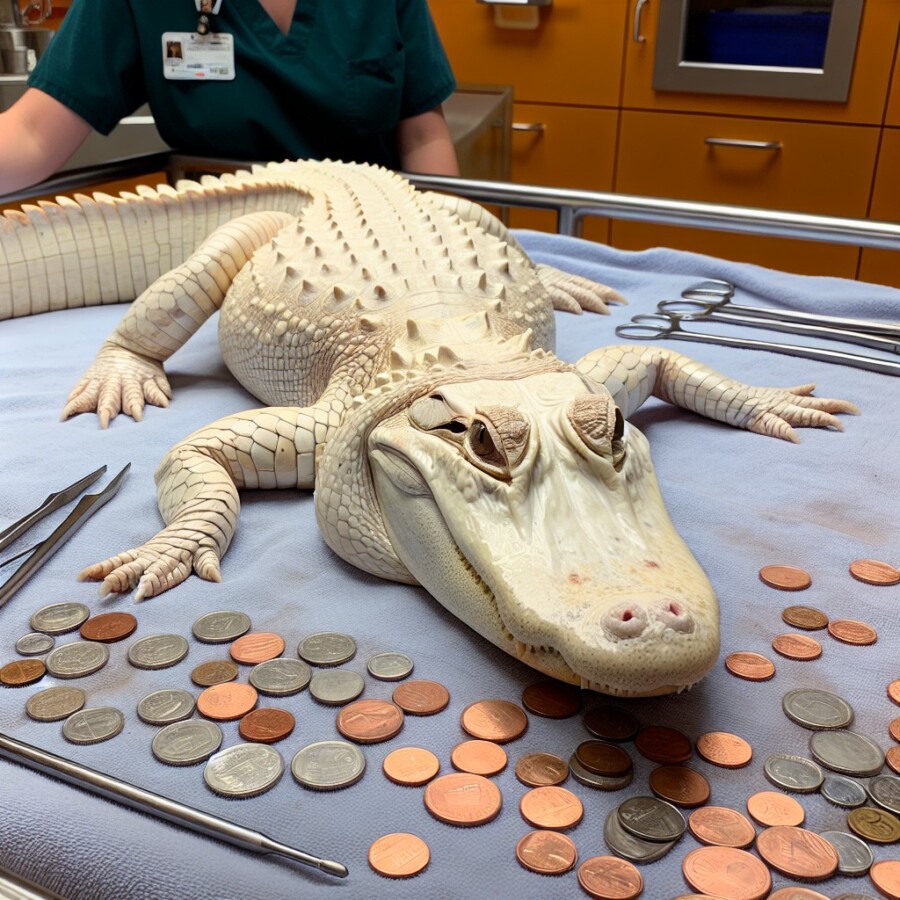
A special white alligator at a zoo in Nebraska had to have an operation to take out 70 coins from its tummy. The alligator, named Thibodaux, is 36 years old and has a rare condition that makes it have white skin and blue eyes. People who visited the zoo threw coins into the alligator's home and it ate them over time. The zoo wants people to stop throwing coins into any water at the zoo. Thibodaux is all better now and back in its home.
The zoo checked all 10 alligators, including Thibodaux, to make sure they were healthy. They took blood and X-ray pictures. When they found the coins, they acted fast and did surgery to take them out before the alligator got hurt. The surgery was done by a vet named Christina Ploog. She used a plastic pipe to protect the alligator's mouth and get the coins out safely.
The zoo wants everyone to know that this kind of surgery doesn't happen a lot. They also want people to understand that coins can be dangerous for animals. Coins might have bad stuff in them that can hurt animals. The zoo cleans the alligators' homes often, but the alligators still find and eat the coins before they can be taken away.
This shows how important it is to be careful about what we throw into animal homes. Even things that seem harmless, like coins, can be bad for animals. The zoo did a good job with Thibodaux's surgery, and it reminds us to be respectful to animals and their homes by not throwing things into their homes.
Original news source: US zoo extracts 70 coins from white alligator (BBC)
🎧 Listen:
📖 Vocabulary:
Group or Classroom Activities
Warm-up Activities:
– News Summary
Instructions:
1. Divide the class into pairs or small groups.
2. Provide each group with a copy of the article.
3. Explain that each group will have a set amount of time (e.g. 10 minutes) to read the article and summarize the main points.
4. After the time is up, each group will take turns presenting their summaries to the class.
5. Encourage the other groups to ask questions or add any additional information they remember from the article.
– Opinion Poll
Instructions:
1. Divide the class into pairs or small groups.
2. Explain that each group will be conducting an opinion poll about the article.
3. Give each group a list of questions related to the article (e.g. "Do you think people should be allowed to throw coins into animal homes?" "Should the zoo do more to prevent visitors from throwing coins?")
4. In their groups, students should take turns asking and answering the questions and recording their group members' opinions.
5. After completing the poll, each group will share their findings with the class, summarizing the different opinions they gathered.
– Vocabulary Pictionary
Instructions:
1. Write a list of vocabulary words from the article on the board (e.g. alligator, surgery, coins, zoo).
2. Divide the class into pairs or small groups.
3. Explain that each group will take turns selecting a word from the list and drawing a quick sketch to represent the word.
4. The other group members must guess the word based on the sketch within a set amount of time (e.g. 1 minute).
5. After each round, rotate the group members so everyone gets a chance to draw and guess.
– Synonym Challenge
Instructions:
1. Write a list of key words from the article on the board (e.g. operation, condition, coins, surgery).
2. Divide the class into pairs or small groups.
3. Explain that each group will have a set amount of time (e.g. 5 minutes) to come up with as many synonyms for the words on the list as possible.
4. After the time is up, each group will take turns sharing their synonyms with the class.
5. Encourage the class to discuss any differences in meaning or usage between the synonyms.
– Sketch It
Instructions:
1. Divide the class into pairs or small groups.
2. Provide each group with a blank sheet of paper.
3. Explain that each group will have a set amount of time (e.g. 5 minutes) to sketch a scene from the article.
4. After the time is up, each group will take turns presenting their sketches to the class, explaining which part of the article their sketch represents.
5. Encourage the class to ask questions and discuss the different interpretations of the article through the sketches.
🤔 Comprehension Questions:
Thibodaux had a rare condition that made it have white skin and blue eyes.
Thibodaux had to have an operation because it had eaten 70 coins that people threw into its home at the zoo.
People threw coins into Thibodaux's home as a way of making a wish or for good luck.
The zoo checked all the alligators, including Thibodaux, by taking blood and X-ray pictures to make sure they were healthy.
The surgery on Thibodaux was performed by a vet named Christina Ploog.
The zoo wants people to stop throwing coins into any water at the zoo because coins can be dangerous for animals and might have harmful substances in them.
It is important to be careful about what we throw into animal homes because even seemingly harmless things like coins can be harmful to animals and their health.
Thibodaux's surgery reminds us to be respectful to animals and their homes by not throwing things into their habitats.
🎧✍️ Listen and Fill in the Gaps:
A special white alligator at a zoo in had to have an operation to take out 70 coins from its tummy. The alligator, named Thibodaux, is 36 years old and has a rare condition that makes it have white skin and blue eyes. who the zoo threw coins into the alligator's home and it ate them over time. The zoo wants to stop throwing coins into any at the zoo. Thibodaux is all better now and back in its home. The zoo checked all 10 alligators, Thibodaux, to make sure they were healthy. They took blood and X-ray pictures. When they found the coins, they acted fast and did to take them out before the alligator got hurt. The surgery was done by a vet named Christina . She used a plastic pipe to protect the alligator's mouth and get the coins out safely. The zoo wants everyone to know that this kind of surgery doesn't happen a lot. They also want people to understand that coins can be for animals. Coins might have bad in them that can hurt animals. The zoo the alligators' often, but the alligators still find and eat the coins before they can be taken away. This shows how important it is to be careful about what we throw into animal homes. Even things that seem , like coins, can be bad for . The zoo did a good job with Thibodaux's surgery, and it us to be respectful to animals and their homes by not things into their homes.
💬 Discussion Questions:
1. What is a special white alligator?
2. How do you think Thibodaux felt when it had to have an operation?
3. Have you ever visited a zoo? What did you see there?
4. Do you like alligators? Why or why not?
5. How would you feel if people threw coins into your home?
6. Do you think it's important to be careful about what we throw into animal homes? Why or why not?
7. Have you ever seen a rare animal before? What was it like?
8. Do you think the zoo did the right thing by checking all the alligators' health? Why or why not?
9. What do you think the vet used to protect the alligator's mouth during the surgery?
10. How would you feel if you found out that coins can be dangerous for animals?
11. Do you think people should be respectful to animals and their homes? Why or why not?
12. Have you ever thrown something into an animal's home by accident? What happened?
13. What do you think the zoo could do to prevent people from throwing coins into the alligators' home?
14. How would you feel if you were an alligator living in a zoo?
15. Do you think the zoo should have a rule against throwing things into animal homes? Why or why not?
Individual Activities
📖💭 Vocabulary Meanings:
Click a dot next to a word, then click the dot next to its meaning to draw a line connecting them.
Words
Meanings
🔡 Multiple Choice Questions:
🕵️ True or False Questions:
📝 Write a Summary:
Write a summary of this news article in two sentences.
Check your writing now with the best free AI for English writing!