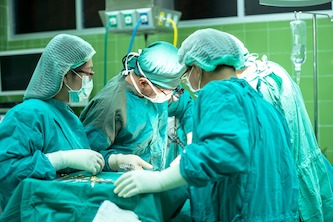
Aaron James is a worker from Arkansas who got really hurt in an electrical accident. Over 140 healthcare pros at NYU Langone Health did the surgery, and it's a huge deal in medical history. His right eye still works, but the successful eye transplant gives hope for more progress in fixing vision.
The surgery helps doctors learn more about how the human eye heals. They say the goal isn't to promise Aaron will see again, but to make way for more progress. They put adult stem cells into the optic nerve during the surgery to help it heal. The face and eye came from one guy in his 30s who donated them.
Aaron is the 19th person in the US to get a face transplant, and doctors are watching him closely. His wife felt a mix of emotions when she saw him after the surgery, feeling relieved and happy that he's getting better. Aaron, a military vet, thanked the donor and their family for making the surgery possible and changing his life.
This big achievement in surgery and transplants gives hope to people with similar health problems and sets the stage for more progress in fixing vision.
Original news source: US veteran gets world's first eye transplant (BBC)
📖 Vocabulary:
Group or Classroom Activities
Warm-up Activities:
– News Summary
Instructions: Students will work in pairs to summarize the article in their own words, aiming to do so in under two minutes. They should focus on the main points: the breakthrough eye transplant surgery, the patient Aaron James, the potential implications for future vision restoration, and the emotional reaction of Aaron's family.
– Vocabulary Pictionary
Instructions: Write down key vocabulary words from the article (such as transplant, breakthrough, optic nerve, donor, etc.) on individual slips of paper. Divide the class into two teams. Members of each team take turns drawing the words on the board without speaking or writing letters or numbers, while their team guesses the word within a set time limit.
– Opinion Spectrum
Instructions: Create a line in the classroom representing a spectrum of opinions about the potential of eye transplants to restore sight. One end signifies 'Very Optimistic' and the other 'Very Pessimistic'. Read statements related to the topic, and have students place themselves along the spectrum according to their opinion. Afterwards, select students from different points on the spectrum to explain their reasoning.
– Future Predictions
Instructions: Ask students to imagine the future of medical transplants based on the article. They will write a short paragraph predicting the advancements in the next 10, 20, or 50 years. Encourage creativity, but remind them to use information from the article as a starting point for their predictions.
– Think-Pair-Share
Instructions: Pose a question to the class based on the article, such as "Do you believe that the risks involved with transplant surgeries are justified by the potential benefits?" Students will first think individually, then pair up with a partner to discuss their thoughts, and finally, share their conclusions with the class. This activity encourages students to articulate their ideas and listen to differing viewpoints.
🤔 Comprehension Questions:
Doctors performed the first complete eye transplant on Aaron James in New York, which also included a rare partial face transplant.
The surgery took 21 hours to complete.
Aaron James also underwent a rare partial face transplant.
The main goal of the surgery is not necessarily to guarantee that Aaron will regain his sight, but to advance medical knowledge and pave the way for future progress in restoring vision.
Aaron received the donated eye and part of the face from a man in his 30s who had donated them.
Before Aaron, 18 other people in the US have received a face transplant.
Aaron's wife felt a mix of emotions, feeling relieved and happy that he was recovering after seeing him post-surgery.
Aaron James's surgery gives hope to people with similar health issues and marks an important step towards further advancements in restoring vision.
🎧✍️ Listen and Fill in the Gaps:
A major breakthrough happened in New York when doctors did the first complete eye transplant on a guy named James. The surgery took 21 hours and also a rare partial face transplant. Even though it's not for sure if he'll get his sight back, experts think this is a big step in millions of people see again. Aaron James is a worker from Arkansas who got really hurt in an electrical . Over 140 healthcare pros at NYU Langone Health did the surgery, and it's a huge deal in medical . His right eye still works, but the successful eye gives hope for more progress in fixing vision. The surgery helps doctors learn more about how the human eye . They say the goal isn't to promise Aaron will see again, but to make way for more progress. They put adult stem cells into the nerve during the to help it heal. The face and eye came from one guy in his 30s who them. Aaron is the 19th in the US to get a face transplant, and doctors are watching him closely. His wife felt a mix of emotions when she saw him after the surgery, feeling relieved and happy that he's getting better. Aaron, a vet, thanked the donor and their family for the surgery possible and changing his life. This big achievement in surgery and transplants gives hope to people with similar health and sets the stage for more progress in fixing .
💬 Discussion Questions:
1. What is a medical breakthrough and why is it important?
2. How would you feel if you were to undergo a major surgery like an eye transplant?
3. Do you think science should keep pushing the limits with surgeries like these? Why or why not?
4. What do you think it means to give someone hope for a better future?
5. Have you or anyone you know ever donated or received an organ? What was that like?
6. What is your opinion on organ donation? Would you consider donating?
7. How do you think Aaron's life might change after this surgery?
8. Do you believe that with modern medicine, most health problems can be fixed? Why or why not?
9. What are stem cells, and why might they be important in surgeries?
10. Do you think Aaron's military background might have influenced his decision to undergo this surgery? Why might that be?
11. How do you feel about the use of adult stem cells in medical treatments?
12. Can you imagine what Aaron's wife might have felt seeing him after the surgery? Why might she have mixed emotions?
13. What do you think are the biggest challenges for someone recovering from a transplant surgery?
14. Do you like the idea of doctors learning from each surgery to improve future ones? Why is that beneficial?
15. Do you think surgeries like Aaron's should be more widely available, or should they be limited to certain cases? Why?
Individual Activities
📖💭 Vocabulary Meanings:
Click a dot next to a word, then click the dot next to its meaning to draw a line connecting them.
Words
Meanings
🔡 Multiple Choice Questions:
🕵️ True or False Questions:
📝 Write a Summary:
Write a summary of this news article in two sentences.
Check your writing now with the best free AI for English writing!