


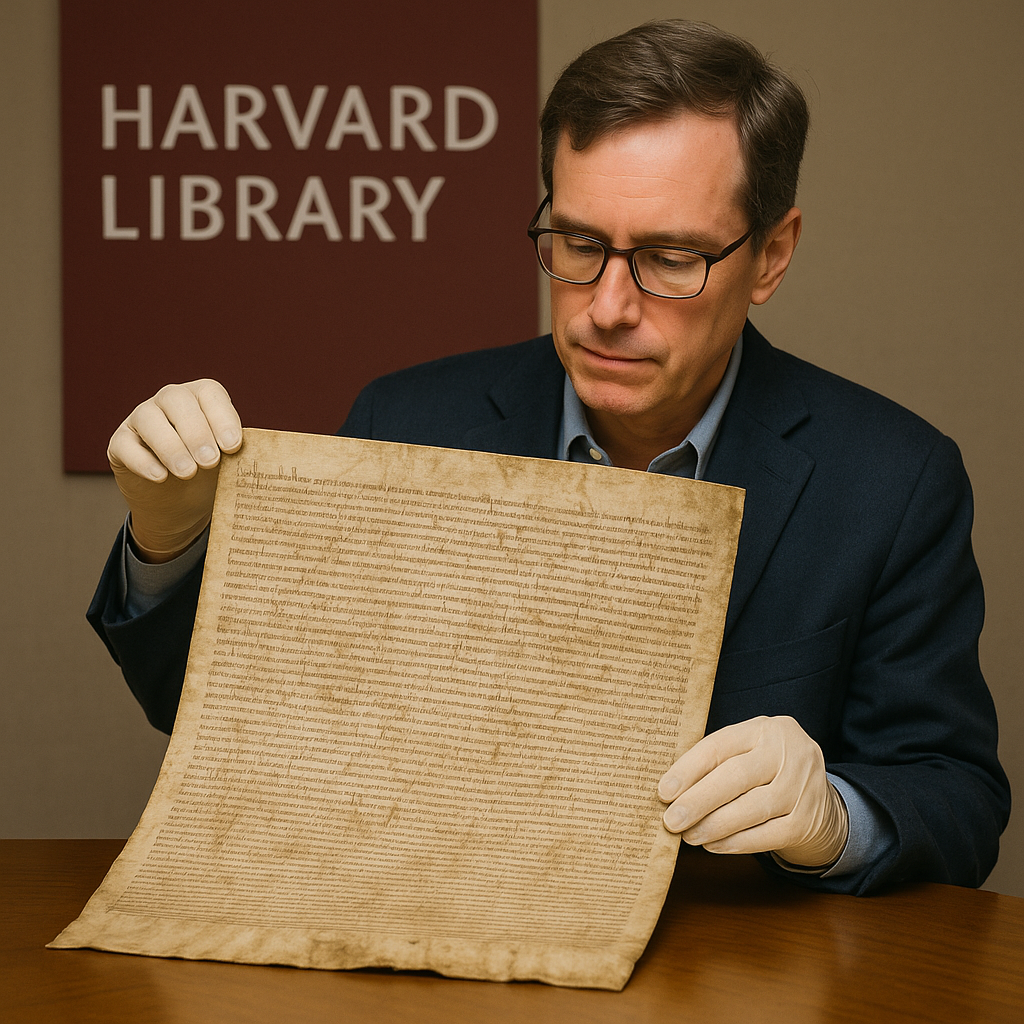
In a remarkable turn of events, a document long believed to be a mere copy of the Magna Carta has been confirmed as an original. This significant finding took place at Harvard Law School Library, where the document was purchased in 1946 for $27.50 from the London book dealers Sweet & Maxwell. The library had assumed that the document was a faded and stained reproduction, miscatalogued as dating back to 1327 during the reign of King Edward III.
The book dealers had acquired this document just a month prior at a Sotheby's auction, purchasing it from a First World War pilot for £42. The misdating of the document led to its classification as a copy, which obscured its true historical value. However, recent research has revealed that this document is, in fact, a rare original Magna Carta issued in 1300 by King Edward I, significantly increasing its worth to millions of dollars.
The discovery was made by David Carpenter, a professor of medieval history at King's College London. While studying online versions of the Magna Carta in December 2023, Carpenter noticed that the document displayed on Harvard's website might be an original. Intrigued, he conducted a thorough examination, comparing the text and performing various tests to confirm its authenticity.
The Magna Carta, originally established in 1215 under King John, is a foundational legal document that outlined the rights of ordinary people under common law. Its significance lies in its role in limiting the powers of the monarchy and establishing the principle that everyone, including the king, is subject to the law. The 1300 version owned by Harvard Law School adds to the historical importance of this document and its legacy.
Despite the newfound value of the document, Harvard Law School has no intention of selling it. Instead, the library aims to preserve this important piece of history, which serves as a testament to the evolution of legal rights and governance. The confirmation of this original Magna Carta not only enriches Harvard's collection but also enhances our understanding of the historical context in which it was created.
Original news source: Magna Carta 'copy' miscatalogued in 1940s found to be original (Sky News)
🎧 Listen:
📖 Vocabulary:
Group or Classroom Activities
Warm-up Activities:
– OPINION POLL
Instructions: Students will be divided into small groups and will discuss their opinions on the significance of historical documents like the Magna Carta. Each group will then share their views with the class, and a poll will be conducted to see which opinions are most common.
– HEADLINE CREATION
Instructions: Students will work in pairs to create catchy headlines for the article about the discovery of the original Magna Carta. They should aim to capture the essence of the news in a few words, focusing on the excitement of the find and its historical importance.
– CHARADES
Instructions: Students will act out key terms and concepts from the article (e.g., "Magna Carta," "King Edward," "Harvard Law School") without speaking, while their classmates guess the terms. This activity will help reinforce vocabulary and engage students in a fun way.
– MIND MAP
Instructions: In groups, students will create a mind map that explores the historical significance of the Magna Carta and its impact on modern legal systems. They will identify key figures, events, and ideas related to the document and present their mind map to the class.
– SPEED SUMMARIZING
Instructions: Students will work in pairs to take turns summarizing the article in under one minute. After each summary, they will provide feedback to each other on clarity and key points, helping to develop their summarization skills further.
🤔 Comprehension Questions:
The initial assumption was that the document was a faded and stained reproduction, miscatalogued as dating back to 1327.
Harvard Law School Library paid $27.50 for the document in 1946.
David Carpenter, a professor of medieval history at King's College London, was responsible for confirming the document as an original Magna Carta.
The book dealers acquired the document from a First World War pilot before selling it to Harvard.
The original Magna Carta was issued by King Edward I in the year 1300.
The primary significance of the Magna Carta established in 1215 was to outline the rights of ordinary people under common law and to limit the powers of the monarchy.
Harvard Law School intends to preserve the newly confirmed original Magna Carta and has no intention of selling it.
The discovery enhances our understanding of legal rights and governance by providing insight into the historical context in which the Magna Carta was created and its role in the evolution of legal rights.
🎧✍️ Listen and Fill in the Gaps:
In a turn of events, a document long believed to be a mere copy of the Magna Carta has been as an original. This finding took place at Harvard Law School Library, where the document was purchased in 1946 for $27.50 from the London book dealers Sweet & Maxwell. The library had assumed that the document was a and stained reproduction, miscatalogued as dating back to 1327 during the reign of King Edward III. The book dealers had acquired this document just a month prior at a Sotheby's auction, purchasing it from a World War pilot for £42. The misdating of the document led to its classification as a copy, which obscured its true historical value. However, recent research has revealed that this document is, in fact, a rare original Magna issued in 1300 by King Edward I, significantly increasing its worth to millions of dollars. The was made by Carpenter, a professor of medieval history at King's College London. While studying online versions of the Magna Carta in December 2023, Carpenter noticed that the displayed on Harvard's website might be an original. Intrigued, he conducted a examination, comparing the text and performing various tests to confirm its authenticity. The Magna Carta, originally established in 1215 under King John, is a legal document that the rights of ordinary people under common law. Its significance lies in its role in limiting the powers of the monarchy and establishing the principle that everyone, including the king, is subject to the law. The 1300 version owned by Harvard Law School adds to the historical importance of this document and its . Despite the newfound value of the document, Harvard Law School has no intention of selling it. Instead, the aims to preserve this important of history, which serves as a testament to the evolution of legal rights and governance. The confirmation of this original Magna Carta not only enriches Harvard's but also enhances our understanding of the historical context in which it was created.
💬 Discussion Questions:
1. What is the significance of historical documents like the Magna Carta in shaping modern legal systems?
2. How would you feel if you discovered a valuable artifact in your possession that you thought was worthless?
3. Do you think it's important for libraries to preserve historical documents? Why or why not?
4. What is a modern equivalent of the Magna Carta in terms of protecting individual rights?
5. How do you think the discovery of the original Magna Carta will impact the study of history and law?
6. Do you like visiting museums or libraries that showcase historical documents? Why or why not?
7. How would you react if a historical document you were studying turned out to be a forgery?
8. Do you think the value of historical documents should be measured solely in monetary terms? Why or why not?
9. What is a lesson we can learn from the misclassification of the Magna Carta about the importance of careful documentation?
10. How would you feel if you were a historian involved in the research that led to such a significant discovery?
11. Do you think that the general public has enough access to historical documents? Why or why not?
12. What is a historical event or document that you believe needs more recognition in today’s society?
13. How do you think the role of technology has changed the way we study and authenticate historical documents?
14. Do you think that the principles outlined in the Magna Carta are still relevant today? Why or why not?
15. How would you feel if a significant piece of your country's history was discovered in another country?
Individual Activities
📖💭 Vocabulary Meanings:
Click a dot next to a word, then click the dot next to its meaning to draw a line connecting them.
Words
Meanings
🔡 Multiple Choice Questions:
🕵️ True or False Questions:
📝 Write a Summary:
Write a summary of this news article in two sentences.
Check your writing now with the best free AI for English writing!