

Free Materials For ESL Teachers and Learners

English Newsroom

Learn English through news articles - complete lesson plans, including articles, listening, classroom activities, quiz questions and more!

Medieval Cemetery Near Cardiff Airport Unveils Mysteries

A medieval cemetery near Cardiff Airport reveals intriguing insights into a complex, undocumented community.

Try this article at a different level?

Β 

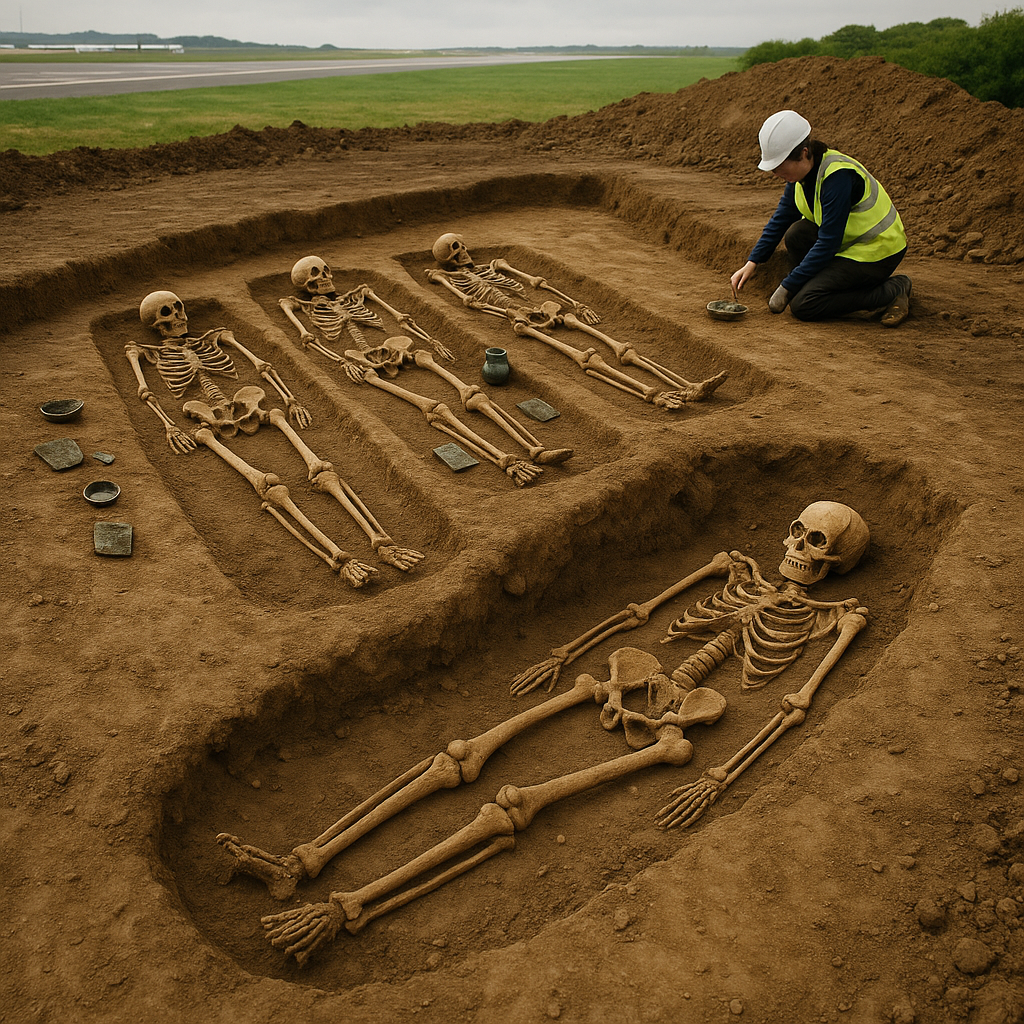
A medieval cemetery discovered near Cardiff Airport is presenting a series of intriguing mysteries for archaeologists. Initially announced last year, the site dates back to the 6th or 7th century and has revealed 41 skeletons buried in unusual positions alongside unexpected artifacts. Recent findings indicate that nearly all the individuals interred in this cemetery are women, whose skeletal remains exhibit signs of heavy manual labor. However, these women also display indications of wealth, adding another layer of complexity to the understanding of this community.

Among the discoveries, one skeleton stands out due to its unusual burial circumstances. A woman was found discarded in a ditch, contrasting sharply with the careful burials of the other individuals. Andy Seaman, the project leader from Cardiff University, expressed the ongoing challenges of interpreting these findings, noting that each new discovery complicates the narrative. The excavation has revealed 39 adult skeletons, predominantly female, and researchers are still analyzing the implications of this gender distribution within the context of the cemetery.

The excavation has also uncovered the remains of two children, which is surprisingly low given the high infant mortality rates of the medieval period. The burial conditions of these children differ from those of the adults, suggesting a potential time gap between the two burials. Archaeologist Dr. Marion Shiner highlighted the distinct characteristics of the soil used to cover the children’s graves, which adds to the overall mystery of the site.

Artifacts found at the cemetery, such as shards of pottery and fine glass, suggest that this community was not ordinary. The glass, likely imported from the Levant and crafted in southern France, indicates a level of status among the individuals buried there. Each burial was conducted with care, with bodies positioned in various orientations, all facing east to west. The treatment of the woman found in the ditch raises questions about her social standing, with researchers considering the possibility that she may have been an outcast or a criminal.

As the excavation continues, the research team is keen to uncover more about the dietary habits and origins of the individuals buried in the cemetery. Preliminary analysis of the skeletons’ teeth reveals a diet rich in carbohydrates but lacking in meat and fish, particularly following the departure of the Romans. The ongoing investigation aims to provide insights into the lives of these medieval individuals and their community, shedding light on a period of history that is often overshadowed by the stories of nobility. Despite the progress made, many questions remain unanswered, and the team hopes to unravel the complexities of this unique archaeological site.

Original news source: Mystery of medieval cemetery near airport runway deepens (BBC)

🎧 Listen:

Slow

Normal

Fast

πŸ“– Vocabulary:

1intriguingArousing curiosity or interest; fascinating
2artifactsObjects made by humans, typically of cultural or historical interest
3interredPlaced in a grave or tomb
4manualInvolving physical work done by hand
5contrastingStrikingly different or opposite
6implicationsPossible effects or consequences of an action or decision
7predominantlyMainly or for the most part
8mortalityThe state of being subject to death
9distinctClearly different or separate
10shardsBroken pieces of a brittle material, such as glass or pottery
11importedBrought in from another country for sale
12orientationThe position or arrangement of something in relation to its surroundings
13outcastA person who is rejected or excluded from a society or group
14preliminaryInitial or early in a process, often serving as a basis for further development
15overshadowedMade less important or prominent compared to something else

Group or Classroom Activities

Warm-up Activities:

– CHARADES
Instructions: Students will break into small groups and take turns acting out key terms or concepts from the article without speaking, while their peers guess the term. This could include words like “archaeologist,” “skeleton,” or “artifacts.”

– NEWS REPORTER ROLE-PLAY
Instructions: In pairs, students will take on the roles of news reporters discussing the archaeological findings. One student will present the information as if reporting live from the excavation site, while the other asks follow-up questions to delve deeper into the story.

– OPINION POLL
Instructions: Students will be divided into two groups. One group will argue that the discoveries shed light on women’s roles in medieval society, while the other will argue that they do not provide enough information. After discussing their viewpoints, students will take a poll to see which opinion had more support.

– ARTICLE TIMELINE
Instructions: In small groups, students will create a timeline of the key events and discoveries mentioned in the article. They will illustrate when the cemetery was discovered, notable findings, and the implications of these findings on our understanding of the past.

– FUTURE PREDICTIONS
Instructions: Students will write down predictions about what future archaeological discoveries at this site might reveal. They will then share their predictions with the class, discussing the importance of these potential findings in understanding the historical context of the cemetery.

πŸ€” Comprehension Questions:

1. What time period does the cemetery near Cardiff Airport date back to, and how many skeletons have been discovered so far?
2. What unusual characteristics have been observed in the skeletal remains of the individuals buried in the cemetery?
3. How does the burial of the woman found in the ditch contrast with the burials of the other individuals in the cemetery?
4. What implications does the gender distribution of the skeletons have for understanding the community that existed at the time?
5. What does the low number of children’s remains suggest about the infant mortality rates during the medieval period?
6. How do the artifacts found at the cemetery, such as pottery and glass, contribute to the understanding of the social status of the individuals buried there?
7. What dietary habits have been revealed through the preliminary analysis of the skeletons’ teeth, and what does this indicate about the community’s lifestyle?
8. What are the ongoing research goals of the excavation team, and what complexities do they hope to unravel regarding this archaeological site?
Go to answers ⇩

🎧✍️ Listen and Fill in the Gaps:

A medieval cemetery discovered near Cardiff Airport is presenting a series of intriguing mysteries for archaeologists. Initially (1)______ last year, the site dates back to the 6th or 7th century and has revealed 41 (2)______ buried in unusual positions alongside unexpected artifacts. Recent findings indicate that nearly all the (3)______ interred in this cemetery are women, whose skeletal remains exhibit signs of heavy manual labor. However, these women also display indications of wealth, adding another layer of complexity to the understanding of this community.

Among the discoveries, one skeleton stands out due to its unusual burial circumstances. A woman was found (4)______ in a ditch, contrasting sharply with the careful burials of the other individuals. Andy Seaman, the project leader from Cardiff University, expressed the ongoing challenges of interpreting these findings, noting that each new discovery complicates the narrative. The excavation has (5)______ 39 adult skeletons, predominantly female, and researchers are still analyzing the implications of this gender distribution within the context of the cemetery.

The excavation has also uncovered the remains of two children, which is surprisingly low given the high infant mortality rates of the (6)______ period. The burial conditions of these children differ from those of the adults, (7)______ a (8)______ time gap between the two (9)______. Archaeologist Dr. Marion Shiner highlighted the distinct characteristics of the soil used to cover the children’s graves, which adds to the overall mystery of the site.

(10)______ found at the cemetery, such as shards of pottery and fine glass, suggest that this (11)______ was not ordinary. The glass, likely imported from the Levant and crafted in southern France, indicates a level of status among the individuals buried there. Each burial was conducted with care, with bodies positioned in various orientations, all facing east to west. The treatment of the (12)______ found in the ditch raises questions about her social standing, with researchers considering the possibility that she may have been an outcast or a (13)______.

As the excavation continues, the research team is keen to uncover more about the dietary habits and origins of the individuals buried in the cemetery. Preliminary analysis of the skeletons’ (14)______ reveals a diet rich in carbohydrates but (15)______ in meat and fish, particularly following the departure of the Romans. The ongoing investigation aims to provide insights into the lives of these medieval individuals and their community, shedding light on a period of history that is often overshadowed by the stories of nobility. Despite the progress made, many questions remain unanswered, and the team hopes to (16)______ the complexities of this unique archaeological site.
Go to answers ⇩

πŸ’¬ Discussion Questions:

Students can ask a partner these questions, or discuss them as a group.

1. What is your opinion on the significance of discovering a medieval cemetery? Why do you think such findings are important for understanding history?

2. How would you feel if you were part of an archaeological team uncovering a site like the one near Cardiff Airport?

3. Do you believe that the gender distribution of skeletons in a burial site can tell us something important about the society? Why or why not?

4. What is a common misconception people have about medieval societies, and how do you think discoveries like this cemetery challenge those views?

5. How would you interpret the unusual burial of the woman found in the ditch compared to the others? What does it say about social status in that community?

6. Do you think that the presence of artifacts like imported glass indicates a more complex social structure? Why or why not?

7. What is your perspective on the treatment of individuals who may have been outcasts in historical societies? How do you think they were viewed by their communities?

8. How would you feel if you discovered that your ancestors were part of a society with a rich history like the one described in the article?

9. Do you think that analyzing dietary habits from skeletal remains can provide a deeper understanding of a community? Why or why not?

10. What is a historical period that you find particularly fascinating, and why do you think it captures your interest?

11. How would you react if you were to find evidence of your own culture or community in an archaeological dig?

12. Do you think that the stories of ordinary people from history are just as important as those of nobility? Why or why not?

13. What is a modern artifact you think future archaeologists might find interesting, and what do you think it would say about our current society?

14. How do you think the discoveries in this cemetery could impact our understanding of women’s roles in medieval society?

15. Do you believe that the mysteries surrounding archaeological sites add to their value? Why or why not?

Individual Activities

πŸ“–πŸ’­ Vocabulary Meanings:

Match each word to its meaning.

Words:
1. intriguing
2. artifacts
3. interred
4. manual
5. contrasting
6. implications
7. predominantly
8. mortality
9. distinct
10. shards
11. imported
12. orientation
13. outcast
14. preliminary
15. overshadowed

Meanings:
(A) Involving physical work done by hand
(B) Brought in from another country for sale
(C) Arousing curiosity or interest; fascinating
(D) The position or arrangement of something in relation to its surroundings
(E) Clearly different or separate
(F) Made less important or prominent compared to something else
(G) Strikingly different or opposite
(H) Placed in a grave or tomb
(I) Objects made by humans, typically of cultural or historical interest
(J) A person who is rejected or excluded from a society or group
(K) Mainly or for the most part
(L) The state of being subject to death
(M) Possible effects or consequences of an action or decision
(N) Initial or early in a process, often serving as a basis for further development
(O) Broken pieces of a brittle material, such as glass or pottery
Go to answers ⇩

πŸ”‘ Multiple Choice Questions:

1. What century does the medieval cemetery near Cardiff Airport date back to?
(a) 8th or 9th century
(b) 10th or 11th century
(c) 6th or 7th century
(d) 12th or 13th century

2. How many skeletons have been discovered at the cemetery?
(a) 39 skeletons
(b) 45 skeletons
(c) 41 skeletons
(d) 30 skeletons

3. What is notable about the gender distribution of the skeletons found in the cemetery?
(a) Nearly all are women
(b) Nearly all are men
(c) They are evenly distributed
(d) There are only children

4. What unusual burial circumstance was noted for one of the skeletons?
(a) A man was buried with gold
(b) A child was buried with toys
(c) A skeleton was found standing
(d) A woman was found discarded in a ditch

5. What type of artifacts were discovered at the cemetery that suggests a level of status among the buried individuals?
(a) Shards of pottery and fine glass
(b) Wooden tools and weapons
(c) Coins and jewelry
(d) Animal bones

6. What dietary habits have been preliminarily identified from the analysis of the skeletons’ teeth?
(a) High in meat and low in grains
(b) Rich in carbohydrates but lacking in meat and fish
(c) Balanced diet with equal parts of all food groups
(d) Primarily vegetarian with no dairy

7. What did the burial conditions of the two children differ from?
(a) The burials of animals
(b) The burials of nobility
(c) The burials of infants
(d) The adults’ burials

8. What aspect of the excavation is the research team particularly interested in uncovering?
(a) Religious practices of the community
(b) Dietary habits and origins of the individuals
(c) Trade routes of the medieval period
(d) Architectural styles of the graves

Go to answers ⇩

πŸ•΅οΈ True or False Questions:

1. One skeleton was found in a pit, contrasting with the negligent burials of others.
2. Artifacts found at the site include shards of ceramics and ordinary glass.
3. The burial conditions of two children found at the site differ from those of the adults.
4. Preliminary analysis of the skeletons’ teeth suggests a diet rich in protein but low in meat and fish.
5. The cemetery dates back to the 8th or 9th century.
6. The excavation revealed 41 skeletons, predominantly of women.
7. The skeletal remains of the women show signs of heavy manual labor.
8. A medieval cemetery was discovered near Cardiff Airport.
Go to answers ⇩

πŸ“ Write a Summary:

Write a summary of this news article in two sentences.
Check your writing now with the best free AI for English writing!




Writing Questions:

Answer the following questions. Write as much as you can for each answer.
Check your answers with our free English writing assistant!

1. What unusual burial circumstances were found regarding one of the skeletons in the medieval cemetery near Cardiff Airport?
2. How do the findings about the skeletal remains of women contribute to the understanding of the community’s social structure?
3. What does the presence of imported glass and pottery suggest about the status of the individuals buried in the cemetery?
4. Why is the low number of child remains surprising in the context of the medieval period’s high infant mortality rates?
5. What are the research team’s goals as they continue to excavate the cemetery, and what specific aspects of the individuals’ lives are they hoping to uncover?

βœ… Answers

πŸ€”βœ… Comprehension Question Answers:

1. What time period does the cemetery near Cardiff Airport date back to, and how many skeletons have been discovered so far?
The cemetery dates back to the 6th or 7th century, and 41 skeletons have been discovered so far.

2. What unusual characteristics have been observed in the skeletal remains of the individuals buried in the cemetery?
Nearly all the individuals interred are women, whose skeletal remains exhibit signs of heavy manual labor, yet they also display indications of wealth.

3. How does the burial of the woman found in the ditch contrast with the burials of the other individuals in the cemetery?
The woman found in the ditch was discarded, contrasting sharply with the careful burials of the other individuals, which were conducted with care and positioned facing east to west.

4. What implications does the gender distribution of the skeletons have for understanding the community that existed at the time?
The predominance of female skeletons raises questions about the social structure and roles within the community, suggesting a unique gender dynamic that researchers are still analyzing.

5. What does the low number of children’s remains suggest about the infant mortality rates during the medieval period?
The low number of children’s remains is surprisingly low given the high infant mortality rates of the medieval period, suggesting that the community may have had different experiences or practices regarding childbirth and child rearing.

6. How do the artifacts found at the cemetery, such as pottery and glass, contribute to the understanding of the social status of the individuals buried there?
The artifacts, including shards of pottery and fine glass likely imported from the Levant and crafted in southern France, suggest that the community was not ordinary and indicates a level of status among the individuals buried there.

7. What dietary habits have been revealed through the preliminary analysis of the skeletons’ teeth, and what does this indicate about the community’s lifestyle?
The preliminary analysis reveals a diet rich in carbohydrates but lacking in meat and fish, indicating that the community’s lifestyle may have changed following the departure of the Romans.

8. What are the ongoing research goals of the excavation team, and what complexities do they hope to unravel regarding this archaeological site?
The ongoing research goals include uncovering more about the dietary habits and origins of the individuals buried in the cemetery, as well as unraveling the complexities of the community’s social structure and practices during this period of history.
Go back to questions ⇧

πŸŽ§βœοΈβœ… Listen and Fill in the Gaps Answers:

(1) announced
(2) skeletons
(3) individuals
(4) discarded
(5) revealed
(6) medieval
(7) suggesting
(8) potential
(9) burials
(10) Artifacts
(11) community
(12) woman
(13) criminal
(14) teeth
(15) lacking
(16) unravel
Go back to questions ⇧

πŸ“–πŸ’­βœ… Vocabulary Meanings Answers:

1. intriguing
Answer: (C) Arousing curiosity or interest; fascinating

2. artifacts
Answer: (I) Objects made by humans, typically of cultural or historical interest

3. interred
Answer: (H) Placed in a grave or tomb

4. manual
Answer: (A) Involving physical work done by hand

5. contrasting
Answer: (G) Strikingly different or opposite

6. implications
Answer: (M) Possible effects or consequences of an action or decision

7. predominantly
Answer: (K) Mainly or for the most part

8. mortality
Answer: (L) The state of being subject to death

9. distinct
Answer: (E) Clearly different or separate

10. shards
Answer: (O) Broken pieces of a brittle material, such as glass or pottery

11. imported
Answer: (B) Brought in from another country for sale

12. orientation
Answer: (D) The position or arrangement of something in relation to its surroundings

13. outcast
Answer: (J) A person who is rejected or excluded from a society or group

14. preliminary
Answer: (N) Initial or early in a process, often serving as a basis for further development

15. overshadowed
Answer: (F) Made less important or prominent compared to something else
Go back to questions ⇧

πŸ”‘βœ… Multiple Choice Answers:

1. What century does the medieval cemetery near Cardiff Airport date back to?
Answer: (c) 6th or 7th century

2. How many skeletons have been discovered at the cemetery?
Answer: (c) 41 skeletons

3. What is notable about the gender distribution of the skeletons found in the cemetery?
Answer: (a) Nearly all are women

4. What unusual burial circumstance was noted for one of the skeletons?
Answer: (d) A woman was found discarded in a ditch

5. What type of artifacts were discovered at the cemetery that suggests a level of status among the buried individuals?
Answer: (a) Shards of pottery and fine glass

6. What dietary habits have been preliminarily identified from the analysis of the skeletons’ teeth?
Answer: (b) Rich in carbohydrates but lacking in meat and fish

7. What did the burial conditions of the two children differ from?
Answer: (d) The adults’ burials

8. What aspect of the excavation is the research team particularly interested in uncovering?
Answer: (b) Dietary habits and origins of the individuals
Go back to questions ⇧

πŸ•΅οΈβœ… True or False Answers:

1. One skeleton was found in a pit, contrasting with the negligent burials of others. (Answer: False)
2. Artifacts found at the site include shards of ceramics and ordinary glass. (Answer: False)
3. The burial conditions of two children found at the site differ from those of the adults. (Answer: True)
4. Preliminary analysis of the skeletons’ teeth suggests a diet rich in protein but low in meat and fish. (Answer: False)
5. The cemetery dates back to the 8th or 9th century. (Answer: False)
6. The excavation revealed 41 skeletons, predominantly of women. (Answer: True)
7. The skeletal remains of the women show signs of heavy manual labor. (Answer: True)
8. A medieval cemetery was discovered near Cardiff Airport. (Answer: True)
Go back to questions ⇧

How about these other Level 4 articles?

Online
Class
Writing
Coach
β˜• 컀피 3μž” &
무료 ν”Όλ“œλ°±! πŸŽ“
β˜• 컀피 3μž” & 무료 ν”Όλ“œλ°±! πŸŽ“

X

[100% 온라인] λž­μ»€μŠ€ν„° λŒ€ν•™κ΅ μ˜μ–΄ 연ꡬ μ°Έμ—¬μž λͺ¨μ§‘
λ³„λ„μ˜ μ°Έκ°€λΉ„ 없이 영ꡭ λŒ€ν•™ 연ꡬ에 도움도 μ£Όμ‹œκ³ , 무료 μ˜μ–΄ μ‹€μ „ μ—°μŠ΅κ³Ό ν”Όλ“œλ°±λ„ λ°›μ•„λ³΄μ„Έμš”!

영ꡭ λž­μ»€μŠ€ν„° λŒ€ν•™κ΅(Lancaster University)μ—μ„œ ν•œκ΅­μΈ μ˜μ–΄ ν•™μŠ΅μžλΆ„λ“€μ„ λŒ€μƒμœΌλ‘œ μƒˆλ‘œμš΄ 연ꡬ ν”„λ‘œμ νŠΈλ₯Ό μ§„ν–‰ν•©λ‹ˆλ‹€. μ „ κ³Όμ • 온라인으둜 μ§„ν–‰λ˜μ–΄ μ–΄λ””μ„œλ“  νŽΈν•˜κ²Œ μ°Έμ—¬ν•˜μ‹€ 수 μžˆμŠ΅λ‹ˆλ‹€. μ—¬λŸ¬λΆ„μ˜ μ†Œμ€‘ν•œ μ°Έμ—¬λ‘œ ν•œκ΅­μΈμ˜ μ˜μ–΄ μ‚¬μš© 방식을 μ•Œμ•„λ³΄λŠ” ν₯미둜운 연ꡬ가 μ™„μ„±λ©λ‹ˆλ‹€.

🎁 μ°Έμ—¬ ν˜œνƒ:
– 원어민 μ—°κ΅¬μ›κ³Όμ˜ 1:1 νšŒν™” μ—°μŠ΅
– μ‹€μ „ μ˜μž‘ μ—°μŠ΅ & λ§žμΆ€ν˜• μ˜μ–΄ ν”Όλ“œλ°± 리포트
– 컀피 κΈ°ν”„ν‹°μ½˜ 총 3μž” μ„ λ¬Ό! (첫 μ„Έμ…˜ ν›„ 1μž”, λ§ˆμ§€λ§‰ μ„Έμ…˜ μ™„λ£Œ ν›„ 2μž” 더 λ“œλ €μš”! β˜•β˜•)

πŸ“… μ°Έμ—¬ 방식: 총 2회의 온라인 μ„Έμ…˜ (Zoom 등을 이용, 각 μ„Έμ…˜λ‹Ή μ•½ 60~80λΆ„ μ†Œμš”) λ§ν•˜κΈ°μ™€ μ“°κΈ° ν™œλ™μ΄ μ„žμ—¬ μžˆμ–΄ λΆ€λ‹΄ 없이 즐겁게 μ°Έμ—¬ν•˜μ‹€ 수 μžˆμŠ΅λ‹ˆλ‹€.

βœ… λŒ€μƒ: μ˜μ–΄ μ‹€λ ₯에 상관없이 μ°Έμ—¬λ₯Ό ν¬λ§ν•˜λŠ” 18μ„Έ 이상 ν•œκ΅­μΈ λˆ„κ΅¬λ‚˜

Feedback