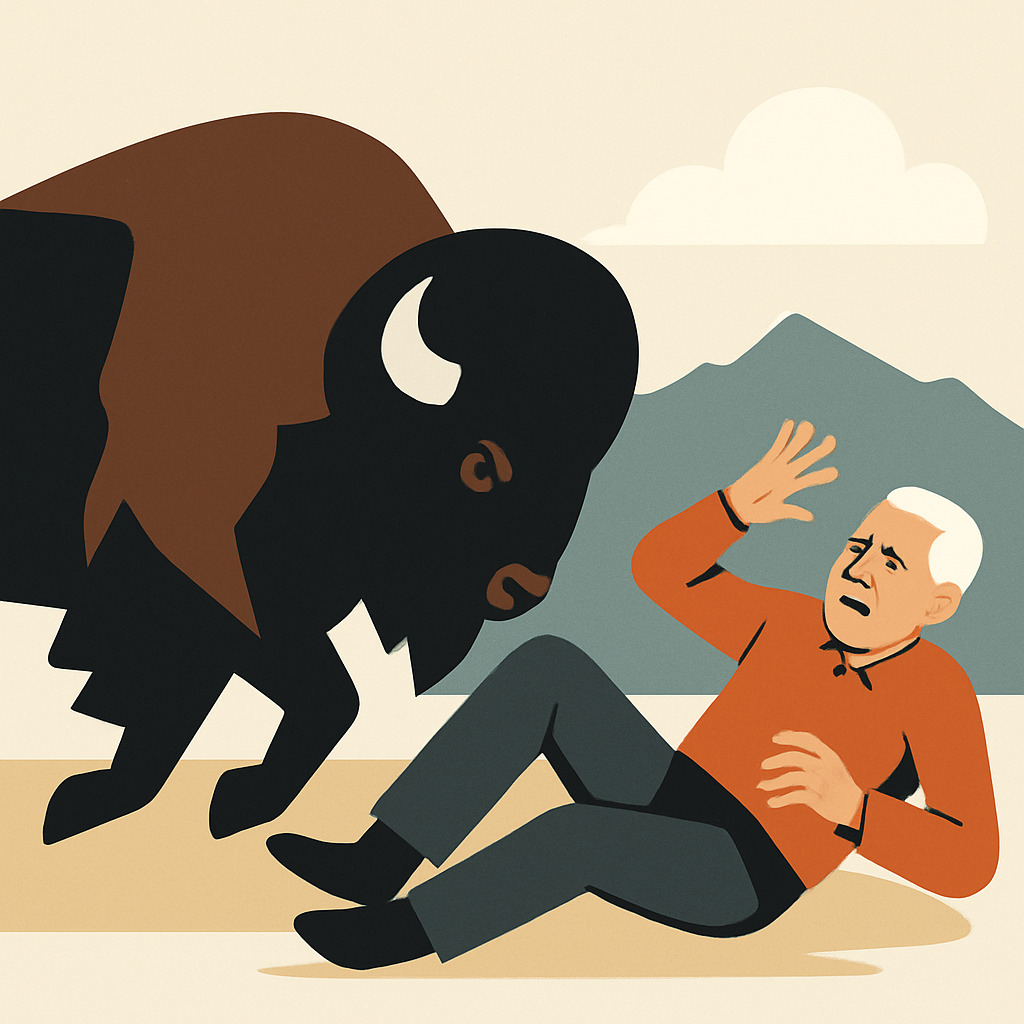
In Yellowstone National Park, a recent incident involving a massive 2,000lb bison resulted in significant injuries to 65-year-old Carl Isom-McDaniel. The event transpired when Carl and his grandson paused to photograph a resting bison, which then unexpectedly charged at them. Video evidence captures the animal's abrupt movements before it propelled Carl into the air, requiring his urgent transport to a medical facility with painful injuries.
The National Park Service (NPS) emphasizes that although bison may appear docile, they are accountable for more injuries within Yellowstone than any other species. Bison are capable of reaching speeds three times faster than humans, necessitating a minimum safe distance of 25 yards as recommended by park guidelines. Despite these warnings, the incident recorded shows Carl and his grandson maintaining some distance, yet it was insufficient to avert the attack.
The clash occurred at Bridge Bay Campground near sunset. Carl's attempt to evade by navigating through a cluster of trees with his grandson was insufficient. Witnesses recall that the bison charged at Carl, using its horn to catapult him into the air in a hazardous trajectory, while an adjacent vehicle attempted in vain to divert the bison's focus.
This episode unfolded during Yellowstone's peak tourist season, coinciding with the bison's mating season—a period noted for erratic animal behavior due to heightened testosterone levels in male bison. Park officials and experts strongly advise increased vigilance during these times, as the bison's augmented aggression can result in unpredictable encounters.
The present scenario underscores an essential reminder for all park visitors: to respect and adhere to established safety protocols, particularly during seasons or situations that might trigger wildlife. The silence from the NPS regarding this particular incident may indicate ongoing investigations or managerial considerations.
Original news source: Bison rams elderly man in Yellowstone, flinging him into the sky (BBC)
🎧 Listen:
📖 Vocabulary:
Group or Classroom Activities
Warm-up Activities:
1. Describe an experience you had with wildlife.
2. What are some safety measures you follow when visiting a park?
3. Have you ever witnessed an animal behaving unexpectedly?
4. Why do you think maintaining distance from wildlife is important?
5. How should people prepare for visiting places like Yellowstone National Park?
🤔 Comprehension Questions:
Carl Isom-McDaniel was injured when a bison charged at him in Yellowstone National Park.
The NPS emphasizes that bison are responsible for more injuries than any other species in Yellowstone.
Bison can run three times faster than humans.
The incident occurred at Bridge Bay Campground in Yellowstone National Park.
The incident occurred during the bison's mating season, which is significant due to increased aggression.
Witnesses described Carl's attempt to escape through trees as futile before the bison struck him.
The NPS's silence might suggest ongoing investigations or management considerations regarding the incident.
🎧✍️ Listen and Fill in the Gaps:
In Yellowstone National Park, a recent incident involving a massive 2,000lb bison resulted in significant injuries to 65- Carl Isom-McDaniel. The event transpired when Carl and his grandson paused to photograph a resting bison, which then unexpectedly charged at them. Video evidence captures the animal's abrupt movements before it propelled Carl into the air, requiring his transport to a medical facility with painful injuries. The National Park (NPS) that although bison may appear docile, they are accountable for more injuries within Yellowstone than any other species. Bison are capable of reaching speeds three times faster than humans, necessitating a minimum safe distance of 25 yards as recommended by park guidelines. Despite these , the incident recorded shows Carl and his grandson maintaining some distance, yet it was insufficient to the attack. The occurred at Bridge Bay near sunset. Carl's attempt to evade by navigating through a cluster of trees with his was insufficient. Witnesses recall that the bison charged at Carl, using its horn to catapult him into the air in a hazardous , while an vehicle attempted in vain to divert the bison's focus. This episode unfolded during Yellowstone's peak tourist season, coinciding with the bison's mating season—a period noted for erratic behavior due to heightened in male bison. Park officials and experts strongly advise increased vigilance during these , as the bison's augmented aggression can result in unpredictable encounters. The present scenario underscores an essential reminder for all park : to respect and adhere to established safety protocols, particularly during seasons or situations that might trigger wildlife. The silence from the NPS regarding this particular incident may indicate ongoing investigations or managerial considerations.
💬 Discussion Questions:
1. Have you ever visited a national park? What was your experience?
2. Why do you think people underestimate the danger posed by seemingly peaceful animals?
3. How should park authorities balance visitor safety with preserving natural habitats?
4. What are the most effective ways to educate the public about wildlife safety?
5. How do you think technology can aid in wildlife management and protection?
6. Have you ever captured an unexpected incident on camera? What happened?
7. How should one react in a sudden wildlife encounter? Share your thoughts.
8. What role do national parks play in environmental conservation?
9. How can visitors ensure they are not disrupting wildlife during their visits?
10. Do you think national parks should have more stringent safety measures? Why or why not?
11. How would you handle witnessing someone else encountering danger with wildlife?
12. What are the potential consequences for wildlife when human interactions become too frequent?
Individual Activities
📖💭 Vocabulary Meanings:
Click a dot next to a word, then click the dot next to its meaning to draw a line connecting them.