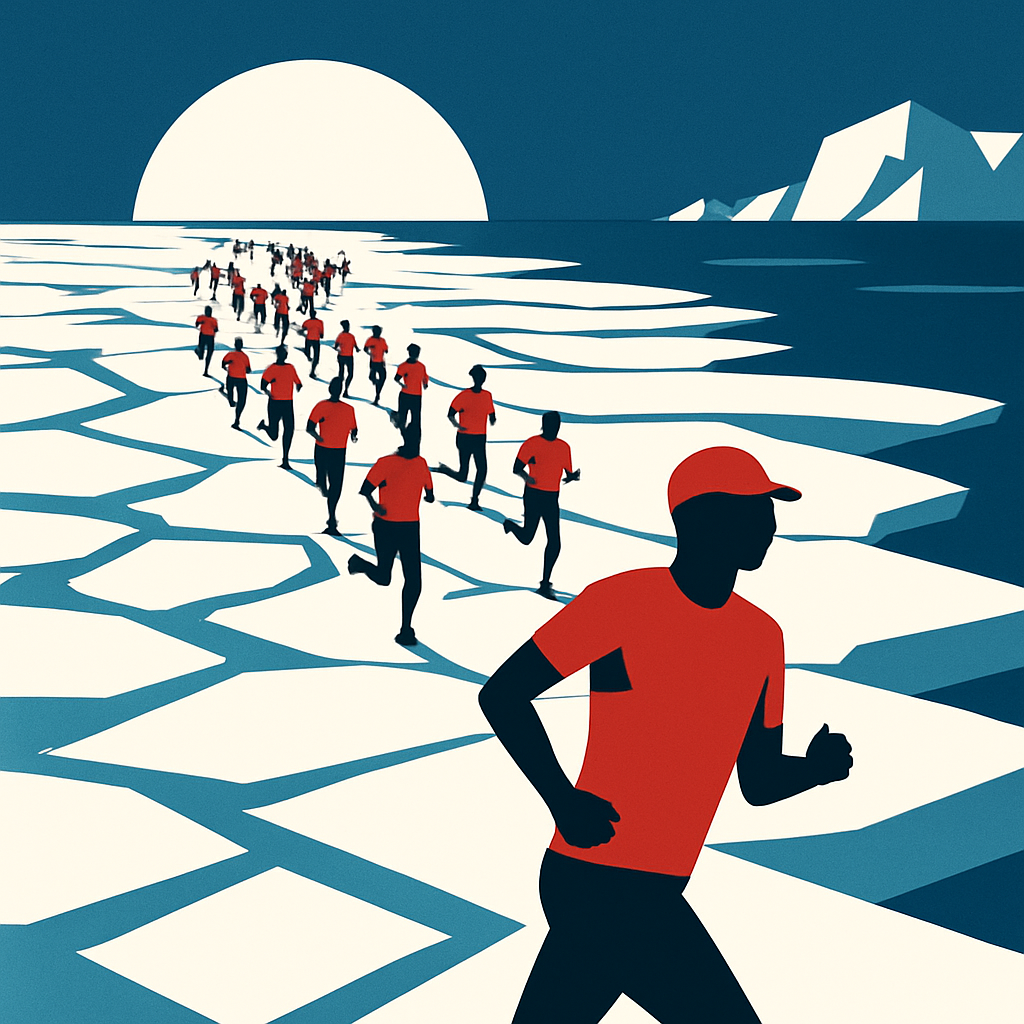
At the geographic North Pole, runners from seven countries gathered for a rare marathon. This event took place on drifting sea ice and was regarded as the "world's coolest marathon". Participants were transported to the pole on a French polar exploration ship leaving from Norway. The runners disembarked onto a sea ice platform to begin their race.
The marathon consisted of laps around a 1,055-meter circuit marked on the ice. To ensure safety, competitors wore thermal gear and life vests as they ran. Armed guards kept watch to protect the racers from potential polar bear encounters. The event featured 23 participants, each racing in extreme conditions.
In the women's category, Denmark's Rikke Dam secured the title with a time of 6 hours and 54 minutes. For the men’s race, China's Wang Shengxian crossed the finish line first, completing it in 3 hours and 52 minutes. The ice supporting the race venue disappeared only hours after the completion of the event.
The experience offered runners a unique and challenging setting unlike any marathon. Despite the extreme conditions, the event unfolded successfully, highlighting the harsh yet stunning landscapes of the Arctic's geographic North Pole.
Original news source: Marathon runners compete on drifting sea ice at North Pole – BBC News (BBC)
📖 Vocabulary:
Group or Classroom Activities
Warm-up Activities:
1. Do you know where the North Pole is located?
2. Have you ever participated in a marathon or a long-distance race?
3. What do you think are the most challenging weather conditions for sports?
4. Can you imagine running on ice? How would it feel?
5. What kind of clothes do you need in extremely cold environments?
🤔 Comprehension Questions:
The marathon was held at the geographic North Pole.
Runners from seven countries participated.
Participants were transported on a French polar exploration ship.
Competitors wore thermal gear and life vests, and armed guards watched for polar bears.
The marathon consisted of laps around a 1,055-meter circuit.
Wang Shengxian won the men’s race with a time of 3 hours and 52 minutes.
The ice disappeared only hours after the marathon was completed.
🎧✍️ Listen and Fill in the Gaps:
At the geographic North Pole, runners from seven countries gathered for a rare . This event took place on drifting sea ice and was regarded as the " marathon". Participants were transported to the pole on a French exploration ship leaving from Norway. The runners onto a sea ice platform to their race. The marathon consisted of laps around a 1,055- circuit on the ice. To ensure safety, competitors wore thermal gear and life vests as they ran. Armed guards kept watch to protect the racers from potential polar bear encounters. The event 23 participants, each racing in extreme conditions. In the women's category, Denmark's Rikke Dam secured the with a time of 6 hours and 54 . For the men’s race, China's Wang crossed the finish line first, completing it in 3 hours and 52 minutes. The ice supporting the race venue disappeared only hours the completion of the event. The experience runners a unique and challenging setting any marathon. Despite the conditions, the event unfolded successfully, highlighting the harsh yet stunning landscapes of the Arctic's geographic North Pole.
💬 Discussion Questions:
1. Why do you think people participate in extreme marathons like this?
2. Would you ever consider running in a marathon at the North Pole? Why or why not?
3. How do you think the organizers ensure the safety of participants in such environments?
4. What are some of the biggest challenges participants might face in this kind of event?
5. How does the natural environment impact sports events?
6. What other extreme sports are you interested in, and why?
7. How important is mental preparation for participating in extreme sports?
8. What do you think motivates people to visit remote locations?
9. How can extreme sports events benefit the local or global community?
10. What would you consider the most important piece of gear for this marathon?
11. How does teamwork play a role in extreme sports?
12. Can you think of any benefits to hosting events in unusual locations like the North Pole?
Individual Activities
📖💭 Vocabulary Meanings:
Click a dot next to a word, then click the dot next to its meaning to draw a line connecting them.