

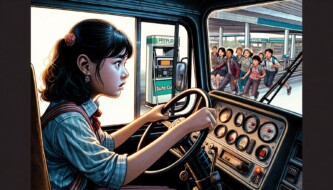
People are talking about the video of what Isabelle did. She was very brave and knew what to do when there was danger. If the bus had hit the gas station, it could have been a big disaster. Everyone is saying Isabelle is a hero for saving the day.
This story shows us that it's important to be careful and know what to do on a bus. Big vehicles like buses can be dangerous. The video teaches us a lesson about being brave like Isabelle when something scary happens.
Original news source: Watch: Teen steers runaway bus away from petrol pumps (BBC)
📖 Vocabulary:
Group or Classroom Activities
Warm-up Activities:
– News Summary
Instructions: Divide the class into pairs or small groups. Give each group a few minutes to read the article. Then, ask each group to summarize the article in their own words, focusing on the main points. Afterward, have each group share their summary with the class.
– Opinion Poll
Instructions: Write a question on the board related to the article, such as "Do you think Isabelle Miller is a hero?" Have the students stand up and move to different areas of the room to indicate their opinion. One side of the room can represent "Yes," while the other side represents "No." Give the students a few minutes to discuss their opinions with others who have the same stance. Then, ask a few students from each side to share their reasons for their opinion.
– Vocabulary Pictionary
Instructions: Choose 5-10 vocabulary words from the article, such as "brave," "disaster," or "danger." Write each word on a separate piece of paper or index card. Divide the class into two teams. One student from each team comes to the front of the class and picks a word without showing it to their teammates. They then have one minute to draw a picture that represents the word while their team guesses what it is. The team that guesses correctly gets a point. Repeat with different students and words until all the vocabulary words have been used.
– Think-Pair-Share
Instructions: Ask the students to think quietly for a minute about a time when they felt brave or had to face a scary situation. Then, ask them to pair up with a partner and share their stories. Afterward, select a few pairs to share their stories with the whole class.
– Future Predictions
Instructions: Ask the students to imagine what might happen after the events in the article. Will Isabelle receive any recognition for her bravery? Will the school take any safety measures to prevent a similar incident? Have the students write down their predictions individually, then pair up and share their ideas. Finally, discuss the predictions as a class and encourage the students to explain their reasoning.
🤔 Comprehension Questions:
Isabelle took the wheel and stopped the bus from hitting anything.
The bus was going towards a place where cars get gas.
People are calling Isabelle a hero because she saved the day by stopping the bus from hitting anything.
We can learn that it's important to be careful and know what to do on a bus.
Big vehicles like buses are dangerous because they can cause a lot of damage if they hit something or if something goes wrong.
The video teaches us that being brave means knowing what to do when something scary happens and taking action to keep everyone safe.
It is important to know what to do on a bus because buses are big and can be dangerous, so knowing how to handle different situations can help keep everyone safe.
🎧✍️ Listen and Fill in the Gaps:
A 14-year-old girl from did something very . Her school bus started to move by itself when the bus driver and a were not on it. The bus was going towards a place where cars get gas. But the girl, named , took the wheel and stopped the bus from hitting anything. People are about the video of what Isabelle did. She was very brave and knew what to do when there was danger. If the bus had hit the gas station, it could have been a big . Everyone is Isabelle is a hero for the day. This story shows us that it's important to be and what to do on a bus. Big vehicles like buses can be dangerous. The video teaches us a lesson about being brave like Isabelle when something scary .
💬 Discussion Questions:
1. What did Isabelle do when the school bus started moving by itself?
2. How do you think Isabelle felt when she had to take the wheel of the bus?
3. What do you think would have happened if Isabelle hadn't stopped the bus?
4. Have you ever been in a situation where you had to be brave? Can you tell us about it?
5. What can we learn from Isabelle's story about being careful on a bus?
6. Do you think Isabelle is a hero? Why or why not?
7. What would you do if you were in Isabelle's situation?
8. Have you ever seen a video of something brave or amazing? Can you describe it?
9. Why do you think people are talking about Isabelle's video?
10. How would you feel if you were on the bus when it started moving by itself?
11. Do you like riding on buses? Why or why not?
12. Do you think it's important to know what to do in dangerous situations? Why or why not?
Individual Activities
📖💭 Vocabulary Meanings:
Click a dot next to a word, then click the dot next to its meaning to draw a line connecting them.
Words
Meanings
🔡 Multiple Choice Questions:
🕵️ True or False Questions:
📝 Write a Summary:
Write a summary of this news article in two sentences.
Check your writing now with the best free AI for English writing!