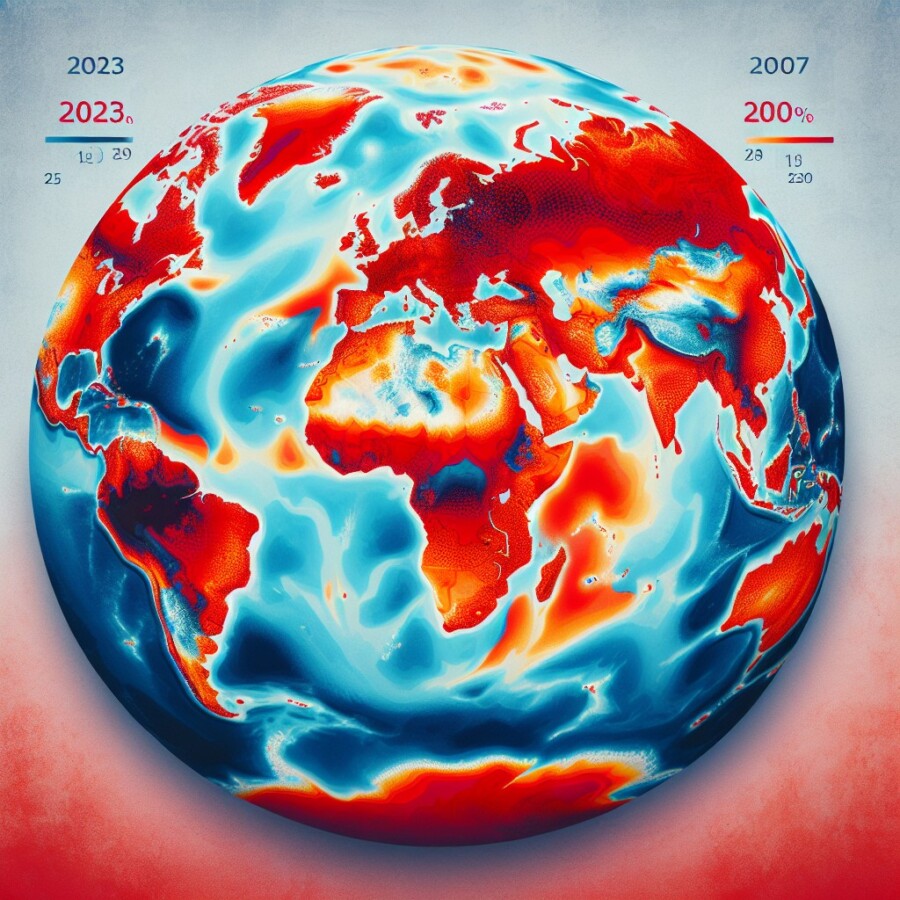
The year 2023 has been confirmed as the hottest year on record, surpassing previous records due to human-caused climate change and the El Niño weather event. The European Union's climate service reported that 2023 was about 1.48C warmer than the long-term average before the widespread burning of fossil fuels began. BBC analysis shows that almost every day since July has seen a new global air temperature high for that time of year, and sea surface temperatures have also reached unprecedented levels. The UK also experienced its second warmest year on record in 2023. These record-breaking temperatures are bringing the world closer to exceeding key international climate targets.
What is particularly striking about 2023 is not only that it broke previous records, but by how much it surpassed them. The margin by which these records were broken is astonishing, considering they represent global averages. The world has become significantly warmer over the past century due to the release of greenhouse gases into the atmosphere. However, 2023 being the hottest year on record was not predicted by major scientific bodies, as the Earth's climate is complex and difficult to forecast.
During the first few months of 2023, only a few days broke air temperature records. However, in the second half of the year, there was an almost unbroken streak of daily temperature records. More than 200 days saw a new daily global temperature record for that time of year. This temperature increase is mainly attributed to the rapid onset of El Niño conditions, which added to the long-term human-caused warming. El Niño is a natural event where warmer surface waters in the East Pacific Ocean release additional heat into the atmosphere. However, the full effects of El Niño were not expected until early 2024, leaving scientists uncertain about the reasons behind the exceptional warmth in 2023.
The record-breaking warmth in 2023 was felt worldwide. Almost all regions of the globe were warmer than the 1991-2020 average, which itself was nearly 0.9C warmer than pre-industrial levels. This global warmth intensified extreme weather events, such as heatwaves, wildfires, droughts, and floods, in various parts of the world. These events occurred on a larger scale and at unusual times of the year, causing significant destruction and loss of life.
In addition to air temperatures, other indicators of climate change also reached record levels in 2023. Antarctic sea-ice reached a record low, glaciers in North America and Europe experienced extreme melting, and the world's sea surface temperature reached its highest recorded level, leading to multiple marine heatwaves. The ocean surface has been breaking records since May 4th, 2023.
Looking ahead to 2024, it is uncertain whether it will be warmer than 2023 due to the unpredictable behavior of the current El Niño. However, there is a possibility that 2024 may surpass the key 1.5C warming threshold for the entire year, which was
Original news source: 2023 confirmed as world's hottest year on record (BBC)
🎧 Listen:
📖 Vocabulary:
Group or Classroom Activities
Warm-up Activities:
– News Summary
Instructions: In pairs or small groups, students will read the article and then summarize the main points in their own words. They should focus on the key information, such as the confirmation of 2023 as the hottest year on record, the role of human-caused climate change and El Niño, and the global impact of the record-breaking temperatures.
– Opinion Poll
Instructions: Students will be divided into groups and given a statement related to climate change, such as "The world needs to take immediate action to combat climate change." Each group will discuss the statement and then take a poll within their group to determine how many agree or disagree. Afterward, each group will present their findings to the class and explain their reasoning.
– Sketch It
Instructions: In pairs, students will choose a specific event mentioned in the article, such as a heatwave or a marine heatwave, and sketch a visual representation of it. They should include key elements and details that capture the essence of the event. Afterward, they will present their sketches to the class and explain their choices.
– Headline Creation
Instructions: Students will work individually or in pairs to create attention-grabbing headlines related to the article. They should focus on capturing the main message or impact of the record-breaking temperatures in 2023. Afterward, they will share their headlines with the class and discuss their choices.
– Future Predictions
Instructions: In pairs or small groups, students will discuss and make predictions about the future impact of climate change based on the information in the article. They should consider possible scenarios and consequences, as well as potential actions that could be taken to mitigate the effects. Afterward, each group will share their predictions with the class and engage in a discussion about the different perspectives.
🤔 Comprehension Questions:
🎧✍️ Listen and Fill in the Gaps:
The year 2023 has been confirmed as the hottest year on , surpassing previous records due to human-caused climate change and the El Niño weather event. The European Union's climate service reported that 2023 was about 1.48C than the long-term average before the widespread burning of fossil fuels . BBC analysis shows that almost every day since July has seen a new global air temperature high for that time of year, and sea surface temperatures have also reached unprecedented levels. The UK also experienced its warmest year on record in 2023. These record-breaking temperatures are bringing the world closer to exceeding key international climate targets. What is particularly striking about 2023 is not only that it broke records, but by how much it surpassed them. The margin by which these records were broken is astonishing, considering they global averages. The world has become significantly warmer over the past century due to the release of greenhouse gases into the atmosphere. However, 2023 being the hottest year on record was not predicted by scientific bodies, as the Earth's is complex and difficult to forecast. During the first few months of 2023, only a few days broke air temperature records. However, in the second half of the year, there was an almost unbroken streak of daily temperature records. More than 200 days saw a new daily global temperature record for that time of year. This temperature increase is mainly attributed to the rapid onset of El Niño conditions, which to the long-term human-caused warming. El Niño is a natural event where warmer surface waters in the East Pacific Ocean release additional heat into the atmosphere. However, the full effects of El Niño were not expected until early 2024, leaving scientists uncertain about the reasons behind the exceptional warmth in 2023. The record-breaking warmth in 2023 was felt wide. Almost all regions of the globe were warmer than the 1991-2020 average, which itself was nearly 0.9C warmer than pre-industrial . This global warmth intensified extreme weather events, such as heatwaves, wildfires, droughts, and floods, in parts of the world. These events occurred on a larger and at unusual times of the year, causing significant destruction and loss of life. In addition to air temperatures, other indicators of climate change also reached record levels in 2023. Antarctic sea-ice reached a record low, glaciers in North America and Europe experienced extreme melting, and the world's sea surface temperature reached its highest recorded level, leading to multiple marine . The ocean surface has been breaking records since May 4th, 2023. Looking ahead to 2024, it is uncertain whether it will be warmer than 2023 due to the behavior of the El Niño. However, there is a possibility that 2024 may surpass the key 1.5C warming threshold for the entire year, which was
💬 Discussion Questions:
1. How do you feel about the fact that 2023 was the hottest year on record?
2. Do you think the record-breaking temperatures in 2023 are a cause for concern? Why or why not?
3. What impact do you think the record-breaking temperatures in 2023 had on extreme weather events around the world?
4. How do you think the record-breaking warmth in 2023 will affect future climate change policies and actions?
5. What steps do you think should be taken to address the issue of climate change in light of the record-breaking temperatures in 2023?
6. How do you think the record-breaking temperatures in 2023 will impact future generations?
7. Do you think the current El Niño event is solely responsible for the record-breaking temperatures in 2023? Why or why not?
8. How do you think the record-breaking temperatures in 2023 will impact the global economy?
9. What measures do you think individuals can take to mitigate the effects of climate change in their own lives?
10. How do you think the record-breaking temperatures in 2023 will impact wildlife and ecosystems around the world?
11. What role do you think governments and international organizations should play in addressing the issue of climate change in light of the record-breaking temperatures in 2023?
12. How do you think the record-breaking temperatures in 2023 will impact agriculture and food production?
13. Do you think the record-breaking temperatures in 2023 will lead to more frequent and severe natural disasters? Why or why not?
14. How do you think the record-breaking temperatures in 2023 will impact global migration patterns?
15. What actions do you think should be taken to prevent future years from surpassing the key 1.5C warming threshold?
Individual Activities
📖💭 Vocabulary Meanings:
Click a dot next to a word, then click the dot next to its meaning to draw a line connecting them.
Words
Meanings
🔡 Multiple Choice Questions:
🕵️ True or False Questions:
📝 Write a Summary:
Write a summary of this news article in two sentences.
Check your writing now with the best free AI for English writing!