

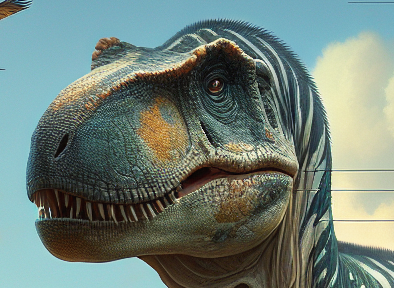
Scientists have discovered the last meal of a 75-million-year-old tyrannosaur, which consisted of two baby dinosaurs. This finding provides new insights into the dietary habits of these predators. The preserved remains of the tyrannosaur and the small dinosaurs it consumed reveal that tyrannosaurs changed their diet as they grew. The specimen in question is a juvenile gorgosaurus, a close relative of the T. rex. It was about seven years old and weighed approximately 330kg at the time of its death. The hind limbs of two small bird-like dinosaurs called citipes were found beneath its ribcage.
Previous fossil evidence, including bite marks on the bones of larger dinosaurs that match tyrannosaur teeth, has allowed scientists to understand how adult gorgosaurs hunted and consumed large plant-eating dinosaurs. Adult tyrannosaurs were indiscriminate eaters, pouncing on large prey and biting through bone to scrape off flesh. However, the smaller, immature tyrannosaurs were not yet capable of hunting large herbivores. Instead, they likely targeted smaller, young dinosaurs.
The fossil containing the remains of the juvenile gorgosaurus and its prey was discovered in the Alberta Badlands in 2009. It took several years to prepare the fossil, and the presence of prey inside was not immediately apparent. The complete hind legs of two baby dinosaurs were eventually revealed. The researchers speculate that the gorgosaurus was particularly interested in the drumstick portion of its prey.
The gorgosaurus is a slightly smaller and older species than the T. rex. As they matured, gorgosaurs transformed, with juveniles having longer legs and blade-like teeth, while adults had rounder teeth. This unique specimen provides physical evidence of the different feeding strategies employed by juveniles and adults. While adults used their powerful teeth to bite and scrape, the juvenile gorgosaurus selectively chose and even dissected its prey, biting off the legs and swallowing them whole.
This discovery highlights that tyrannosaurs were not just monstrous creatures but sophisticated feeders. It also challenges the depiction of T. rex in popular culture, such as the film Jurassic Park, where the giant dinosaur is shown chasing after cars. In reality, it would have been the younger, more agile individuals, like the gorgosaurus, that would have been more likely to engage in such behavior.
Original news source: Tyrannosaur’s last meal was two baby dinosaurs (BBC)
🎧 Listen:
📖 Vocabulary:
Group or Classroom Activities
Warm-up Activities:
– News Summary
Instructions: Divide the class into pairs or small groups. Give each group a few minutes to read the article. Then, ask each group to summarize the main points of the article in a news-style summary. Have each group share their summary with the class and compare the different summaries.
– Opinion Poll
Instructions: Ask the students to form pairs or small groups. Give each group a statement related to the article, such as "Do you think this discovery changes our understanding of tyrannosaur behavior?" or "Do you believe that the depiction of T. rex in popular culture is accurate?" Have each group discuss the statement and come up with their own opinions. Then, conduct a class-wide opinion poll, where each group presents their opinion and the rest of the class votes on whether they agree or disagree.
– Vocabulary Pictionary
Instructions: Write a selection of key vocabulary words from the article on separate slips of paper. Divide the class into two teams. One student from each team will come to the front of the class and choose a slip of paper. They must then draw a picture to represent the word without using any words or letters. The team members must guess the word based on the drawing within a time limit. The team with the most correct guesses wins.
– Headline Creation
Instructions: In pairs or small groups, ask the students to create catchy headlines for the article. Encourage them to think of attention-grabbing phrases that summarize the main points or emphasize the significance of the discovery. Have each group share their headline with the class and discuss why they chose it.
– Pros and Cons
Instructions: Divide the class into two groups. Assign one group to argue the pros of the discovery (e.g. how it contributes to scientific knowledge, understanding of dinosaur behavior) and the other group to argue the cons (e.g. how it challenges existing theories, the limitations of the study). Give each group time to prepare their arguments and then have a class debate, with each group presenting their points and responding to counterarguments.
🤔 Comprehension Questions:
🎧✍️ Listen and Fill in the Gaps:
Scientists have discovered the last meal of a 75-million-year-old , which consisted of two baby dinosaurs. This finding provides new into the dietary habits of these predators. The preserved remains of the tyrannosaur and the small dinosaurs it reveal that tyrannosaurs their diet as they grew. The specimen in question is a juvenile gorgosaurus, a close relative of the T. rex. It was about seven years old and weighed approximately 330kg at the time of its death. The hind limbs of two small bird-like dinosaurs called citipes were found beneath its ribcage. Previous fossil evidence, bite marks on the bones of larger dinosaurs that match tyrannosaur teeth, has allowed scientists to understand how gorgosaurs hunted and consumed large plant-eating dinosaurs. Adult tyrannosaurs were indiscriminate eaters, pouncing on large prey and through bone to scrape off flesh. However, the smaller, immature tyrannosaurs were not yet capable of hunting large herbivores. Instead, they likely targeted smaller, young dinosaurs. The fossil containing the remains of the gorgosaurus and its prey was discovered in the Alberta Badlands in 2009. It took several years to prepare the fossil, and the presence of prey inside was not immediately apparent. The complete hind legs of two baby dinosaurs were eventually . The researchers that the gorgosaurus was particularly in the drumstick portion of its prey. The gorgosaurus is a slightly smaller and older species than the T. rex. As they matured, gorgosaurs transformed, with juveniles having longer legs and blade-like teeth, while adults had rounder teeth. This unique specimen provides physical evidence of the different feeding employed by juveniles and adults. While adults used their powerful teeth to bite and scrape, the juvenile gorgosaurus selectively chose and even dissected its prey, biting off the legs and swallowing them whole. This discovery that tyrannosaurs were not just monstrous creatures but sophisticated feeders. It also challenges the depiction of T. rex in popular culture, such as the film Park, where the giant dinosaur is shown chasing after cars. In reality, it would have been the younger, more individuals, like the gorgosaurus, that would have been more likely to in such behavior.
💬 Discussion Questions:
1. What is your opinion on the discovery of the last meal of the 75-million-year-old tyrannosaur?
2. How would you feel if you found out that the tyrannosaur's last meal consisted of two baby dinosaurs?
3. Do you like learning about dinosaurs? Why or why not?
4. Do you think it is important for scientists to study the dietary habits of ancient predators? Why or why not?
5. What do you think the discovery of the juvenile gorgosaurus and its prey reveals about the feeding habits of tyrannosaurs?
6. How do you think the feeding habits of the juvenile gorgosaurus compare to those of adult tyrannosaurs?
7. Why do you think the gorgosaurus selectively chose and dissected its prey, while adult tyrannosaurs were indiscriminate eaters?
8. What do you think the presence of prey inside the fossil of the juvenile gorgosaurus indicates about its behavior?
9. How do you think the depiction of T. rex in popular culture, such as Jurassic Park, differs from the reality revealed by this discovery?
10. Do you think it is important for popular culture to accurately portray scientific discoveries? Why or why not?
11. What other scientific discoveries have you found particularly interesting or surprising? Why?
12. How do you think the discovery of the juvenile gorgosaurus and its prey contributes to our understanding of prehistoric ecosystems?
13. What other aspects of the lives of dinosaurs do you think scientists should study? Why?
14. How do you think the dietary habits of ancient predators compare to those of modern predators?
15. Do you think the study of dinosaurs and ancient ecosystems is relevant to our lives today? Why or why not?
Individual Activities
📖💭 Vocabulary Meanings:
Click a dot next to a word, then click the dot next to its meaning to draw a line connecting them.
Words
Meanings
🔡 Multiple Choice Questions:
🕵️ True or False Questions:
📝 Write a Summary:
Write a summary of this news article in two sentences.
Check your writing now with the best free AI for English writing!