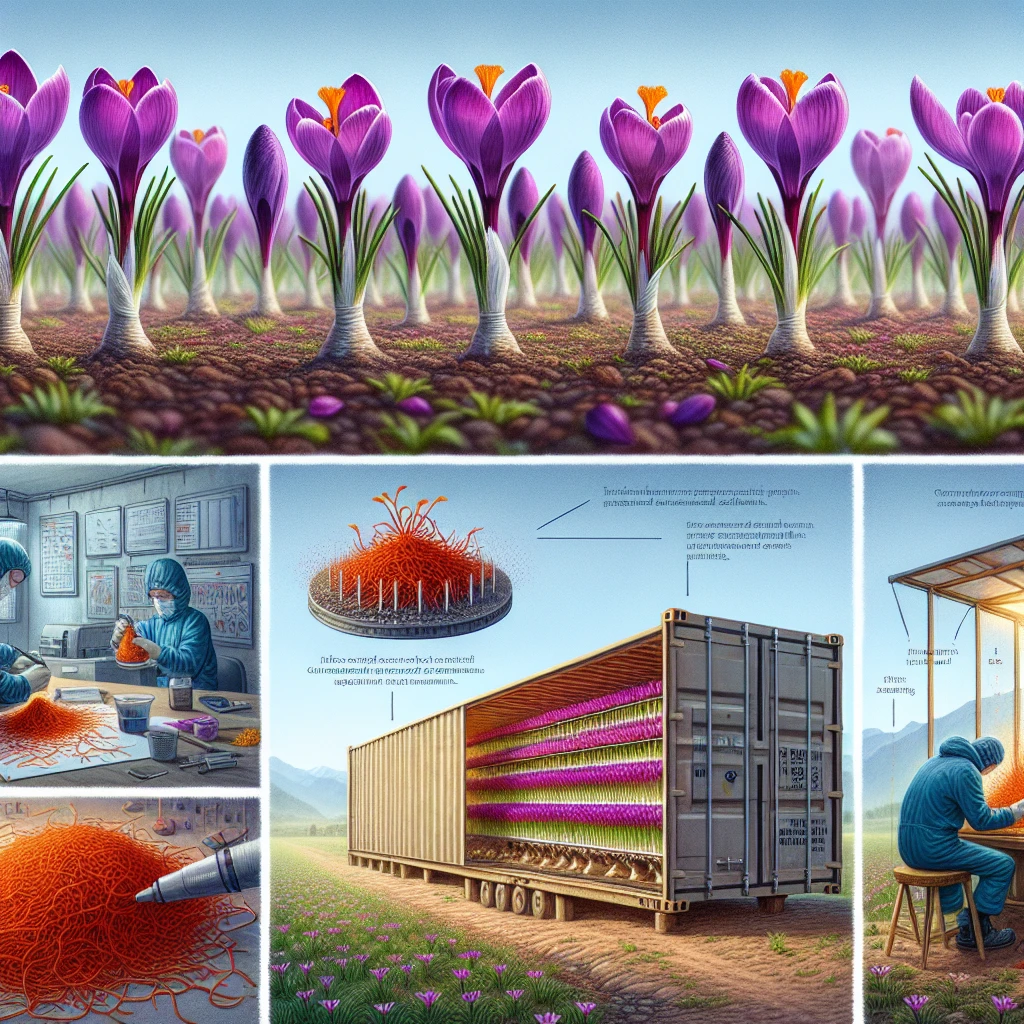
To address these challenges, scientists are working on breeding hardier crocus plants that can thrive in different climatic conditions. They are using a technique called mutation breeding, which disrupts the DNA of the plants by exposing seeds to radiation. The hope is that some of the resulting gene mutations will be beneficial for the plants. Additionally, farmers are being advised on how to make their fields more productive, such as growing almond trees alongside saffron to provide shade and lower the soil temperature.
Some farmers are taking a more innovative approach to saffron production. Shailesh Modak, a former software engineer, decided to quit his job and venture into saffron farming. He grows crocus plants in a shipping container fitted with an air conditioning and circulation system to meet the specific needs of the plants. The plants are cultivated in tubes containing moisture and nutrients, using a technique called hydroponics. Modak has developed software to remotely control all the conditions required for saffron cultivation.
Another approach being explored is growing the crocus plants indoors for part of the year. This involves carefully removing the corms from the soil and growing them inside for three months before replanting them outside just before harvest. Some farmers have found this method successful in protecting the delicate plants and increasing productivity.
While these innovative methods show promise, some farmers have found them unreliable and prefer traditional outdoor cultivation. Despite the challenges, efforts are being made to revitalize saffron production in India and ensure the sustainability of this valuable spice.
Original news source: Red gold': Why saffron production is dwindling in India (BBC)
📖 Vocabulary:
Group or Classroom Activities
Warm-up Activities:
– News Summary
Instructions: Divide the class into pairs or small groups. Give each group a few minutes to read the article independently. Then, ask each group to summarize the main points of the article in a brief news summary. Encourage them to include the challenges faced by saffron production, the solutions being explored, and the importance of saffron in India.
– Think-Pair-Share
Instructions: Ask the students to individually think about and write down their thoughts on the following question: "What are some potential solutions to the challenges faced by saffron production in India?" After a few minutes, have them pair up and share their ideas with each other. Finally, facilitate a class discussion where students can share their ideas and discuss the pros and cons of each solution.
– Opinion Poll
Instructions: Create a list of statements related to the article, such as "Mutation breeding is the most effective solution to the challenges faced by saffron production" or "Indoor cultivation is a more sustainable method for saffron production." Have students move around the classroom and place themselves along a spectrum from strongly agree to strongly disagree for each statement. After everyone has chosen their position, ask a few students from each side to explain their reasoning.
– Pros and Cons
Instructions: Divide the class into two groups. Assign one group the task of listing the pros of traditional outdoor cultivation for saffron production, and assign the other group the task of listing the pros of innovative methods like hydroponics or indoor cultivation. Give the groups a few minutes to brainstorm and write down their ideas. Then, have each group present their lists to the class. Facilitate a discussion where students can compare and contrast the pros and cons of each approach.
– Future Predictions
Instructions: Ask the students to imagine that they are saffron farmers in India. In pairs or small groups, have them discuss and write down their predictions for the future of saffron production in the country. They should consider factors such as climate change, technological advancements, and market demand. After a few minutes, ask each group to share their predictions with the class and discuss the likelihood of each scenario.
🤔 Comprehension Questions:
🎧✍️ Listen and Fill in the Gaps:
Saffron production in India, known as "red gold," is facing challenges that are causing a decline in its . The town of Pampore in Indian-administered is the center of saffron production in the country. Saffron, derived from the crocus plant, is a highly valuable spice, fetching around $1,500 per kilo. The process of harvesting saffron involves the deep-red threads, called stigma, from the crocus petals and drying them. However, the changing climate, with erratic patterns and higher temperatures, has made saffron cultivation more difficult. This, along with the expansion of towns and villages onto fields and lack of in irrigation and training for farmers, has led to a in saffron production. To address these challenges, scientists are working on breeding hardier crocus plants that can thrive in different climatic conditions. They are using a technique mutation breeding, which disrupts the DNA of the plants by exposing seeds to radiation. The hope is that some of the resulting gene mutations will be beneficial for the plants. Additionally, farmers are being advised on how to make their fields more productive, such as growing almond trees alongside saffron to shade and lower the soil temperature. Some farmers are taking a more innovative to saffron production. Shailesh Modak, a former software engineer, decided to quit his job and venture into saffron . He grows crocus plants in a shipping container fitted with an air conditioning and circulation system to meet the specific needs of the plants. The plants are cultivated in tubes containing moisture and nutrients, using a technique called hydroponics. Modak has developed software to remotely all the conditions required for saffron cultivation. Another approach being explored is growing the crocus plants indoors for part of the year. This involves carefully removing the corms from the soil and growing them inside for three months before replanting them outside just before harvest. Some farmers have found this successful in protecting the delicate plants and increasing productivity. While these innovative methods show promise, some farmers have found them unreliable and traditional outdoor cultivation. Despite the challenges, efforts are being made to revitalize saffron production in India and the sustainability of this valuable .
💬 Discussion Questions:
1. What is saffron and why is it considered valuable?
2. How do you think climate change is affecting saffron production in India?
3. Do you think it is important for scientists to develop hardier crocus plants? Why or why not?
4. How would you feel if your town or village expanded onto saffron fields?
5. Do you think it is worth investing in irrigation and training for saffron farmers? Why or why not?
6. Why do you think some farmers prefer traditional outdoor cultivation over innovative methods?
7. How do you think technology, like Modak's software, can benefit saffron farming?
8. Do you think growing crocus plants indoors for part of the year is a good solution to protect the plants? Why or why not?
9. Why do you think some farmers find the innovative methods unreliable?
10. How would you feel if you were a saffron farmer and your production was declining?
11. Do you think it is important to revitalize saffron production in India? Why or why not?
12. How do you think the decline in saffron production could impact the economy of India?
13. What other challenges do you think saffron farmers face besides climate change?
14. Do you think saffron production can be sustainable in the long term? Why or why not?
15. How do you think the decline in saffron production could impact the availability and price of saffron worldwide?
Individual Activities
📖💭 Vocabulary Meanings:
Click a dot next to a word, then click the dot next to its meaning to draw a line connecting them.
Words
Meanings
🔡 Multiple Choice Questions:
🕵️ True or False Questions:
📝 Write a Summary:
Write a summary of this news article in two sentences.
Check your writing now with the best free AI for English writing!