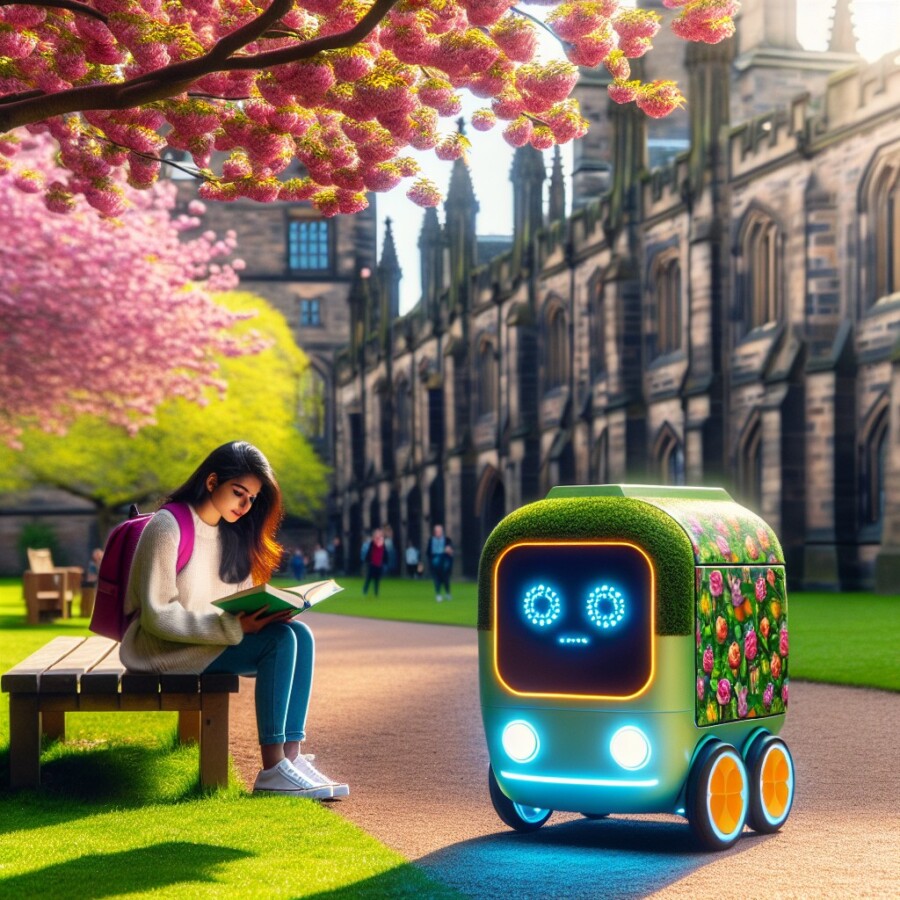
A trial project is currently taking place at the University of Edinburgh, where robots are being used to deliver food to students. These autonomous vehicles, known as Pixie, can travel on private roads within the campus. Students at the university's King's Building can order food or drinks using a mobile app. The goal of this project is to showcase the potential of autonomous vehicles in various settings, such as airports or the healthcare sector.
BBC Scotland News recently visited the University of Edinburgh to explore the progress of this autonomous food delivery robot. The team of scientists at the university have been working on developing this technology. The video highlights the use of these robots in delivering takeaways to students, and discusses the potential for their application in other areas.
The project aims to demonstrate the feasibility of using autonomous vehicles for food delivery. By using an app, students can easily place their orders and have them delivered by the Pixie robots. This technology has the potential to revolutionize the way food is delivered, not just on university campuses, but also in other settings such as airports or hospitals.
The video raises the question of how close we are to making this technology a reality. While the trial project at the University of Edinburgh is a step in the right direction, there are still challenges to overcome before autonomous vehicles can be widely used for food delivery. However, the progress made so far is promising and suggests that we are moving closer to a future where robots can play a significant role in delivering goods and services.
In conclusion, the trial project at the University of Edinburgh is using autonomous vehicles, known as Pixie robots, to deliver food to students. This project aims to showcase the potential of autonomous vehicles in various settings and revolutionize the way food is delivered. While there are still challenges to overcome, the progress made so far is promising and suggests that a future with robots delivering takeaways is not too far away.
Original news source: The robots delivering takeaways to Edinburgh students (BBC)
🎧 Listen:
📖 Vocabulary:
Group or Classroom Activities
Warm-up Activities:
– News Summary
Instructions:
1. Divide the class into pairs or small groups.
2. Provide each group with a copy of the article.
3. Instruct the groups to read the article and discuss the main points.
4. Each group must then summarize the article in 3-4 sentences.
5. Have each group present their summary to the class.
– Opinion Poll
Instructions:
1. Divide the class into pairs or small groups.
2. Instruct each group to come up with 3-4 discussion questions related to the article.
3. Have each group take turns asking their questions to the rest of the class.
4. Encourage the class to engage in a discussion and share their opinions on the topic.
– Headline Creation
Instructions:
1. Divide the class into pairs or small groups.
2. Instruct each group to create a catchy headline for the article.
3. Give them a few minutes to come up with their headlines.
4. Have each group share their headline with the class and explain why they chose it.
– Vocabulary Pictionary
Instructions:
1. Write down 10-15 key vocabulary words from the article on separate pieces of paper.
2. Divide the class into pairs or small groups.
3. Randomly distribute the vocabulary words to each group.
4. Instruct each group to draw a picture representing the vocabulary word they received.
5. Have each group take turns showing their drawing to the class and asking the class to guess the word.
– Future Predictions
Instructions:
1. Instruct each student to write down 3-4 predictions about the future of autonomous vehicles and their impact on food delivery.
2. Divide the class into pairs or small groups.
3. Have each group discuss and share their predictions with each other.
4. Encourage the class to have a lively discussion and debate about the different possibilities.
🤔 Comprehension Questions:
🎧✍️ Listen and Fill in the Gaps:
A trial is currently taking place at the University of Edinburgh, where robots are being used to deliver food to students. These autonomous vehicles, known as Pixie, can travel on private roads within the campus. Students at the university's King's can order food or drinks a mobile app. The goal of this project is to showcase the potential of autonomous vehicles in various , such as airports or the healthcare sector. BBC Scotland News recently visited the University of Edinburgh to explore the progress of this food delivery robot. The team of scientists at the have been working on developing this technology. The video highlights the use of these robots in delivering takeaways to students, and discusses the for their application in other areas. The project aims to demonstrate the feasibility of using autonomous vehicles for food delivery. By using an app, students can easily place their orders and have them by the Pixie robots. This technology has the potential to revolutionize the way food is delivered, not just on university campuses, but also in other settings such as airports or . The video raises the question of how close we are to making this technology a reality. While the project at the University of is a step in the direction, there are still challenges to overcome before autonomous vehicles can be widely used for food delivery. However, the progress made so far is promising and suggests that we are moving closer to a future where robots can play a significant role in delivering goods and services. In , the trial project at the University of Edinburgh is using autonomous vehicles, known as Pixie robots, to deliver food to students. This project aims to showcase the potential of autonomous vehicles in various settings and the way food is delivered. While there are still challenges to overcome, the made so far is promising and suggests that a future with robots delivering is not too far away.
💬 Discussion Questions:
1. What is your opinion on using robots to deliver food?
2. How would you feel if a robot delivered food to your doorstep?
3. Do you think using autonomous vehicles for food delivery is a good idea? Why or why not?
4. What are some potential benefits of using robots to deliver food?
5. Do you think robots could replace human delivery drivers in the future? Why or why not?
6. How do you think the use of autonomous vehicles for food delivery could impact the job market?
7. Have you ever used a mobile app to order food? How was your experience?
8. What are some potential challenges or obstacles that could arise when using robots to deliver food?
9. How do you think the use of autonomous vehicles for food delivery could affect the environment?
10. Do you think the use of robots for food delivery could improve efficiency and speed? Why or why not?
11. What other settings do you think could benefit from the use of autonomous vehicles for delivery?
12. How do you think the use of robots for food delivery could impact the customer experience?
13. Have you ever interacted with a robot before? If so, what was your experience like?
14. What are some potential concerns or drawbacks of using robots to deliver food?
15. How do you think the use of autonomous vehicles for food delivery could change the way we think about transportation?
Individual Activities
📖💭 Vocabulary Meanings:
Click a dot next to a word, then click the dot next to its meaning to draw a line connecting them.
Words
Meanings
🔡 Multiple Choice Questions:
🕵️ True or False Questions:
📝 Write a Summary:
Write a summary of this news article in two sentences.
Check your writing now with the best free AI for English writing!