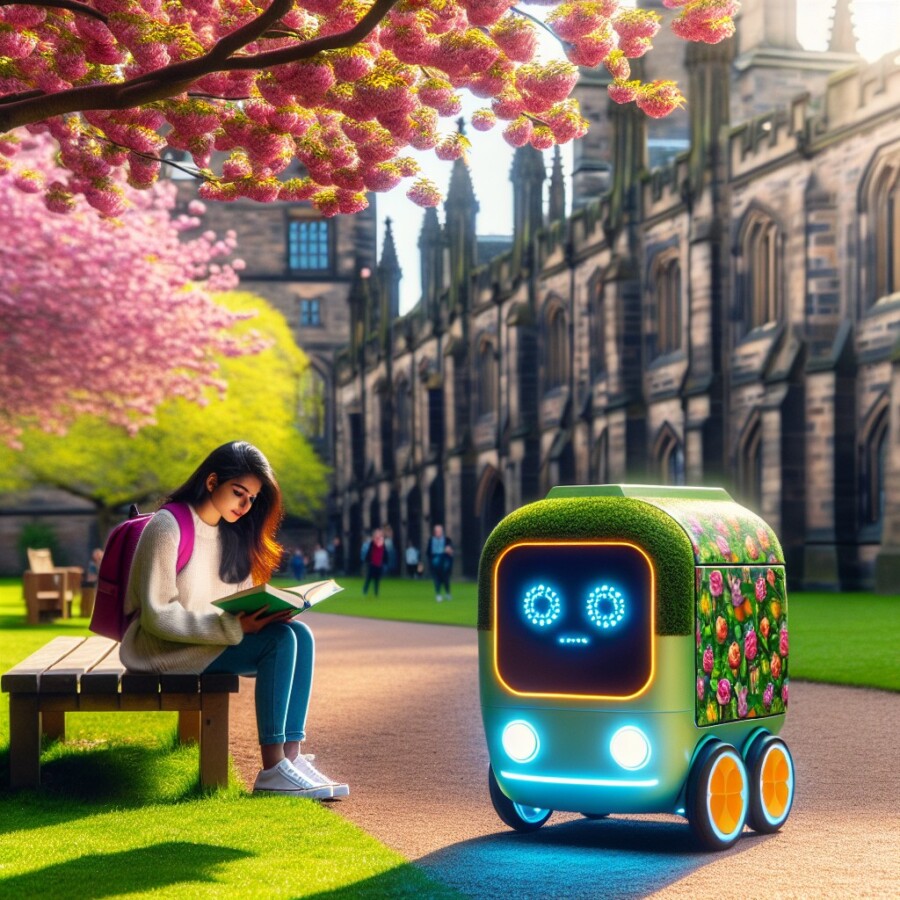
At the University of Edinburgh, there are small robots called Pixie that can bring food to students. Students use a phone app to tell Pixie what food they want. These robots can move by themselves on special paths in the school. The school made its own robot to show how these robots can work in different places, like airports or hospitals.
People are starting to use robots more to deliver food, like what's happening at the University of Edinburgh. Students can get their food without any person having to bring it to them. This robot idea could also be used in other places, not just schools. The school hopes that by using these robots, they can show how good they are at delivering food. They think that in the future, more robots will be used to bring us our food.
Original news source: The robots delivering takeaways to Edinburgh students (BBC)
🎧 Listen:
📖 Vocabulary:
Group or Classroom Activities
Warm-up Activities:
– Charades
Instructions: Divide the class into small groups. Give each group a set of vocabulary cards related to the article (e.g. robot, food, university, app). One student from each group will act out a word without speaking, while the other group members guess what word it is. The group that guesses correctly gets a point. Repeat with different students acting out words.
– Vocabulary Pictionary
Instructions: Divide the class into pairs. Give each pair a set of vocabulary cards related to the article. One student from each pair will choose a card and draw a picture to represent the word, while the other student guesses what word it is. After a set time, switch roles. The pair with the most correct guesses wins.
– Opinion Poll
Instructions: Ask the students to form a circle. Give each student a slip of paper with a question related to the article (e.g. "Do you think robots will replace humans in delivering food?"). Students should write "yes" or "no" on their papers without showing anyone. Then, go around the circle and have each student share their opinion and briefly explain why.
– Think-Pair-Share
Instructions: Ask the students to think about the advantages and disadvantages of using robots to deliver food. Then, pair them up and have them discuss their thoughts with their partner. After a few minutes, ask some pairs to share their ideas with the whole class.
– Future Predictions
Instructions: Divide the class into small groups. Ask each group to brainstorm and write down three predictions about how robots will be used in the future. Give them a few minutes to discuss and come up with their predictions. Then, have each group share their predictions with the class. Encourage them to explain their reasoning behind each prediction.
🤔 Comprehension Questions:
The small robots at the University of Edinburgh are called Pixie.
Students use a phone app to tell the robots what food they want.
Yes, the robots can move by themselves.
These robots could also be used in places like airports or hospitals.
The school wants to use these robots to show how good they are at delivering food.
The robots bring food to the students.
The school thinks that in the future, more robots will be used to bring us our food.
🎧✍️ Listen and Fill in the Gaps:
At the University of , there are small robots called that can bring food to students. Students use a phone app to tell Pixie what food they want. These robots can move by themselves on special in the school. The school made its own robot to show how these robots can work in places, like airports or hospitals. People are starting to use robots more to deliver food, like what's happening at the of Edinburgh. Students can get their food without any person having to bring it to them. This idea could also be used in other places, not just schools. The school hopes that by using these , they can show how good they are at delivering food. They think that in the future, more robots will be to bring us our food.
💬 Discussion Questions:
1. What is a robot?
2. How would you feel if a robot brought your food to you?
3. Do you like the idea of robots delivering food? Why or why not?
4. What other places do you think robots could deliver food to?
5. How do you think the robots know where to go in the school?
6. Do you think more robots will be used to deliver food in the future? Why or why not?
7. Have you ever seen a robot before? Where?
8. How do you think the robots at the University of Edinburgh help the students?
9. What kind of food do you think the robots can bring?
10. Do you think it's important for robots to be able to deliver food? Why or why not?
11. If you had a robot, what would you want it to do for you?
12. How do you think the robots at the University of Edinburgh make the students feel?
Individual Activities
📖💭 Vocabulary Meanings:
Click a dot next to a word, then click the dot next to its meaning to draw a line connecting them.
Words
Meanings
🔡 Multiple Choice Questions:
🕵️ True or False Questions:
📝 Write a Summary:
Write a summary of this news article in two sentences.
Check your writing now with the best free AI for English writing!