

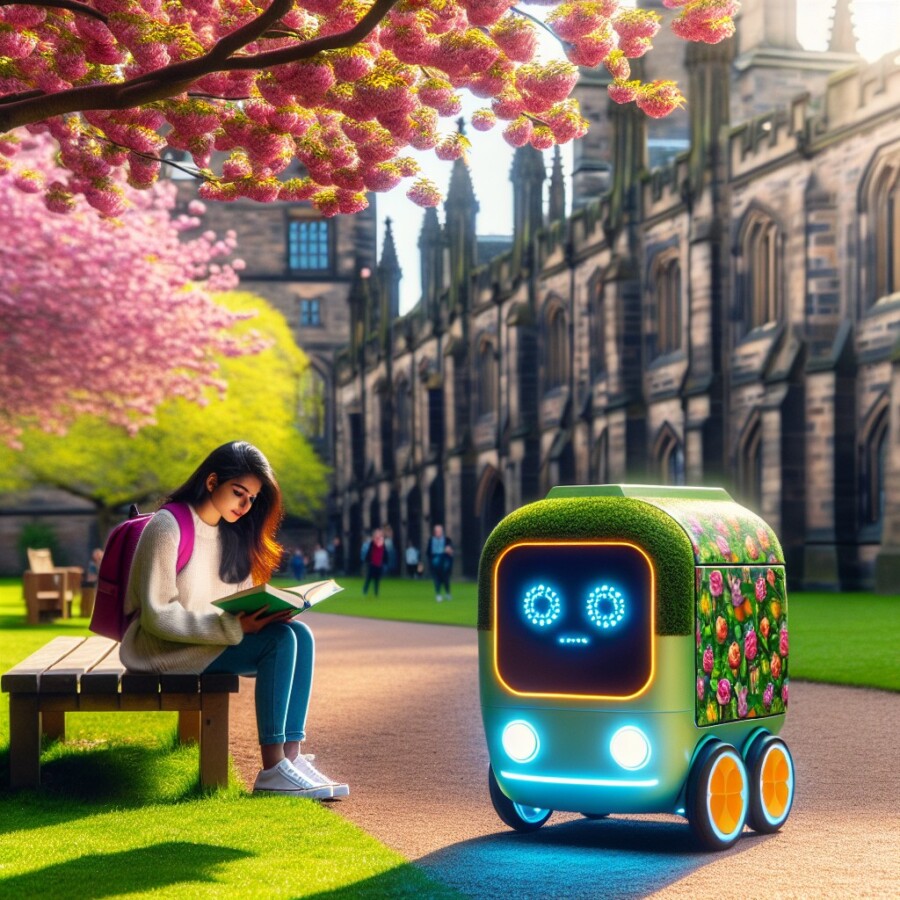
At the University of Edinburgh, there's a new way to get food using robots named Pixie. These robots can move by themselves on special paths in the school and bring food to students who ask for it through an app. The school wants to show how these self-driving robots can be used in different places, like airports or hospitals. They made their own robot to deliver food as part of this project.
More and more, robots are being used to bring food to people, and the University of Edinburgh is trying this out too. With these robots, students can get their food easily without needing a person to bring it. This robot delivery could also work in other places, not just schools, but also in airports and hospitals.
The University of Edinburgh hopes this robot food delivery will show that it's a good idea and can work well. They want to show that Pixie and their own food robot can help make food delivery better in the future. This project could help more places start using robots to deliver food.
Original news source: The robots delivering takeaways to Edinburgh students (BBC)
🎧 Listen:
📖 Vocabulary:
Group or Classroom Activities
Warm-up Activities:
– Charades
Instructions: Divide the class into teams. Give each team a set of vocabulary words related to the article, such as "robot," "food," "delivery," "university," etc. One person from each team will act out a word without speaking, while the rest of their team tries to guess the word within a time limit. The team that guesses the most words correctly wins.
– News Summary
Instructions: Have the students read the article individually or in pairs. Afterward, ask each student to write a summary of the article in their own words. They should include the main idea, key details, and any important vocabulary words. Once they have finished, have them share their summaries with a partner or in small groups.
– Vocabulary Pictionary
Instructions: Write a list of vocabulary words from the article on the board or on separate pieces of paper. Divide the class into pairs. One person from each pair will choose a word and draw a picture to represent that word, while their partner tries to guess the word. The pairs can take turns until all the words have been used.
– Opinion Poll
Instructions: Divide the class into small groups. Give each group a set of discussion questions related to the article, such as "Do you think using robots for food delivery is a good idea? Why or why not?" Each student should take turns answering the questions and explaining their opinions. Afterward, have each group share their opinions with the rest of the class.
– Future Predictions
Instructions: In pairs or small groups, have the students discuss and make predictions about the future of food delivery using robots. They should consider questions such as "How do you think robots could improve food delivery?" and "What challenges might arise from using robots for this purpose?" Afterward, have each group share their predictions with the rest of the class.
🤔 Comprehension Questions:
The robots at the University of Edinburgh are called Pixie.
The robots bring food to the students by moving on special paths in the school and delivering the food to students who ask for it through an app.
The school made their own robot to deliver food as part of a project to show how self-driving robots can be used in different places, like airports or hospitals.
Yes, robots are being used more and more to bring food to people.
These robot deliveries could work in other places like airports and hospitals.
The University of Edinburgh hopes to show that using robots to deliver food is a good idea and can work well.
This project could help other places start using robots to deliver food by showing them how it can be done successfully and efficiently at the University of Edinburgh.
🎧✍️ Listen and Fill in the Gaps:
At the of Edinburgh, there's a new way to get food named Pixie. These robots can move by themselves on special paths in the school and bring food to students who ask for it through an app. The school wants to show how these self-driving robots can be used in different places, like or hospitals. They made their own robot to food as part of this . More and more, robots are being used to bring food to people, and the University of Edinburgh is trying this out too. With these robots, students can get their food easily without a person to it. This robot delivery could also work in other places, not just schools, but also in airports and . The University of Edinburgh hopes this robot food delivery will show that it's a idea and can well. They want to show that Pixie and their own food robot can help make food delivery better in the future. This project could help places start using robots to deliver food.
💬 Discussion Questions:
1. What is a robot?
2. How would you feel if a robot brought you your food?
3. Do you like the idea of using robots to deliver food? Why or why not?
4. Have you ever seen a robot before? What did it look like?
5. How do you think robots can be helpful in places like airports and hospitals?
6. Do you think using robots for food delivery is a good idea? Why or why not?
7. Have you ever used an app to order food? How was your experience?
8. What do you think are the advantages of using robots to deliver food?
9. Would you feel safe if a robot was delivering your food? Why or why not?
10. How do you think robots can make food delivery better in the future?
11. Do you think robots will replace humans in delivering food? Why or why not?
12. Can you think of any other places where robots can be used to deliver things?
Individual Activities
📖💭 Vocabulary Meanings:
Click a dot next to a word, then click the dot next to its meaning to draw a line connecting them.
Words
Meanings
🔡 Multiple Choice Questions:
🕵️ True or False Questions:
📝 Write a Summary:
Write a summary of this news article in two sentences.
Check your writing now with the best free AI for English writing!