

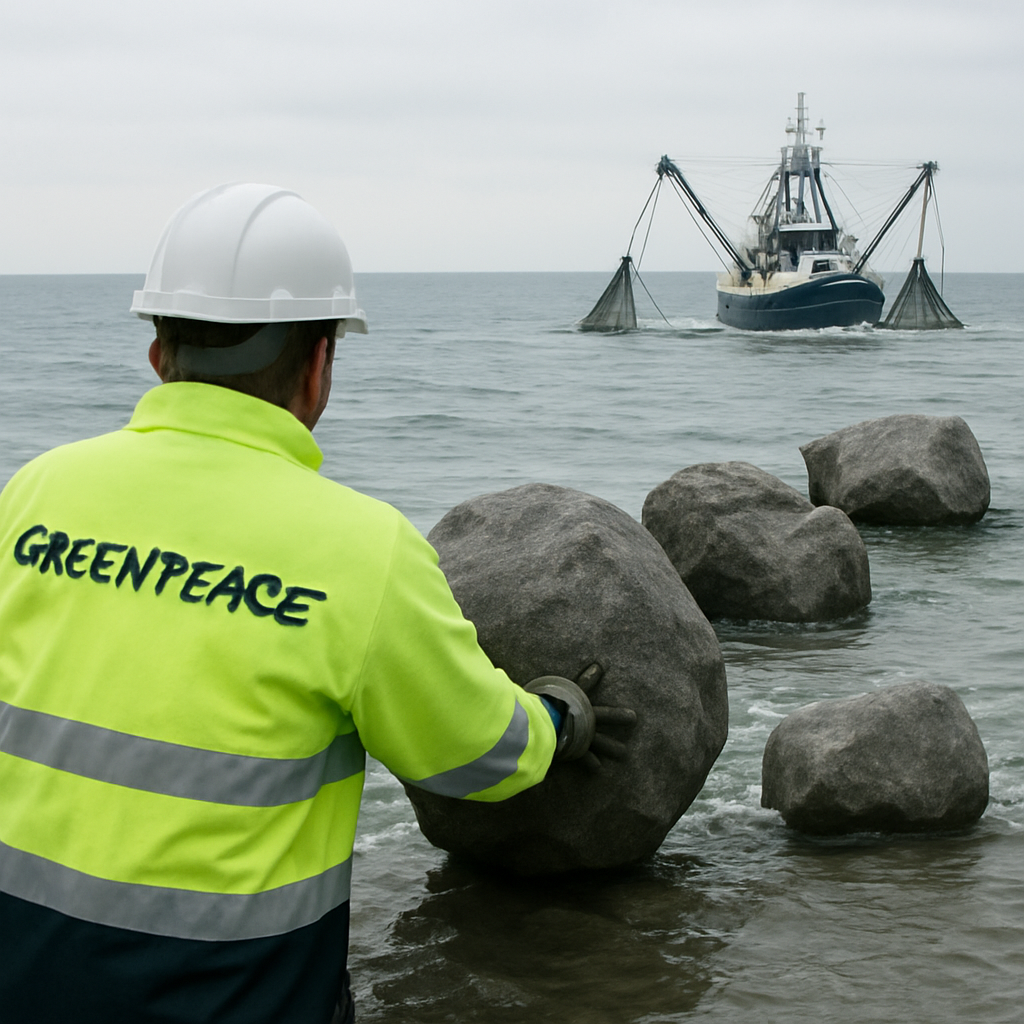
In a bold move against the environmentally damaging practice of bottom trawling, Greenpeace has deployed nine boulders in the Southern North Sea to act as a deterrent for fishing vessels employing this method. Deployed over the weekend by the Arctic Sunrise without official permission, these boulders aim to protect the fragile marine ecosystem by preventing the use of dragging weighted nets across the seabed, a practice known to obliterate underwater habitats.
Greenpeace's latest action underscores their long-standing criticism of the government's sluggishness in enforcing stricter protections for Marine Protected Areas (MPAs). The organization contends that bottom trawling is not only harmful to underwater vegetation but also jeopardizes marine mammals such as porpoises by depleting their prey and creating noise pollution. Despite acknowledging the lack of a permit, Greenpeace insisted that such measures were indispensable, given the government's inadequate response to environmental concerns.
The Department for Environment, Food and Rural Affairs (Defra) reiterated that all marine activities need to be compliant with legislative standards and should prioritize the safety of sea users. However, Greenpeace informed the governing bodies of the exact positions of the boulders to update maritime maps, thus preventing navigation mishaps. This latest incident mirrors Greenpeace's 2022 effort in Cornwall, which also faced regulatory backlash.
Critics, including the Marine Management Organisation (MMO), have denounced this unilateral action by Greenpeace, suggesting it may not ultimately enhance marine protection. Yet, Greenpeace argues that such visible interventions draw attention to the inadequacies in current environmental protections and serve as a catalyst for change.
Greenpeace's approach has ignited a broader conversation about the best methods to safeguard marine life, with this recent stunt illustrating the growing tension between activist initiatives and governmental regulations. They hope that by sparking further debate, there will be momentum toward more rigorous and timely enforcement of protections for marine ecosystems.
Original news source: Greenpeace drops boulders in North Sea fishing grounds off Norfolk – BBC News (BBC)
🎧 Listen:
📖 Vocabulary:
Group or Classroom Activities
Warm-up Activities:
1. Discuss with a partner how Greenpeace's actions could impact local fishermen.
2. Debate the effectiveness of activist interventions in environmental policies.
3. Brainstorm other potential methods to protect marine ecosystems without breaking laws.
4. Consider how government regulations might change due to public awareness campaigns.
5. Share experiences or knowledge about other environmental protests and their outcomes.
🤔 Comprehension Questions:
Greenpeace deployed nine boulders in the Southern North Sea.
Greenpeace criticizes the government's sluggishness in enforcing stricter environmental protections.
It obliterates underwater habitats and jeopardizes marine mammals.
They informed governing bodies of the exact positions to update maritime maps.
Greenpeace conducted a similar boulder deployment in Cornwall in
The Marine Management Organisation criticized it.
It has initiated a conversation about safeguarding marine life methods.
🎧✍️ Listen and Fill in the Gaps:
In a bold move against the damaging practice of bottom trawling, Greenpeace has deployed nine boulders in the Southern North Sea to act as a deterrent for fishing vessels employing this method. Deployed over the weekend by the Arctic Sunrise without official permission, these boulders aim to protect the fragile marine ecosystem by preventing the use of weighted nets across the seabed, a practice known to obliterate underwater habitats. action underscores their long-standing criticism of the government's sluggishness in enforcing stricter protections for Marine Protected Areas (MPAs). The organization contends that bottom trawling is not only harmful to underwater but also jeopardizes mammals such as porpoises by depleting their prey and creating noise pollution. Despite acknowledging the lack of a , Greenpeace insisted that such measures were , given the government's inadequate response to environmental concerns. The Department for Environment, Food and Rural Affairs (Defra) reiterated that all marine activities need to be compliant with standards and should prioritize the safety of sea users. However, Greenpeace informed the governing bodies of the exact positions of the boulders to update maps, thus preventing navigation mishaps. This latest Greenpeace's 2022 effort in Cornwall, which also faced regulatory backlash. Critics, including the Marine Management Organisation (MMO), have denounced this unilateral action by Greenpeace, suggesting it may not ultimately enhance marine protection. Yet, Greenpeace argues that such visible interventions draw attention to the inadequacies in current environmental protections and as a catalyst for change. Greenpeace's approach has a broader about the best methods to safeguard marine life, with this recent stunt illustrating the growing tension between activist initiatives and governmental regulations. They hope that by sparking further debate, there will be momentum toward more rigorous and enforcement of protections for marine ecosystems.
💬 Discussion Questions:
1. Do you think Greenpeace's method of deploying boulders is effective? Why or why not?
2. What are some potential risks of unauthorized environmental actions?
3. How should the government balance activism and regulation?
4. In what ways might bottom trawling affect marine ecosystems?
5. Discuss possible alternative solutions to bottom trawling.
6. What role do NGOs play in environmental protection?
7. Should there be stricter punishments for unauthorized environmental interventions?
8. How does public opinion influence environmental policies?
9. What are the responsibilities of corporations in protecting marine environments?
10. What steps can individuals take to support marine ecosystem conservation?
11. How can government-private partnerships enhance environmental protection?
12. Reflect on a time you changed your behavior to protect the environment.
Individual Activities
📖💭 Vocabulary Meanings:
Click a dot next to a word, then click the dot next to its meaning to draw a line connecting them.