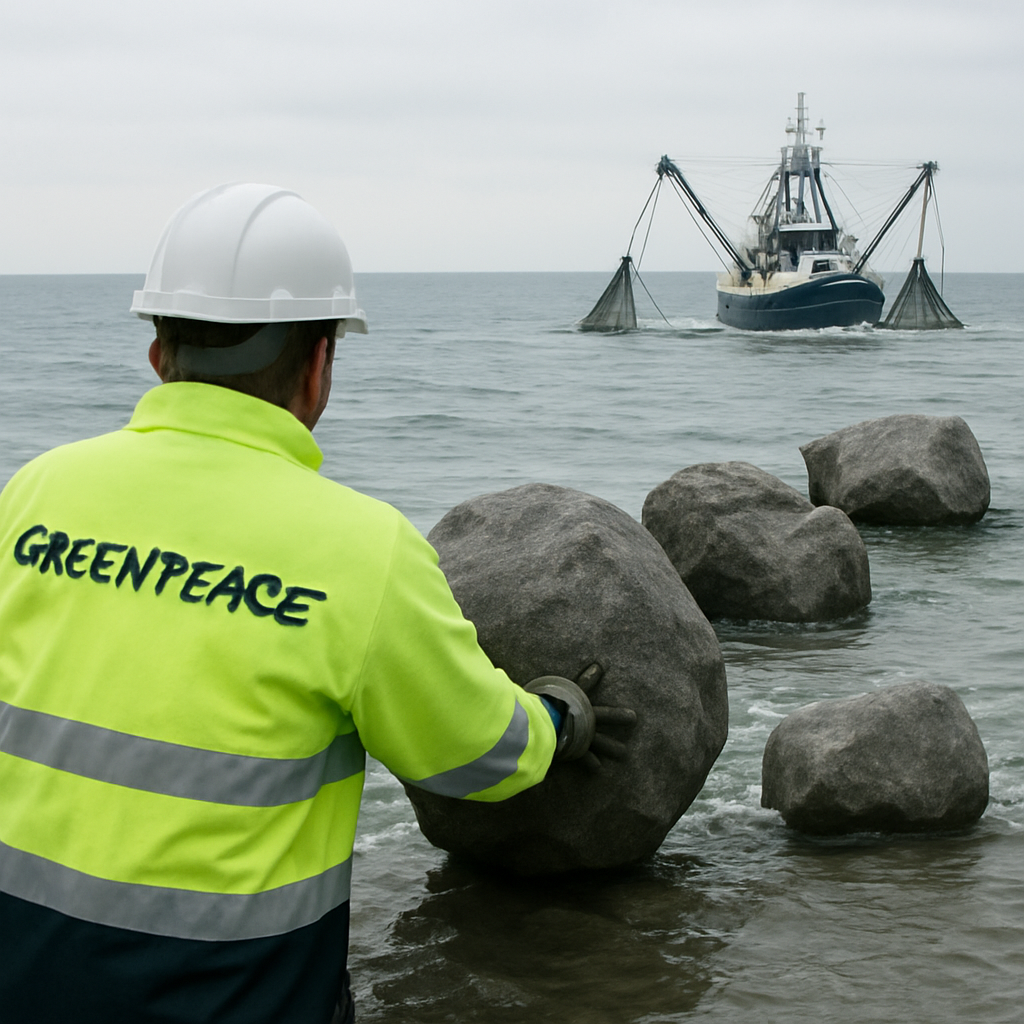
Greenpeace has taken an unusual approach to stop bottom trawling by placing nine boulders in the Southern North Sea. These boulders serve as barriers to prevent fishermen from using weighted nets that damage the seabed. The initiative, led by the Arctic Sunrise ship, happened off the coast of Norfolk, England without official permission.
Bottom trawling significantly harms the marine environment, damaging plants and disrupting the homes of animals like porpoises. Greenpeace argues that protecting Marine Protected Areas (MPAs) from these practices is crucial, pointing out that government action has been too slow.
Even without a permit, Greenpeace insists their actions were necessary for conservation. They sent the locations of the boulders to the authorities to prevent any navigation hazards. However, the Department for Environment, Food and Rural Affairs (Defra) stated that all maritime operations must follow the law.
The Marine Management Organisation (MMO) criticized Greenpeace's method, doubting its success in protecting marine ecosystems. Yet, Greenpeace believes their previous actions, such as rock placements in Cornwall, show the need for more protective steps. They hope this will push officials to take stronger measures to safeguard ocean life.
13. effectivenesssuccess in producing desired results
14. safeguardingkeeping safe from harm
15. protectiveintended to protect
Group or Classroom Activities
Warm-up Activities:
1. Discuss what you know about Greenpeace and its initiatives. 2. Share your opinions on environmental protection methods. 3. Talk about a time you participated in or heard about an environmental protest. 4. Outline the possible effects of bottom trawling on marine life. 5. Explore the reasons why laws and regulations are important for protecting the environment.
🤔 Comprehension Questions:
1. What did Greenpeace do to try and stop bottom trawling?
They dropped nine boulders in the Southern North Sea.
2. Why is bottom trawling considered harmful?
It damages underwater vegetation and disrupts marine animal habitats.
3. Where did Greenpeace place these boulders?
They placed them in the Southern North Sea off the coast of Norfolk, England.
4. Did Greenpeace have a permit for placing the boulders?
No, they placed the boulders without a permit.
5. What have Greenpeace long advocated for?
They have long advocated for the protection of Marine Protected Areas (MPAs).
6. How did Greenpeace prevent accidents with the boulders?
They communicated the coordinates of the boulders to the authorities.
7. What was the MMO's reaction to Greenpeace's actions?
The MMO expressed disappointment and questioned the actions' effectiveness.
🎧✍️ Listen and Fill in the Gaps:
Greenpeace has taken an unusual approach to stop bottom trawling by placing nine boulders in the Southern North Sea. These boulders as to prevent fishermen from using weighted nets that the seabed. The initiative, led by the Arctic Sunrise ship, off the coast of Norfolk, without official permission. Bottom significantly harms the marine environment, damaging plants and disrupting the of animals like porpoises. argues that protecting Marine Protected Areas (MPAs) from these practices is crucial, pointing out that government action has been too slow. Even without a permit, Greenpeace insists their were necessary for conservation. They sent the of the boulders to the authorities to prevent any navigation hazards. However, the Department for Environment, Food and Rural Affairs (Defra) stated that all maritime must the law. The Marine Management Organisation (MMO) criticized Greenpeace's method, its in protecting marine ecosystems. Yet, Greenpeace believes their previous actions, such as rock in Cornwall, show the need for more protective steps. They hope this will push officials to take measures to safeguard ocean life.
💬 Discussion Questions:
1. How effective do you think Greenpeace's boulder strategy is in protecting marine life? 2. Is it ever acceptable to break the law for environmental causes? 3. What alternative methods could be used to protect the seabed? 4. How can governments balance economic interests with environmental protection? 5. What role should non-governmental organizations play in environmental conservation? 6. Have you ever heard of other environmental actions that surprised you? What were they? 7. In your opinion, how can awareness about marine protection be increased? 8. How important is it for youth to be involved in environmental issues? 9. How should authorities respond to unauthorized actions that aim to protect the environment? 10. Can large-scale environmental changes be achieved without the involvement of governments? 11. What environmental issues are most urgent in your country? 12. How do you think environmental education should be implemented in schools?
Individual Activities
📖💭 Vocabulary Meanings:
Click a dot next to a word, then click the dot next to its meaning to draw a line connecting them.
Words
1. destructive
2. permit
3. barrier
4. deploying
5. ecosystem
6. vegetation
7. habitats
8. advocated
9. license
10. coordinates
11. maritime
12. disappointment
13. effectiveness
14. safeguarding
15. protective
Meanings
(A) relating to the sea
(B) keeping safe from harm
(C) geographical positions
(D) community of living organisms
(E) success in producing desired results
(F) publicly supported
(G) placing into use or action
(H) plant life
(I) official permission
(J) formal authorization
(K) intended to protect
(L) natural environments for living things
(M) feeling let down
(N) structure preventing access
(O) causing harm or damage
🔡 Multiple Choice Questions:
1. What action did Greenpeace take to combat bottom trawling?
(a) Petitioned the government
(b) Organized a protest
(c) Dropped boulders in the sea
(d) Sent letters to fishermen
2. Why did Greenpeace place boulders in the sea?
(a) To scare away fish
(b) To test new equipment
(c) To build an underwater park
(d) To create a physical barrier for fishing nets
3. What is bottom trawling?
(a) A coral protection method
(b) A type of scuba diving
(c) Fishing with weighted nets along the seabed
(d) A marine plant cultivation technique
4. What has Greenpeace long advocated for?
(a) Protection of Marine Protected Areas
(b) Increased fishing rights
(c) Open sea exploration
(d) Building underwater cities
5. How did Greenpeace communicate the boulders' locations?
(a) Broadcasted on the radio
(b) Wrote in the newspaper
(c) Marked with buoys
(d) Sent coordinates to authorities
6. What was Defra's response to Greenpeace's action?
(a) Total support
(b) All activities must be lawful
(c) Financial backing
(d) Complete indifference
7. What prior action did Greenpeace take similar to the boulders in the North Sea?
(a) Dropping rocks in Cornwall
(b) Building a new ship
(c) Creating documentaries
(d) Launching protests
8. What does Greenpeace hope their actions will achieve?
(a) More media attention
(b) Stronger government protections for sea life
(c) Financial donations
(d) Increased tourism
🕵️ True or False Questions:
1. The Arctic Sunrise ship abandoned the boulder placement.
2. The boulders were placed without a permit.
3. Bottom trawling harms underwater ecosystems.
4. Greenpeace communicated boulder coordinates to authorities.
5. Greenpeace has long supported Marine Protected Areas.
6. Greenpeace acted with a formal license.
7. The MMO praised Greenpeace's actions' effectiveness.
8. Greenpeace removed boulders from the Southern North Sea.
Writing Questions:
✍️ Write and get instant corrections · 0/5
1. Write about the importance of Marine Protected Areas.Free · instant corrections
2. Discuss the ethical implications of taking direct action for environmental causes.Free · instant corrections
3. Describe an effective solution you would propose for marine conservation.Free · instant corrections
4. Analyze the relationship between governmental policies and environmental protection.Free · instant corrections
5. Explain how community awareness can influence marine conservation efforts.Free · instant corrections
Pakistan’s Wakhi shepherdesses, who have played a crucial role in their community by grazing their flocks in remote mountain pastures, are facing the extinction of their way of life.
Daylesford Organic has issued a recall for some of its crispbreads and biscuits due to potential contamination with moth larvae, highlighting the importance of rigorous quality control measures in the food industry.