
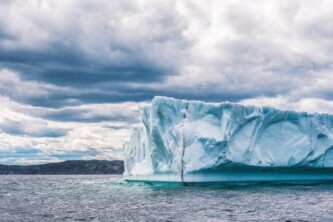
A23a is not only impressive in size but also in thickness. It measures about 400m thick, compared to the height of the London Shard, which is only 310m tall. This iceberg was part of a large group of icebergs that broke away from the Filchner Ice Shelf in Antarctica. It was hosting a Soviet research station at the time, which shows how long ago it broke away. Despite an expedition being sent to remove equipment from the research station, A23a remained anchored to the ocean floor.
The reason why A23a is finally on the move after almost 40 years is still unclear. Some experts speculate that it may be due to changes in water temperatures, while others believe that it was simply a matter of time. Dr. Andrew Fleming, a remote sensing expert from the British Antarctic Survey, observed the first movement of A23a in 2020. In recent months, it has been driven by winds and currents and is now passing the northern tip of the Antarctic Peninsula.
Once A23a enters the Antarctic Circumpolar Current, it will be thrown towards the South Atlantic on a path known as "iceberg alley." This is the same route that the famous explorer Sir Ernest Shackleton used in 1916 to escape from Antarctica after his ship was crushed by sea ice. If A23a grounds at South Georgia, it could disrupt the normal foraging routes of seals, penguins, and other seabirds that breed on the island. However, it is important to note that icebergs play a crucial role in the environment. As they melt, they release mineral dust that provides nutrients for organisms at the base of the ocean food chain.
Scientists will closely monitor the progress of A23a and study its impact on the surrounding ecosystem. Despite the potential risks, icebergs are not just objects of danger but also contribute to the biological activity of the ocean.
Original news source: A23a: World's biggest iceberg on the move after 30 years (BBC)
📖 Vocabulary:
Group or Classroom Activities
Warm-up Activities:
– News Summary
Instructions: Divide the class into pairs or small groups. Give each group a few minutes to read the article. Then, ask each group to write a summary of the article, highlighting the main points and key information. After they finish, have each group share their summary with the rest of the class.
– Opinion Poll
Instructions: Divide the class into pairs or small groups. Ask each group to come up with a question related to the article. It could be something like, "Do you think A23a will have a negative impact on the ecosystem?" or "Should measures be taken to prevent icebergs from drifting into certain areas?" Then, have each group conduct an opinion poll among the class, asking for their classmates' opinions on the question. After gathering the results, have each group present their findings and lead a class discussion on the topic.
– Sketch It
Instructions: Give each student a blank piece of paper and ask them to draw a sketch or illustration related to the article. It could be a depiction of A23a, the Antarctic landscape, or any other relevant aspect. After they finish, have each student share their sketch with a partner or small group. Each student should explain their drawing and discuss the significance of their chosen subject in relation to the article.
– Vocabulary Pictionary
Instructions: Write a list of vocabulary words from the article on the board. Divide the class into two teams. Call one student from each team to the front of the class. Show them a vocabulary word from the list (without letting the rest of the class see). The students must then draw a picture to represent the word while their team members try to guess what it is. The team that guesses correctly gets a point. Continue with different students and words until all the vocabulary words have been used.
– Future Predictions
Instructions: Ask the students to work individually or in pairs and make predictions about what might happen next with A23a. They can consider factors such as its movement, impact on the ecosystem, or any other relevant aspect. After they finish, have each student or pair share their predictions with the class. Encourage them to support their predictions with evidence or reasoning from the article.
🤔 Comprehension Questions:
🎧✍️ Listen and Fill in the Gaps:
The world's largest iceberg, as A23a, is finally on the move after being stuck to the ocean floor for over 30 years. This iceberg away from the Antarctic coastline in 1986 but quickly became grounded in the Sea, essentially becoming an ice island. With an area of almost 4,000 sq km, it is more than twice the size of Greater London. Over the past year, it has started drifting at a fast pace and is now about to move beyond Antarctic waters. A23a is not only impressive in size but also in thickness. It measures about 400m thick, compared to the height of the London Shard, which is only 310m tall. This iceberg was part of a large group of icebergs that broke away from the Filchner Ice Shelf in . It was a Soviet research at the time, which shows how long ago it broke away. Despite an being sent to remove equipment from the research station, A23a remained anchored to the ocean floor. The reason why A23a is finally on the move after almost 40 years is still unclear. Some experts speculate that it may be due to changes in water temperatures, while others believe that it was simply a matter of time. Dr. Andrew Fleming, a remote sensing expert from the British Antarctic Survey, observed the first of A23a in 2020. In recent months, it has been driven by winds and currents and is now passing the northern tip of the Antarctic Peninsula. Once A23a enters the Antarctic Circumpolar Current, it will be towards the South Atlantic on a path known as "iceberg alley." This is the same route that the famous explorer Sir Ernest used in 1916 to escape from Antarctica after his ship was by sea ice. If A23a grounds at South Georgia, it could disrupt the normal foraging routes of seals, penguins, and other that breed on the island. However, it is important to note that icebergs play a crucial role in the . As they melt, they release dust that provides nutrients for organisms at the base of the ocean food chain. Scientists will closely monitor the progress of A23a and study its on the surrounding ecosystem. Despite the potential risks, icebergs are not just objects of danger but also contribute to the biological activity of the ocean.
💬 Discussion Questions:
1. What is an iceberg and how are they formed?
2. How would you feel if you saw an iceberg in person? Why?
3. Do you think it's important for scientists to study the movement of icebergs? Why or why not?
4. Have you ever witnessed any extreme natural events? If so, how did it make you feel?
5. What do you think would happen if A23a grounds at South Georgia? How might it impact the ecosystem there?
6. Do you think it's necessary to remove icebergs from certain areas to protect wildlife? Why or why not?
7. Have you ever experienced a change in temperature or climate in your area? How did it affect you and your surroundings?
8. What do you think would happen if all the icebergs melted? How might it impact the planet?
9. How do you think the movement of icebergs can affect ocean currents and weather patterns?
10. Do you think it's possible for humans to prevent icebergs from breaking away and drifting? Why or why not?
11. What are some potential dangers or risks associated with icebergs?
12. How do you think icebergs contribute to the biodiversity of the ocean?
13. Have you ever seen any documentaries or movies about icebergs? If so, what did you learn from them?
14. Do you think it's important for countries to cooperate in monitoring and studying icebergs? Why or why not?
15. How do you think the movement of icebergs can impact shipping and navigation in the ocean?
Individual Activities
📖💭 Vocabulary Meanings:
Click a dot next to a word, then click the dot next to its meaning to draw a line connecting them.
Words
Meanings
🔡 Multiple Choice Questions:
🕵️ True or False Questions:
📝 Write a Summary:
Write a summary of this news article in two sentences.
Check your writing now with the best free AI for English writing!