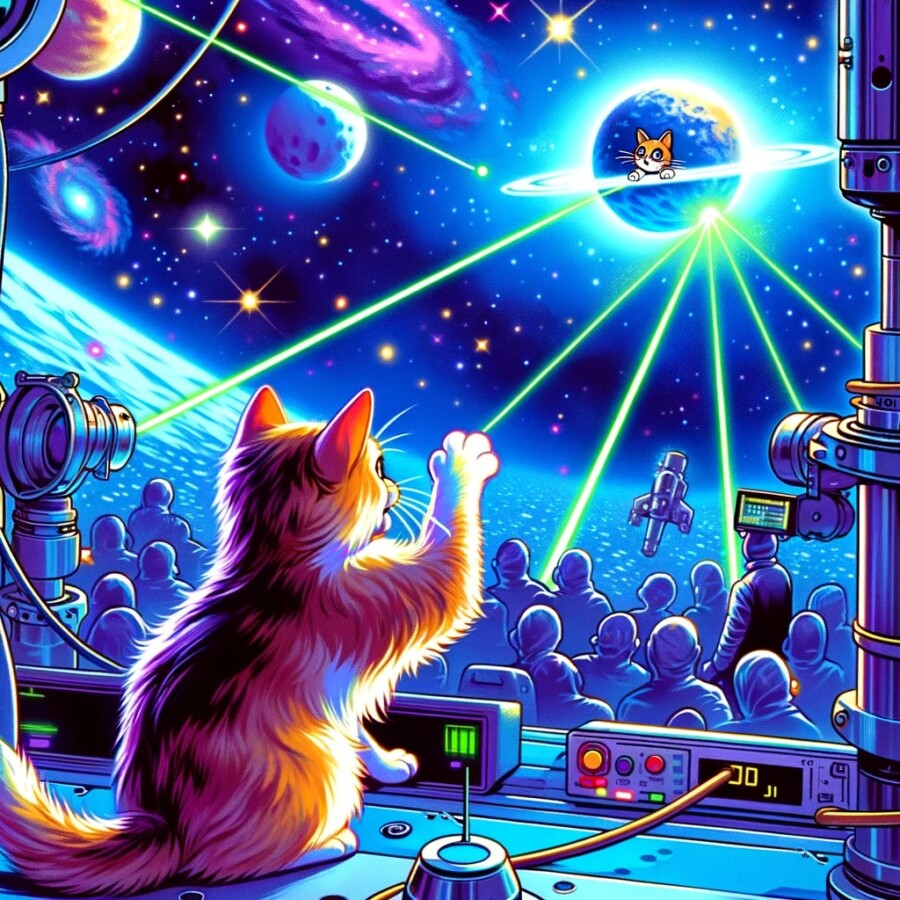
Nasa recently achieved a remarkable feat by streaming a high-definition video of a cat from deep space back to Earth. The 15-second clip featured Taters the cat, who was seen chasing a laser beam. The footage traveled an astonishing distance of 19 million miles, which is about 80 times the distance from Earth to the Moon. Nasa conducted this experiment to test laser technology that could potentially improve communication with remote parts of the solar system. Taters, the star of the video, belongs to an employee of Nasa's Jet Propulsion Laboratory in California. The video was uploaded to a spacecraft launched by SpaceX's Falcon Heavy rocket and was streamed on 11 December.
Despite the vast distance, the video was transmitted faster than most broadband internet connections. It was received by the Hale telescope at the Palomar observatory and then downloaded. From there, it was streamed to the JPL and played in real-time. The connection between the observatory and the JPL base was actually slower than the signal transmitting the video from space. Nasa's DesignLab played a crucial role in showcasing this technology, and the success of the experiment was celebrated by everyone involved.
The video, which can be found on YouTube, was designed to be memorable by overlaying technical mission information and details about Taters, such as breed, heart rate, and age. This demonstration project is part of Nasa's Deep Space Optical Communications (DSOC) mission, which aims to explore communication beyond the Earth-Moon range. The DSOC mission is investigating technologies that can deliver higher bandwidth content from deep space to Earth. Radio frequencies struggle to handle the vast amount of data required to transmit high-quality images and videos over long distances. Nasa's commitment to advancing optical communications is driven by the need to increase bandwidth to achieve future exploration and science goals.
Nasa's achievement in beaming a cat video from deep space using laser technology marks a significant milestone in space communication. This breakthrough has the potential to revolutionize how we communicate during interplanetary missions and meet the increasing data transmission needs of future space exploration. By pushing the boundaries of optical communications, Nasa is paving the way for more efficient and effective communication with remote parts of the solar system.
Original news source: Nasa beams cat video from deep space with laser (BBC)
🎧 Listen:
📖 Vocabulary:
Group or Classroom Activities
Warm-up Activities:
– News Summary
Instructions: In pairs or small groups, have students read the article and summarize the key points in their own words. They can then share their summaries with the class and compare their understanding of the article.
– Opinion Poll
Instructions: Divide the class into groups and have each group discuss and debate the following question: "Do you think Nasa's achievement in streaming a cat video from deep space is a significant milestone in space communication? Why or why not?" After the discussion, each group can present their opinions and the class can vote on which argument they find most convincing.
– Word Association
Instructions: Write the word "communication" on the board and have students brainstorm as many related words or phrases as they can in one minute. After the minute is up, go around the class and have each student share one word or phrase from their list. Encourage them to explain the connection between their word and the topic of communication.
– Sketch It
Instructions: Give each student a piece of paper and ask them to draw a visual representation of Nasa's achievement in streaming a cat video from deep space. They can use symbols, images, or diagrams to convey the main idea of the article. After they have finished, have students share their drawings with a partner and explain their artistic choices.
– Pros and Cons
Instructions: Divide the class into two groups and assign one group to discuss the pros of Nasa's achievement in streaming a cat video from deep space, and the other group to discuss the cons. After the discussion, each group can present their arguments to the class and engage in a debate. Encourage students to use evidence from the article to support their points.
🤔 Comprehension Questions:
🎧✍️ Listen and Fill in the Gaps:
Nasa recently achieved a remarkable feat by streaming a high-definition video of a cat from deep space back to Earth. The 15-second clip featured the cat, who was seen chasing a laser beam. The footage traveled an astonishing distance of 19 million miles, which is about 80 times the distance from Earth to the Moon. Nasa this experiment to test laser that could potentially communication with remote parts of the solar system. Taters, the star of the video, belongs to an employee of Nasa's Jet Propulsion Laboratory in California. The video was uploaded to a spacecraft launched by SpaceX's Falcon Heavy rocket and was streamed on 11 December. Despite the vast distance, the video was faster than most broadband internet connections. It was received by the Hale telescope at the Palomar observatory and then downloaded. From there, it was streamed to the JPL and played in real-time. The connection between the observatory and the JPL base was actually than the signal transmitting the video from space. Nasa's DesignLab played a crucial role in showcasing this technology, and the of the experiment was celebrated by everyone . The video, which can be found on YouTube, was designed to be memorable by overlaying technical mission information and details about Taters, such as breed, heart rate, and age. This demonstration project is part of Nasa's Deep Space Optical Communications (DSOC) mission, which aims to explore communication beyond the -Moon range. The DSOC mission is technologies that can deliver higher bandwidth content from deep space to Earth. Radio frequencies struggle to handle the vast amount of data required to high-quality and videos over long distances. Nasa's commitment to advancing optical communications is driven by the need to increase bandwidth to achieve future and science goals. Nasa's achievement in beaming a cat from deep space laser technology marks a significant milestone in space communication. This has the potential to revolutionize how we communicate during interplanetary missions and meet the increasing data transmission needs of future space exploration. By pushing the boundaries of optical communications, Nasa is paving the way for more efficient and effective communication with remote parts of the solar system.
💬 Discussion Questions:
1. What do you think about Nasa's achievement in streaming a cat video from deep space?
2. How would you feel if you were able to communicate with remote parts of the solar system using laser technology?
3. Do you think it is important for Nasa to explore communication beyond the Earth-Moon range? Why or why not?
4. What is the significance of Nasa's achievement in terms of future space exploration?
5. How do you think advancements in optical communications could benefit interplanetary missions?
6. Do you think it is necessary for Nasa to increase bandwidth for future exploration and science goals? Why or why not?
7. Have you ever used laser technology for communication? If so, what was your experience like?
8. How do you think the ability to transmit high-quality images and videos over long distances could impact our understanding of the universe?
9. What other applications do you think laser technology could have in space exploration?
10. Do you think the success of this experiment will lead to more funding and support for Nasa's Deep Space Optical Communications mission? Why or why not?
11. How do you think this breakthrough in space communication could inspire future generations of scientists and engineers?
12. What challenges do you think Nasa might face in implementing laser technology for communication in deep space?
13. Do you think it is important for Nasa to continue pushing the boundaries of optical communications? Why or why not?
14. How do you think this achievement will impact the public's perception of Nasa and space exploration?
15. Have you ever witnessed or experienced a technological breakthrough that had a significant impact on a particular field? If so, can you share your experience?
Individual Activities
📖💭 Vocabulary Meanings:
Click a dot next to a word, then click the dot next to its meaning to draw a line connecting them.
Words
Meanings
🔡 Multiple Choice Questions:
🕵️ True or False Questions:
📝 Write a Summary:
Write a summary of this news article in two sentences.
Check your writing now with the best free AI for English writing!