
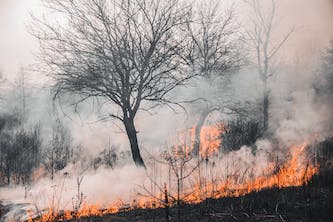
Canada experienced an unprecedented fire season this year, with over 6,500 fires burning approximately 18 million hectares of forest and land. Smoke from these fires traveled to major cities in Canada and the US, as well as across the Atlantic to Spain and Portugal. The majority of fires in the northern forests were ignited by lightning strikes. A new global map developed using machine learning tools revealed that 77% of burned areas in these forests are linked to lightning ignitions, unlike tropical regions where human activity is the primary cause of fires.
The study also predicts that the frequency of lightning strikes in intact northern forests could increase by 11-31% for every degree of global warming, posing a threat of increased carbon emissions. These extratropical forests, often located in permafrost regions, are vulnerable to the combined effects of a warmer, drier climate and a heightened likelihood of ignitions by lightning strikes. While fires in tropical forests can be managed through education and intervention programs, preventing lightning-induced fires is far more challenging.
The researchers emphasize the need for significant reductions in warming gas emissions to limit the rise in lightning strikes. They warn that the unprecedented fire season in Canada should serve as a wake-up call, urging action to address the growing threat of wildfires in the planet's cooling forests. Despite the challenges, experts believe it is not too late to make a change and that forest fires should be seen as a warning rather than a reason for inaction.
Original news source: Lightning fires threaten planet-cooling forests (BBC)
📖 Vocabulary:
Group or Classroom Activities
Warm-up Activities:
– News Summary
Instructions: Students will work in small groups to summarize the article, focusing on the main points: the correlation between climate change and an increase in lightning strikes, the impact of wildfires on carbon emissions, and the significance of the recent study's findings. Each group will have three minutes to present their summary to the class.
– Opinion Poll
Instructions: Conduct an opinion poll in the classroom where each student must choose a position on the following statement: "Significant reductions in warming gas emissions can effectively limit the rise in lightning-induced wildfires." Students will then discuss their positions in pairs or small groups, providing arguments to support their opinions, and share a summary of their discussion with the class.
– Mind Map
Instructions: Individually or in pairs, students will create a mind map on a large sheet of paper, visually organizing the key concepts and data from the article, such as "lightning strikes," "carbon emissions," "wildfires," "climate change," and so on. After completing their mind maps, students will present them to the class and explain the connections they have made.
– Future Predictions
Instructions: Students will write a short paragraph predicting the future of forest management in the context of climate change and increased wildfires, based on information from the article. They will share their predictions with a partner and discuss the likelihood and potential implications of these scenarios.
– Synonym Challenge
Instructions: Divide the students into pairs and provide each pair with a list of keywords from the article (e.g., unprecedented, mitigate, vulnerable, ignitions, emissions). Pairs will then have a set amount of time to come up with as many synonyms as possible for each keyword. Afterward, they'll share their synonyms with the class, and the class will discuss the nuances of each synonym in the context of the article.
🤔 Comprehension Questions:
The article discusses the potential increase in lightning strikes in the forests of the northern hemisphere due to climate change, leading to a higher risk of wildfires.
The forests in the northern hemisphere capture carbon emissions, playing a crucial role in mitigating climate change.
The fires caused by lightning strikes release carbon dioxide into the atmosphere, contributing to a cycle of more frequent storms and lightning, and exacerbating climate change.
Globally, the overall number of fires has decreased over the last two decades, but heavily forested areas outside the tropics have seen a significant increase in wildfires.
Canada experienced over 6,500 fires during its unprecedented fire season, burning approximately 18 million hectares of forest and land.
The new global map indicates that 77% of burned areas in northern forests are linked to lightning ignitions.
The predicted increase in the frequency of lightning strikes is 11-31% for every degree of global warming, posing a threat of increased carbon emissions from extratropical forests, which are vulnerable to warmer, drier climates and heightened likelihood of ignitions by lightning strikes.
Researchers suggest that significant reductions in warming gas emissions are necessary to limit the rise in lightning strikes. They argue that forest fires should be seen as a warning to take action against the growing threat of wildfires in the planet's cooling forests, rather than a reason for inaction.
🎧✍️ Listen and Fill in the Gaps:
A recent suggests that climate change may lead to an increase in strikes in the of the northern hemisphere, which could in turn raise the risk of wildfires. The forests in these regions play a crucial role in mitigating climate change by capturing carbon emissions. However, the fires caused by lightning strikes release carbon dioxide, contributing to a cycle of more frequent storms and lightning. While the overall number of fires has decreased globally over the last two decades, heavily areas outside the tropics have seen a increase in wildfires. Canada experienced an unprecedented fire season this year, with over 6,500 fires burning approximately 18 million hectares of forest and land. Smoke from these fires traveled to major in Canada and the US, as well as across the Atlantic to Spain and . The majority of fires in the northern forests were ignited by lightning strikes. A new global map developed using learning tools revealed that 77% of burned areas in these forests are linked to lightning ignitions, unlike tropical regions where human activity is the primary cause of . The study also predicts that the frequency of lightning strikes in intact northern forests could by 11-31% for every degree of global warming, posing a threat of increased carbon emissions. These extratropical forests, often located in permafrost regions, are vulnerable to the combined effects of a warmer, drier climate and a heightened likelihood of by lightning strikes. While fires in tropical forests can be managed through and intervention programs, preventing lightning-induced fires is far more challenging. The researchers the need for significant reductions in warming gas emissions to limit the rise in lightning strikes. They warn that the fire season in Canada should serve as a wake-up call, action to address the growing threat of in the planet's cooling forests. Despite the challenges, experts believe it is not too late to make a change and that forest fires should be seen as a warning rather than a reason for inaction.
💬 Discussion Questions:
1. What is your opinion on the link between climate change and an increase in lightning strikes?
2. How would you feel if your local forests were at a higher risk of wildfires due to climate change?
3. Do you think your government is doing enough to combat the effects of climate change on forest fires? Why or why not?
4. What are some ways you believe communities can prepare for the increased risk of wildfires?
5. How do you think the rise in wildfires could affect wildlife and biodiversity in forested areas?
6. Do you think the media is giving enough attention to the issue of wildfires and climate change? Why or why not?
7. What is your stance on the use of machine learning tools to predict and manage natural disasters like wildfires?
8. How would you propose educating people about the risks of wildfires in areas not typically affected by them?
9. Do you like the idea of international cooperation to address the issue of wildfires? Why or why not?
10. Do you think that wildfires should be seen as a warning sign for action against climate change, as the article suggests?
11. What is your experience with air quality issues resulting from distant wildfires, if any?
12. How do you think the increase in wildfires will impact future generations?
13. Do you think that current intervention programs in tropical forests are effective? What could be improved?
14. How do you feel about the potential for forest fires to release more carbon dioxide, further contributing to climate change?
15. What do you think are the biggest challenges in preventing lightning-induced fires in northern forests?
Individual Activities
📖💭 Vocabulary Meanings:
Click a dot next to a word, then click the dot next to its meaning to draw a line connecting them.
Words
Meanings
🔡 Multiple Choice Questions:
🕵️ True or False Questions:
📝 Write a Summary:
Write a summary of this news article in two sentences.
Check your writing now with the best free AI for English writing!