
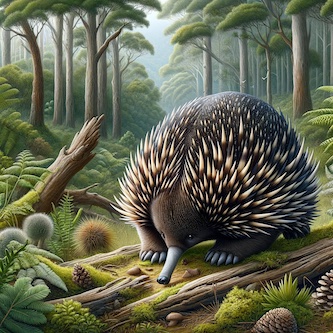
The Attenborough echidna, along with the western echidna, is considered critically endangered, and previous expeditions had uncovered signs of its existence in the Cyclops Mountains. However, accessing the remotest reaches of the mountains to provide definitive proof of their existence had been challenging. The rediscovery of the echidna and other new species in the region highlights the need for conservation efforts in the Cyclops Mountains, as the area is not currently protected despite its biodiversity.
The treacherous terrain of the Cyclops Mountains, with steep cliffs, venomous animals, and frequent earthquakes, made the expedition challenging. Despite the difficulties, the scientists were able to confirm the existence of several dozen new insect species and discovered an entirely new type of tree-dwelling shrimp and a previously unknown cave system. The team worked closely with local villages, respecting the sacred areas and traditions of the land, and hopes that the rediscovery of the echidna will aid in building the case for conservation in the region.
The elusiveness of the Attenborough echidna has played a role in local conflict resolution, with disputes between community members being resolved symbolically by finding an echidna and a marlin. The rediscovery of this species and the other new findings emphasize the importance of protecting the Cyclops Mountains and its unique biodiversity. The expedition team believes that the Attenborough long-beaked echidna serves as a symbol of the need to protect and conserve the region to ensure the discovery and preservation of its diverse wildlife.
Original news source: First-ever images prove 'lost echidna' not extinct (BBC)
📖 Vocabulary:
Group or Classroom Activities
Warm-up Activities:
– News Summary
Instructions: Students are tasked with summarizing the article in under two minutes, capturing all the key points: the discovery of the Attenborough's long-beaked echidna, the significance of the discovery, the biodiversity of the Cyclops Mountains, the challenges faced during the expedition, and the implications for conservation efforts.
– Opinion Spectrum
Instructions: Lay out a spectrum in the classroom representing different opinions on biodiversity conservation. At one end, place 'Not important at all' and at the other 'Extremely important'. Read out different statements related to the article and conservation, and have students physically place themselves along the spectrum according to their opinion. Then ask volunteers to explain their stance.
– Sketch It
Instructions: Divide students into small groups. Assign each group a different element from the article (e.g., the Attenborough's long-beaked echidna, the Cyclops Mountains, new species found, etc.). Each group must create a quick sketch that represents their assigned element. Afterward, they present their picture to the class and explain how it relates to the article.
– Keyword Taboo
Instructions: Write down key terms from the article (e.g., echidna, biodiversity, conservation, Cyclops Mountains, etc.). Students take turns picking a word and describing it to their peers without using the word itself or five additional taboo words you've pre-selected.
– Future Predictions
Instructions: Students discuss and write down their predictions about the future implications of the discovery mentioned in the article. They should consider the environmental, scientific, and cultural impacts. Afterward, have students share their predictions with the class and discuss the likelihood and potential consequences of these outcomes.
🤔 Comprehension Questions:
The Attenborough's long-beaked echidna was rediscovered by the Oxford University researchers in Indonesia.
The Attenborough's long-beaked echidna is named after Sir David Attenborough.
During their expedition, the research team found new species of insects and frogs, healthy populations of tree kangaroos, and birds of paradise.
The Attenborough echidna is considered critically endangered because it had only been known from a decades-old museum specimen prior to this discovery.
The researchers faced challenges such as steep cliffs, venomous animals, and frequent earthquakes while accessing the remotest parts of the Cyclops Mountains.
The scientists confirmed the existence of several dozen new insect species during their expedition.
The expedition team worked closely with local villages by respecting the sacred areas and traditions of the land.
The Attenborough echidna has played a role in local conflict resolution, with disputes between community members being resolved symbolically by finding an echidna and a marlin.
🎧✍️ Listen and Fill in the Gaps:
A recent expedition led by Oxford researchers in Indonesia has provided the first-ever footage of the Attenborough's long-beaked echidna, dispelling fears that the species was . The discovery of this egg-laying mammal, named after Sir David Attenborough, is significant as it had only been known from a decades-old museum specimen. The team also found new species of insects and frogs, as well as populations of tree kangaroos and birds of paradise during the month-long expedition in the Cyclops Mountains. The Attenborough , along with the western echidna, is considered critically endangered, and previous had uncovered signs of its existence in the Cyclops Mountains. However, accessing the reaches of the mountains to provide definitive proof of their existence had been challenging. The rediscovery of the echidna and new species in the region highlights the need for conservation efforts in the Cyclops Mountains, as the area is not currently protected despite its biodiversity. The treacherous terrain of the Cyclops Mountains, with steep cliffs, animals, and frequent earthquakes, made the expedition challenging. Despite the difficulties, the scientists were able to confirm the existence of several dozen new insect species and discovered an entirely new type of tree-dwelling and a previously unknown cave system. The team worked closely with local villages, the sacred areas and traditions of the land, and hopes that the of the echidna will aid in building the case for conservation in the region. The elusiveness of the Attenborough echidna has played a role in local conflict resolution, with disputes between community members being resolved symbolically by finding an echidna and a . The rediscovery of this species and the other new findings emphasize the importance of ing the Cyclops Mountains and its biodiversity. The expedition team that the Attenborough long-beaked echidna serves as a symbol of the need to protect and conserve the region to ensure the discovery and preservation of its diverse wildlife.
💬 Discussion Questions:
1. What is your opinion on the importance of discovering new species in remote areas like the Cyclops Mountains?
2. How would you feel if a species thought to be extinct was found in a region near you?
3. Do you think it's important to name newly discovered species after famous people? Why or why not?
4. What are some challenges you think scientists might face when conducting expeditions in treacherous terrains?
5. How do you believe local communities can benefit from scientific expeditions in their area?
6. Do you think the discovery of new species should influence the creation of protected areas? Why or why not?
7. What is your stance on balancing scientific exploration with respect for indigenous traditions and sacred lands?
8. How would you react if you learned that a creature from your local folklore was actually a real animal?
9. Do you like the idea of using wildlife as symbols for conservation efforts? Why or why not?
10. Do you think international collaboration is important in conservation efforts? Why or why not?
11. What is your perspective on the role of biodiversity in resolving local conflicts?
12. How do you feel about the use of modern technology to discover and document new species?
13. Do you believe that the discovery of new species can significantly change our understanding of an ecosystem?
14. How do you think conservation efforts should be prioritized when funding is limited?
15. Do you think that the rediscovery of species like the Attenborough echidna gives hope for other species considered extinct? Why or why not?
Individual Activities
📖💭 Vocabulary Meanings:
Click a dot next to a word, then click the dot next to its meaning to draw a line connecting them.
Words
Meanings
🔡 Multiple Choice Questions:
🕵️ True or False Questions:
📝 Write a Summary:
Write a summary of this news article in two sentences.
Check your writing now with the best free AI for English writing!