


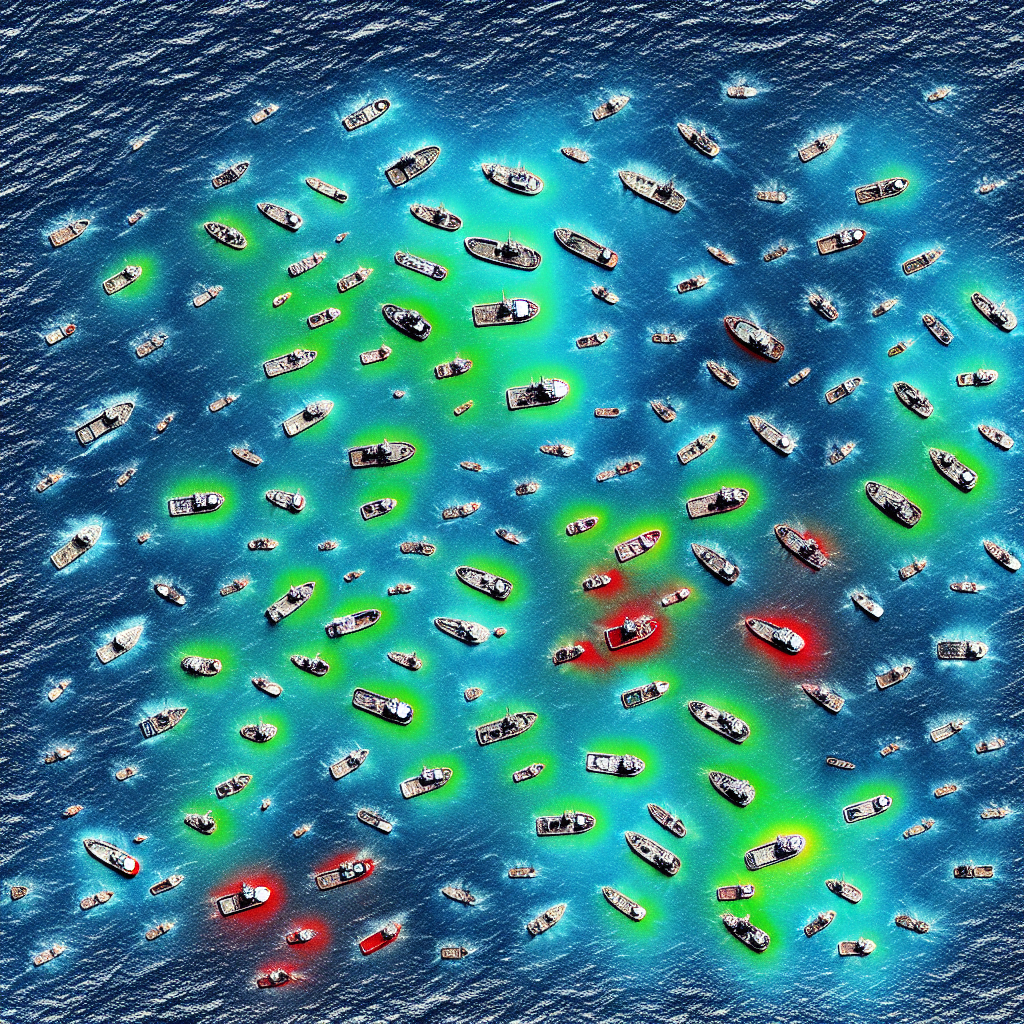
Illegal fishing is a significant problem worldwide, with an estimated 20% of all fish caught being the result of illegal or unregulated fishing. This type of fishing is not only detrimental to marine ecosystems but also contributes to overfishing, with a third of global fish stocks being fished beyond sustainable levels. To combat this issue, organizations like Global Fishing Watch are using artificial intelligence (AI) and satellite imagery to monitor and track the movements of commercial fishing vessels. By analyzing data from vessels' automatic identification systems (AIS) and combining it with satellite imagery, AI algorithms can identify vessels that are engaged in illegal fishing activities.
Global Fishing Watch's AI software analyzes millions of gigabytes of satellite imagery to detect vessels and offshore infrastructure. It then cross-references this information with publicly accessible AIS data to identify vessels that are not broadcasting their positions. The AI takes into account various factors such as vessel length, location, density of vessel traffic, and environmental conditions to determine whether a vessel is likely engaged in fishing. This technology has revealed that three-quarters of the world's industrial fishing vessels are not publicly tracked, particularly in hotspots around Africa and South Asia. Efforts are underway to introduce higher-resolution imagery to better detect smaller fishing vessels.
In addition to AI-based monitoring, other innovative solutions are being developed to combat illegal fishing. For example, a project by the University of Southampton and RS Aqua aims to build a submarine robot equipped with underwater sensors and AI to identify the sound of fishing. This robot would transmit real-time information about fishing activity, particularly within marine protected areas (MPAs), to authorities who can take appropriate action. Currently, less than half of the world's MPAs are fully protected from fishing, and the robot aims to address this issue by providing timely data to enforce fishing regulations.
The use of AI and other emerging technologies is seen as complementary to traditional law enforcement efforts in combating illegal fishing. However, it is not solely the responsibility of authorities and technology to tackle this problem. Consumers also play a crucial role by making sustainable choices and supporting efforts to crack down on illegal fishing. By raising awareness and demanding sustainable seafood options, individuals can contribute to the preservation of marine ecosystems and the long-term viability of the fishing industry.
Original news source: How AI is being used to prevent illegal fishing (BBC)
🎧 Listen:
📖 Vocabulary:
Group or Classroom Activities
Warm-up Activities:
– Charades
Instructions: Divide the students into small groups. Give each group a word or phrase related to the article (e.g. illegal fishing, satellite imagery, sustainable seafood). One student from each group will act out the word or phrase without speaking, while the other group members try to guess what it is. The first group to correctly guess the word or phrase gets a point. Rotate the roles so that each student has a chance to act and guess.
– News Summary
Instructions: Have the students read the article individually or in pairs. Then, ask them to summarize the main points of the article in their own words. They can write a short summary or orally present it to the class. Encourage them to include key details and explain why illegal fishing is a significant problem and how technology is being used to combat it.
– Sketch It
Instructions: Divide the students into pairs. Give each pair a key word or phrase from the article (e.g. illegal fishing, AI algorithms, marine protected areas). One student will sketch a visual representation of the word or phrase, while the other student tries to guess what it is. The students can switch roles and continue until they have gone through all the words or phrases.
– Speed Summarizing
Instructions: Divide the students into pairs. Give each pair a timer (e.g. one minute). One student will summarize a section of the article within the given time, while the other student listens and takes notes. Then, they switch roles and repeat the process with a different section of the article. Afterward, have them compare their notes to see how well they captured the main ideas.
– Opinion Spectrum
Instructions: Create a spectrum on one side of the classroom, with one end labeled "Strongly Agree" and the other end labeled "Strongly Disagree". Ask the students to stand along the spectrum based on their opinions about the statement: "Technology is the most effective solution for combating illegal fishing." Give them a few minutes to think about their position, and then have them stand along the spectrum, explaining their reasons for their placement. Encourage respectful debate and discussion among the students.
🤔 Comprehension Questions:
An estimated 20% of all fish caught is the result of illegal or unregulated fishing.
Illegal fishing contributes to overfishing by exceeding sustainable fishing levels. It is estimated that a third of global fish stocks are being fished beyond sustainable levels.
Global Fishing Watch uses AI and satellite imagery to monitor and track the movements of commercial fishing vessels. By analyzing data from vessels' automatic identification systems (AIS) and combining it with satellite imagery, AI algorithms can identify vessels that are engaged in illegal fishing activities.
The AI software takes into account various factors such as vessel length, location, density of vessel traffic, and environmental conditions to determine whether a vessel is likely engaged in fishing.
Three-quarters (75%) of the world's industrial fishing vessels are not publicly tracked, particularly in hotspots around Africa and South Asia.
The purpose of the submarine robot being developed by the University of Southampton and RS Aqua is to identify the sound of fishing using underwater sensors and AI. It would transmit real-time information about fishing activity, particularly within marine protected areas (MPAs), to authorities who can take appropriate action.
Currently, less than half of the world's marine protected areas (MPAs) are fully protected from fishing.
Consumers play a crucial role in combating illegal fishing by making sustainable choices and supporting efforts to crack down on illegal fishing. By raising awareness and demanding sustainable seafood options, individuals can contribute to the preservation of marine ecosystems and the long-term viability of the fishing industry.
🎧✍️ Listen and Fill in the Gaps:
Illegal fishing is a problem worldwide, with an estimated 20% of all fish caught being the result of illegal or unregulated fishing. This type of fishing is not only detrimental to marine ecosystems but also contributes to overfishing, with a third of global fish stocks being fished beyond sustainable levels. To combat this issue, organizations like Global Fishing Watch are using intelligence (AI) and satellite imagery to monitor and track the movements of commercial fishing vessels. By data from vessels' automatic systems (AIS) and combining it with satellite imagery, AI algorithms can identify vessels that are engaged in illegal fishing activities. Global Fishing Watch's AI software analyzes millions of gigabytes of satellite imagery to vessels and offshore infrastructure. It then cross-references this information with publicly accessible AIS data to identify vessels that are not broadcasting their . The AI takes into account various such as vessel length, location, density of vessel traffic, and environmental conditions to determine whether a vessel is likely engaged in fishing. This has revealed that three-quarters of the world's industrial fishing vessels are not publicly tracked, particularly in hotspots around Africa and South Asia. Efforts are underway to introduce higher-resolution imagery to better detect smaller vessels. In addition to AI-based monitoring, other innovative solutions are being developed to combat fishing. For , a project by the University of Southampton and RS Aqua aims to build a submarine robot with underwater sensors and AI to identify the sound of fishing. This robot would transmit real-time information about fishing activity, particularly within marine protected areas (MPAs), to authorities who can take appropriate action. Currently, less than half of the world's MPAs are fully protected from fishing, and the robot aims to address this issue by providing timely data to enforce fishing regulations. The use of AI and other emerging technologies is seen as complementary to traditional law enforcement efforts in combating illegal fishing. However, it is not solely the responsibility of authorities and technology to tackle this problem. also play a crucial role by making sustainable choices and supporting efforts to down on illegal fishing. By raising awareness and sustainable options, individuals can contribute to the preservation of marine ecosystems and the long-term viability of the fishing industry.
💬 Discussion Questions:
1. What is the impact of illegal fishing on marine ecosystems?
2. How would you feel if you found out that the fish you were eating was caught illegally?
3. Do you think it is important for consumers to make sustainable choices when it comes to seafood? Why or why not?
4. What are some ways that consumers can support efforts to crack down on illegal fishing?
5. How do you think AI and satellite imagery can help in monitoring and tracking fishing vessels?
6. Do you think the use of AI-based monitoring is enough to combat illegal fishing? Why or why not?
7. What are some other innovative solutions that can be developed to combat illegal fishing?
8. How do you think the submarine robot equipped with AI and underwater sensors can help in identifying illegal fishing activity?
9. Do you think it is the responsibility of consumers to demand sustainable seafood options? Why or why not?
10. How can raising awareness about illegal fishing contribute to the preservation of marine ecosystems?
11. What are some challenges in enforcing fishing regulations within marine protected areas?
12. How do you think higher-resolution imagery can help in detecting smaller fishing vessels?
13. Have you ever encountered or heard about any cases of illegal fishing in your country? If so, what were the consequences?
14. Do you like seafood? How do you ensure that the seafood you consume is sourced sustainably?
15. What do you think is the long-term impact of illegal fishing on the fishing industry?
Individual Activities
📖💭 Vocabulary Meanings:
Click a dot next to a word, then click the dot next to its meaning to draw a line connecting them.
Words
Meanings
🔡 Multiple Choice Questions:
🕵️ True or False Questions:
📝 Write a Summary:
Write a summary of this news article in two sentences.
Check your writing now with the best free AI for English writing!