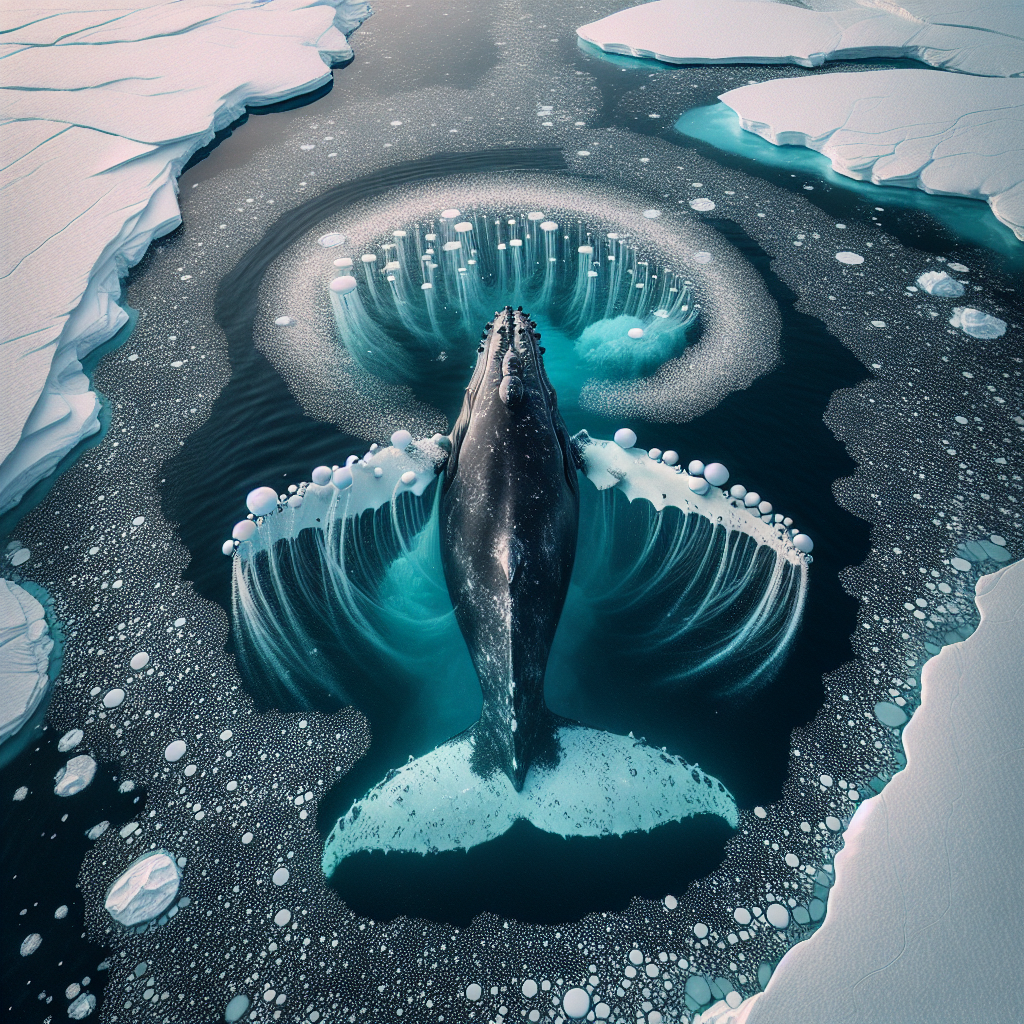
Drones have taken videos of humpback whales in Antarctica, showing how they catch food. One whale uses its big fin to make bubbles and trap fish, a trick called "bubble-netting." Humpback whales are very good at moving their bodies because of their big tails and flippers. Drones help scientists see these whale actions up close.
Drones also help scientists see how whale numbers are growing in places where they were almost gone. Scientists from the British Antarctic Survey used drones to watch whales in South Georgia, a place where many whales were hunted. They saw a mother and baby southern right whale, showing that whale numbers are getting better. They also saw the biggest whales, Antarctic blue whales, feeding in the same area.
Drones help scientists measure whale sizes too. Some whales are getting smaller because climate change is affecting their food. For example, gray whales near the Pacific Northwest are now 13% smaller than 20 years ago. This could mean the whales are not healthy. Drones are important tools for learning about whales and the problems they face.
Original news source: Drones reveal Antarctic whale 'acrobatics' (BBC)
🎧 Listen:
📖 Vocabulary:
Group or Classroom Activities
Warm-up Activities:
– Charades
Instructions: Divide the class into two teams. One student from each team will come to the front of the class and act out a word or phrase related to the article using only gestures and body language. The team members must guess what the word or phrase is within a certain time limit. The team that guesses correctly earns a point.
– News Summary
Instructions: In pairs, students will take turns summarizing the main points of the article to their partner. They should try to include as much information as possible in a limited amount of time (e.g. 1 minute). After both students have had a chance to summarize, they can compare their summaries and discuss any differences or missing details.
– Opinion Poll
Instructions: Create a list of questions related to the article and have students answer them individually. Questions could include: "Do you think using drones to study whales is a good idea? Why or why not?" or "Do you think climate change is a serious problem for whale populations? Why or why not?" After students have answered the questions, they can share their opinions in small groups or as a whole class discussion.
– Vocabulary Pictionary
Instructions: Write a list of key vocabulary words from the article on the board. Divide the class into small groups and give each group a piece of paper and a pen. One student from each group will choose a word from the list and draw a picture to represent that word. The rest of the group members must guess what the word is based on the drawing. The group that guesses correctly earns a point.
– Future Predictions
Instructions: In pairs, students will take turns making predictions about the future of whale populations based on the information in the article. They can discuss questions such as: "Do you think whale numbers will continue to grow in places where they were almost gone? Why or why not?" or "What do you think will happen to whale sizes in the future due to climate change?" After both students have made their predictions, they can compare their ideas and discuss their reasoning.
🤔 Comprehension Questions:
Drones help scientists observe and study humpback whales in Antarctica.
Humpback whales use their big fin to make bubbles and trap fish, a trick called "bubble-netting."
Scientists used drones to watch whales in South Georgia, a place where many whales were hunted.
The scientists saw a mother and baby southern right whale in South Georgia.
Drones are used to measure the sizes of whales.
Some whales are getting smaller because climate change is affecting their food, which can make them less healthy.
Drones are important for learning about whales because they allow scientists to observe whale behaviors up close and study whale populations in areas where they were once scarce.
🎧✍️ Listen and Fill in the Gaps:
Drones have taken videos of humpback whales in Antarctica, how they catch food. One whale uses its big fin to make bubbles and trap fish, a trick called "bubble-netting." whales are very at moving their bodies because of their big tails and flippers. Drones help scientists see these whale actions up close. Drones also help scientists see how whale are growing in places where they were almost gone. Scientists from the British Antarctic Survey used to whales in South Georgia, a place where many were hunted. They saw a mother and southern right whale, showing that whale numbers are getting better. They also saw the biggest whales, Antarctic blue whales, feeding in the same area. Drones scientists measure whale sizes too. Some whales are getting smaller because climate change is their food. For example, gray whales near the Pacific are now 13% smaller than 20 years ago. This could mean the whales are not healthy. are important tools for learning about whales and the problems they face.
💬 Discussion Questions:
1. What is a drone and how does it help scientists study whales?
2. How do humpback whales catch their food? Do you think it's a clever trick?
3. How do drones help scientists see whale actions up close? Why is this important?
4. What did scientists from the British Antarctic Survey see when they used drones in South Georgia?
5. Do you think it's good news that whale numbers are getting better in South Georgia? Why or why not?
6. What is the biggest whale called? Where did scientists see them feeding?
7. How can drones help scientists measure whale sizes? Why is this important?
8. What is happening to some whales because of climate change? How does this affect their health?
9. Do you think it's a problem that gray whales near the Pacific Northwest are getting smaller? Why or why not?
10. Why are drones important tools for learning about whales and the problems they face?
11. Have you ever seen a whale in real life? How did it make you feel?
12. If you could use a drone to study any animal, which animal would you choose and why?
Individual Activities
📖💭 Vocabulary Meanings:
Click a dot next to a word, then click the dot next to its meaning to draw a line connecting them.
Words
Meanings
🔡 Multiple Choice Questions:
🕵️ True or False Questions:
📝 Write a Summary:
Write a summary of this news article in two sentences.
Check your writing now with the best free AI for English writing!