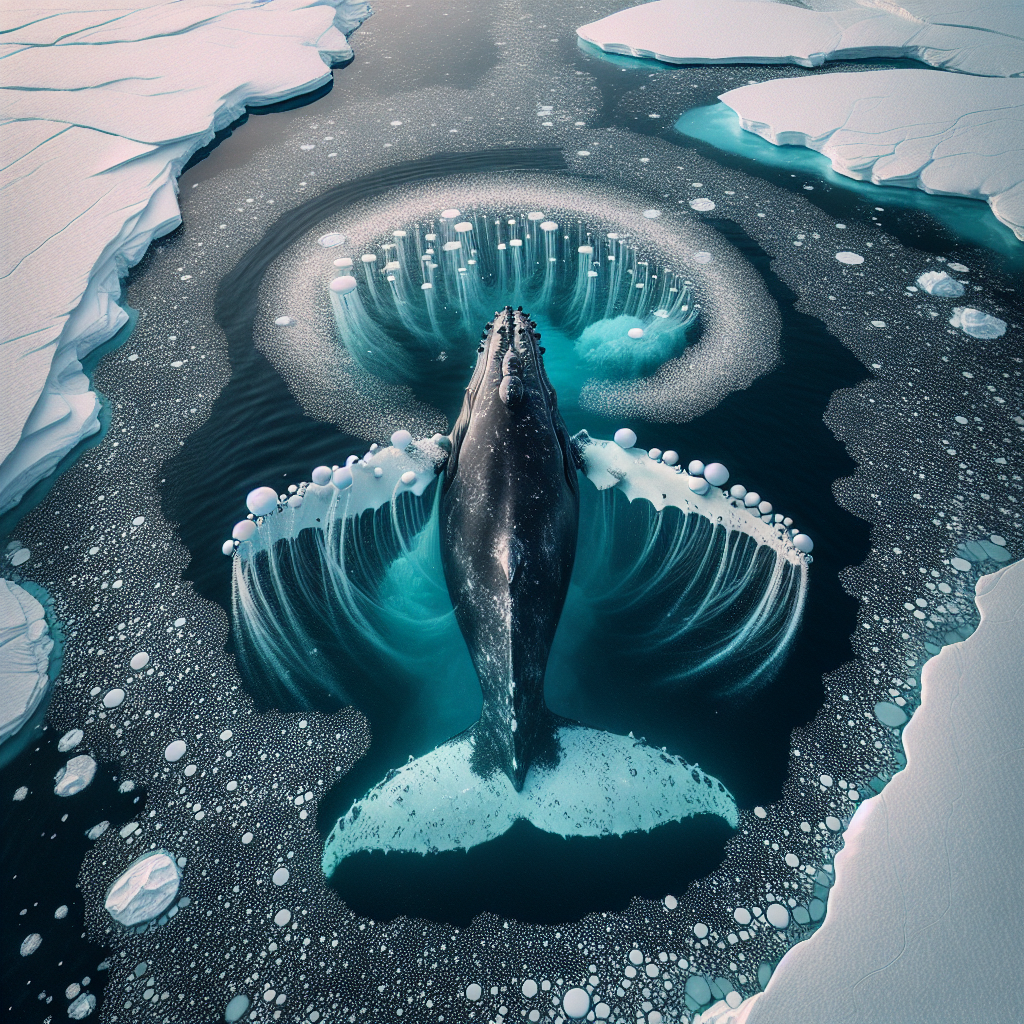
Drones have provided new insights into the behavior of humpback whales in the Antarctic. The footage captured by BBC News and scientists shows how these whales use their bodies to create a "bubble net" to trap their prey. The whales use their long fins to sweep a net of bubbles around their prey, demonstrating their adaptability and creativity. Humpback whales are known for their acrobatic nature, and they are the only species known to produce these solitary "bubble nets." The use of drone cameras has revolutionized scientists' ability to study this behavior in detail.
The aerial view provided by drones has also shed light on the recovery of whale populations in areas where they were once hunted to near extinction. Researchers, including those from the British Antarctic Survey, have used drones to study whales in South Georgia, a key location for the whaling industry in Antarctica. The footage captured the first drone footage of a mother-calf pair of southern right whales off the coast of South Georgia, indicating that these populations are slowly recovering. The researchers also filmed an Antarctic blue whale mother and calf, the largest animals on Earth, feeding in the same area.
Drones have also been used to measure the bodies of whales, revealing evidence that some whales are shrinking due to climate change affecting their food supplies. A study published in the journal Global Change Biology showed that gray whales off the Pacific Northwest coast have shrunk by about 13% in the last two decades. This could be an early warning sign of population decline or poor health. Size is critical for animals as it affects their behavior, physiology, and the ecosystem they are a part of.
In addition to monitoring threats to whales, drones have captured fascinating marine mammal behavior. Filming humpback whales working together to feed has provided insight into how these animals learn and cooperate. In Antarctica, multiple animals are seen blowing bubbles at the same time, suggesting that they are still learning the feeding technique and have not yet refined it to give each animal a specific role. The footage also shows humpbacks spinning, circling boats, and interacting with other species, which could be described as "play." This behavior strengthens social bonds and is critical for the well-being of these animals.
Overall, the use of drones has revolutionized the study of whales, providing new insights into their feeding behavior, population recovery, and response to climate change. The aerial view provided by drones has allowed scientists to observe and understand these magnificent creatures in ways that were not possible before.
Original news source: Drones reveal Antarctic whale 'acrobatics' (BBC)
🎧 Listen:
📖 Vocabulary:
Group or Classroom Activities
Warm-up Activities:
– News Summary
Instructions: Divide the class into pairs or small groups. Give each group a few minutes to read the article. Then, ask each group to summarize the main points of the article in one or two sentences. Have each group share their summaries with the class and compare the different perspectives.
– Word Association
Instructions: Write the word "whales" on the board. Ask the students to brainstorm as many words or phrases associated with whales as they can in two minutes. After the time is up, go around the class and have each student share one word or phrase they came up with. Write all the words on the board and discuss their meanings and connections to the article.
– Sketch It
Instructions: Divide the class into pairs or small groups. Assign each group a specific scene or behavior mentioned in the article (e.g. humpback whales using bubble nets, whales blowing bubbles, etc.). Give the groups a few minutes to discuss and plan how they will sketch or draw their assigned scene. Afterward, have each group present their sketches to the class and explain the significance of the scene they depicted.
– Vocabulary Pictionary
Instructions: Choose about 10 key vocabulary words from the article (e.g. adaptability, acrobatic, extinct, etc.) and write each word on a separate index card. Divide the class into two teams. Choose a student from the first team to come to the front of the class. Show them a vocabulary word and have them draw it on the board without speaking or writing any letters or numbers. The student's team must guess the word within a certain time limit (e.g. one minute). Repeat the process with a student from the second team. Continue alternating between teams until all the vocabulary words have been used.
– Pros and Cons
Instructions: Divide the class into two groups. Assign one group to list the pros (benefits) of using drones to study whales, and assign the other group to list the cons (disadvantages) of using drones. Give the groups a few minutes to brainstorm and discuss their ideas. Then, have each group share their lists with the class and facilitate a discussion comparing the different perspectives. Encourage the students to critically analyze and evaluate the arguments presented.
🤔 Comprehension Questions:
🎧✍️ Listen and Fill in the Gaps:
Drones have provided new insights into the behavior of humpback whales in the Antarctic. The footage captured by BBC News and scientists shows how these whales use their bodies to create a "bubble net" to trap their prey. The whales use their long fins to sweep a net of bubbles around their prey, their and . Humpback whales are known for their nature, and they are the only species known to produce these solitary "bubble nets." The use of drone cameras has revolutionized scientists' ability to study this behavior in detail. The aerial view provided by drones has also shed light on the recovery of whale populations in areas where they were once hunted to near extinction. Researchers, including those from the British Antarctic Survey, have used to study whales in South Georgia, a key for the whaling industry in Antarctica. The footage captured the first drone footage of a mother-calf pair of southern right whales off the coast of South Georgia, that these populations are slowly recovering. The researchers also filmed an Antarctic blue whale mother and calf, the largest animals on Earth, in the same area. Drones have also been used to measure the bodies of whales, revealing evidence that some whales are shrinking due to climate change affecting their food supplies. A study published in the Global Change Biology showed that gray whales off the Northwest coast have shrunk by about 13% in the last two decades. This could be an early warning sign of population decline or poor health. Size is critical for animals as it affects their behavior, , and the ecosystem they are a part of. In addition to monitoring to whales, drones have captured fascinating marine mammal behavior. Filming humpback whales working together to feed has provided insight into how these animals learn and cooperate. In Antarctica, multiple animals are seen blowing bubbles at the same time, suggesting that they are still learning the feeding technique and have not yet refined it to give each animal a specific role. The footage also humpbacks spinning, circling boats, and interacting with species, which could be described as "play." This behavior social bonds and is critical for the well-being of these animals. Overall, the use of drones has revolutionized the study of whales, providing new insights into their feeding behavior, population recovery, and response to climate . The aerial view provided by drones has allowed scientists to observe and understand these magnificent creatures in ways that were not possible before.
💬 Discussion Questions:
1. What is a "bubble net" and how do humpback whales use it to trap their prey?
2. How would you feel if you were able to observe humpback whales using a drone camera? Why?
3. Do you like the idea of using drones to study and monitor whale populations? Why or why not?
4. Do you think it's important to study and understand the behavior of whales? Why or why not?
5. What other marine animals do you think could benefit from drone technology for research and observation? Why?
6. How do you think the use of drones has changed the way scientists study and monitor whale populations?
7. Why do you think the recovery of whale populations is significant? How does it impact the ecosystem?
8. Do you think the use of drones to measure the bodies of whales is an effective way to monitor their health? Why or why not?
9. How would you feel if you discovered that whale populations were shrinking due to climate change? Why?
10. What do you think can be done to protect and preserve whale populations from the effects of climate change?
11. Why do you think it's important for animals to learn and cooperate with each other, like the humpback whales blowing bubbles together?
12. How do you think the behavior of humpback whales, such as spinning and interacting with other species, contributes to their well-being?
13. Do you think the use of drones in studying whales could have any negative impacts on the animals or their habitats? Why or why not?
14. How do you think the use of drones in studying whales compares to traditional research methods? Which do you think is more effective? Why?
15. Why do you think it's important for humans to understand and appreciate the behavior of whales and other marine mammals?
Individual Activities
📖💭 Vocabulary Meanings:
Click a dot next to a word, then click the dot next to its meaning to draw a line connecting them.
Words
Meanings
🔡 Multiple Choice Questions:
🕵️ True or False Questions:
📝 Write a Summary:
Write a summary of this news article in two sentences.
Check your writing now with the best free AI for English writing!