
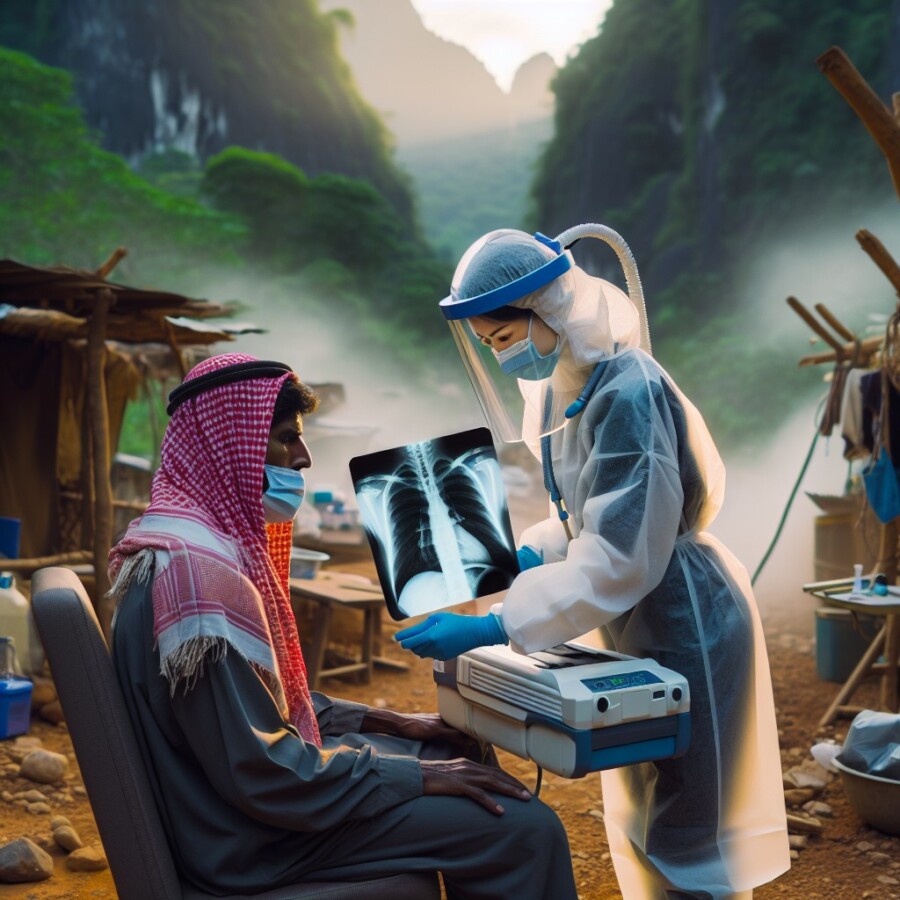
Small X-ray machines that you can take anywhere are very helpful in places far from hospitals, like in the countryside or where there has been a big accident or a fight. People don't have to go to a big hospital to get checked because these machines can go to them. In 2020, people spent $7.1 billion on these machines, and they might spend $14 billion by 2028. There are two kinds: ones with wheels and ones so light a person can carry them. These machines help a lot of people in places where it's hard to find a doctor.
On some islands in Scotland, they tried a very light X-ray machine that you can hold in your hand. It worked so well that everyone who needed an X-ray got one because they didn't have to go far away to a big hospital. These small machines are also helping to find a sickness called TB in places where people don't have much money. The machines can tell if someone has TB very fast and they are smart because they use a special computer brain. But some people worry about the bad things that can happen from the X-rays and that these machines cost a lot of money.
Even though there are some problems, more and more people will use these small X-ray machines. The hope is that everyone who needs an X-ray can get one from a new, smart machine that is easy to carry. As more companies start making these machines, they might get cheaper because the companies will try to have better prices than each other. This could make it easier for everyone to get these machines.
Original news source: How portable X-ray machines are helping remote patients (BBC)
🎧 Listen:
📖 Vocabulary:
Group or Classroom Activities
Warm-up Activities:
– Charades
Instructions: Divide the students into small groups. Give each group a card with a word related to the article (e.g. hospital, X-ray, doctor). One student from each group will act out the word without speaking, while the other students try to guess what word it is. The group that guesses the word correctly gets a point. Repeat with different words from the article.
– Vocabulary Pictionary
Instructions: Divide the students into pairs. Give each pair a list of vocabulary words from the article (e.g. X-ray, hospital, TB). One student will choose a word and draw a picture to represent it, while the other student tries to guess the word. They can only communicate through drawing. After a set amount of time, switch roles. The pair with the most correct guesses wins.
– News Summary
Instructions: Divide the students into pairs. Ask each pair to read the article together and then write a summary of the main points. After a few minutes, have the pairs share their summaries with the class. Encourage discussion and compare the different summaries to highlight key information from the article.
– Think-Pair-Share
Instructions: Ask the students to think about and write down their opinions on the use of small X-ray machines in remote areas. Then, pair them up to discuss their opinions and reasons behind them. After a few minutes, have each pair share their opinions with the class. Encourage students to listen and respond respectfully to different viewpoints.
– Sketch It
Instructions: Divide the students into small groups. Give each group a blank piece of paper and a pen. Instruct them to work together to create a sketch or diagram illustrating the benefits and challenges of using small X-ray machines in remote areas. After a few minutes, have each group present their sketch to the class, explaining their choices and ideas. Encourage discussion and reflection on the different perspectives presented.
🤔 Comprehension Questions:
🎧✍️ Listen and Fill in the Gaps:
Small X-ray machines that you can take anywhere are very in places far from s, like in the countryside or where there has been a big or a fight. People don't have to go to a big hospital to get checked because these machines can go to them. In 2020, people spent $7.1 billion on these machines, and they might spend $14 billion by 2028. There are two kinds: ones with wheels and ones so light a person can carry them. These machines a lot of people in places where it's hard to find a doctor. On some islands in Scotland, they a very light X-ray machine that you can hold in your . It worked so well that everyone who needed an X-ray got one because they didn't have to go far away to a big hospital. These small machines are also helping to find a sickness called TB in places where people don't much money. The machines can tell if someone has TB very fast and they are smart because they use a special computer brain. But some people worry about the bad things that can from the X-rays and that these machines a lot of money. Even though there are some problems, and more people will use these small X-ray s. The hope is that everyone who needs an X-ray can get one from a new, smart machine that is easy to carry. As more companies start making these machines, they might get because the companies will try to have better prices than each other. This could make it easier for everyone to get these machines.
💬 Discussion Questions:
1. What are small X-ray machines used for?
2. How do these machines help people in places far from hospitals?
3. Have you ever been to a big hospital? How did you feel?
4. What do you think about small X-ray machines that can be carried?
5. Why do you think people spent $7.1 billion on these machines in 2020?
6. Do you think it's important for everyone to have access to X-ray machines? Why or why not?
7. How do small X-ray machines help find TB in places with less money?
8. What are some worries that people have about X-ray machines?
9. Do you think the benefits of these machines outweigh the risks? Why or why not?
10. How do you think more companies making these machines will affect the prices?
11. Would you like to have a small X-ray machine that you can carry? Why or why not?
12. How do you think these machines can make it easier for everyone to get an X-ray?
Individual Activities
📖💭 Vocabulary Meanings:
Click a dot next to a word, then click the dot next to its meaning to draw a line connecting them.
Words
Meanings
🔡 Multiple Choice Questions:
🕵️ True or False Questions:
📝 Write a Summary:
Write a summary of this news article in two sentences.
Check your writing now with the best free AI for English writing!