
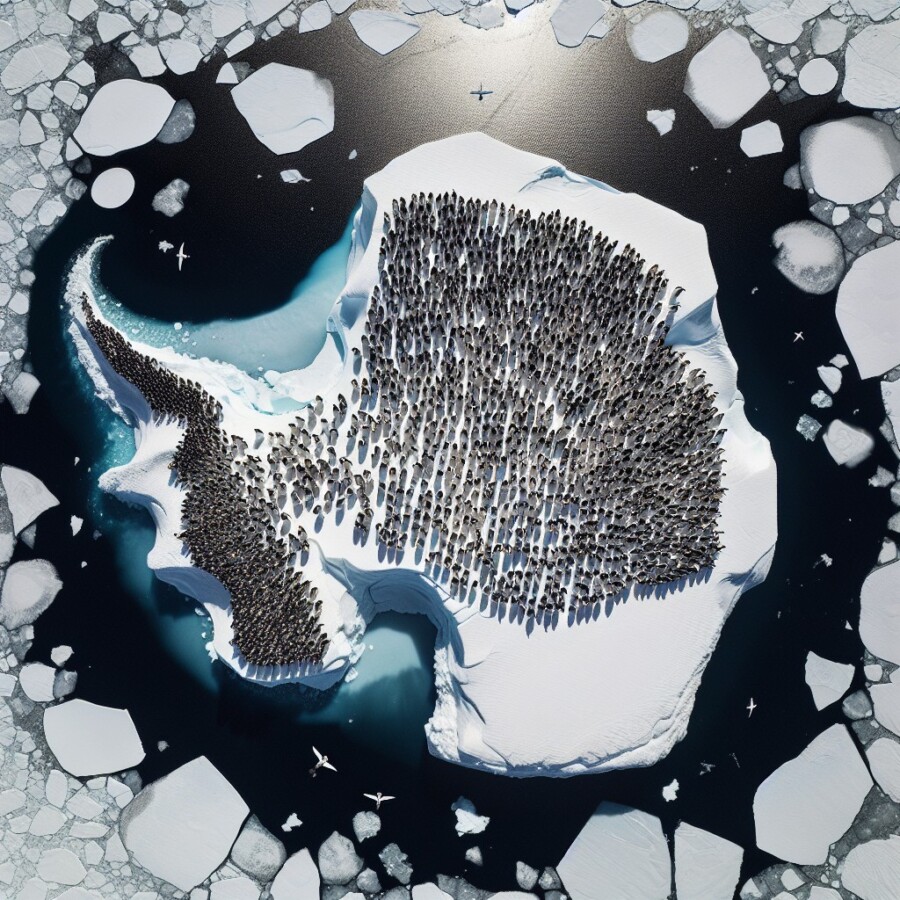
Scientists have found four new groups of emperor penguins in Antarctica using pictures from space. This means there are now 66 places where these big penguins live and have their babies. Emperor penguins need ice to live and have their babies, but because the Earth is getting warmer, there is less ice for them. Finding new groups of penguins is good news, but these penguins might have to find new homes because of the changing ice.
Emperor penguins are the biggest kind of penguin and they live in very cold places. They like to stay together in big groups, but these groups are usually far apart from each other. Scientists have been looking at pictures from space to find penguin groups we didn't know about before. With these four new groups, there might be a few thousand more penguins, adding to the total number of about 550,000. But, the penguins will have to be good at moving to new places if their ice homes keep changing.
The best way to find where emperor penguins live is by looking at pictures from space. Scientists can see where the penguins are because the penguins make the ice look dirty from far away. A scientist named Dr. Peter Fretwell has found about half of the penguin groups this way. Finding new groups shows us that penguins can move and live in new places when their ice homes change.
Original news source: Four new emperor penguin groups found by satellite (BBC)
🎧 Listen:
📖 Vocabulary:
Group or Classroom Activities
Warm-up Activities:
– Charades
Instructions: Divide the class into small groups. Give each group a word related to the article (e.g. penguin, ice, Antarctica). One person from each group will act out the word without speaking, while the others try to guess what it is. The group that guesses correctly earns a point. Repeat with different words from the article.
– News Summary
Instructions: Have the students work in pairs. Give each pair a copy of the article. Instruct them to read the article and write a summary of the main points in their own words. After a few minutes, have pairs share their summaries with the class. Discuss any differences or similarities between the summaries.
– Opinion Poll
Instructions: Write the following statement on the board: "Emperor penguins should be protected from the effects of climate change." Have students indicate whether they agree or disagree by raising their hands. Divide the class into two groups: one group representing those who agree and one group representing those who disagree. Give each group a few minutes to come up with reasons to support their stance. Then, have a class discussion where students from each group share their reasons and try to convince others to join their side.
– Vocabulary Pictionary
Instructions: Divide the class into pairs. Give each pair a list of vocabulary words from the article (e.g. penguin, Antarctica, ice). One person from each pair will choose a word and draw a picture representing that word. Their partner must guess the word based on the picture. Each correct guess earns a point. The pair with the most points at the end wins.
– Future Predictions
Instructions: Discuss with the class the potential consequences of climate change on the habitat of emperor penguins. Have students work in small groups to brainstorm and write down three predictions about what might happen to the penguins in the future. After a few minutes, have each group share their predictions with the class. Encourage discussion and debate about the likelihood and potential impact of each prediction.
🤔 Comprehension Questions:
Scientists found the new groups of emperor penguins by looking at pictures from space.
Emperor penguins need ice to live and have their babies because they like to stay together in big groups and the ice provides a safe place for them to do that.
The ice that the penguins need is melting because the Earth is getting warmer.
Yes, emperor penguins are the biggest kind of penguin.
Scientists know where the penguins are by looking at pictures from space. The penguins make the ice look dirty from far away, so scientists can see where they are.
A scientist named Dr. Peter Fretwell found about half of the penguin groups.
Finding new groups of penguins shows us that penguins can move and live in new places when their ice homes change.
🎧✍️ Listen and Fill in the Gaps:
Scientists have found four new groups of emperor penguins in Antarctica using pictures from . This means there are now 66 where these big penguins live and have their . Emperor penguins need ice to live and have their babies, but because the Earth is getting warmer, there is less ice for them. Finding new groups of is good news, but these penguins might have to find new homes because of the changing ice. Emperor penguins are the biggest kind of penguin and they live in very places. They like to together in big groups, but these groups are usually far apart from each other. Scientists have been looking at pictures from space to penguin groups we didn't know about before. With these four new groups, there might be a few thousand penguins, adding to the total number of about 550,000. But, the penguins will have to be good at moving to new places if their ice homes keep changing. The best way to find where emperor penguins is by looking at pictures from space. Scientists can see where the penguins are because the penguins make the ice look dirty from far away. A scientist named Dr. Peter has found about half of the penguin this way. Finding new groups shows us that penguins can and live in new places when their ice homes change.
💬 Discussion Questions:
1. What is an emperor penguin?
2. How would you feel if you had to move to a new home?
3. Do you like penguins? Why or why not?
4. What do you think is causing the Earth to get warmer?
5. How do scientists find new groups of penguins?
6. Why do emperor penguins need ice to live and have their babies?
7. How do scientists know where the penguins are when they look at pictures from space?
8. Do you think it's important to protect the penguins' ice homes? Why or why not?
9. What do you think might happen if the penguins can't find new homes?
10. Have you ever seen a penguin in real life? If so, where?
11. What do you think the penguins might do if their ice homes keep changing?
12. How do you think the penguins feel when they have to move to a new place?
Individual Activities
📖💭 Vocabulary Meanings:
Click a dot next to a word, then click the dot next to its meaning to draw a line connecting them.
Words
Meanings
🔡 Multiple Choice Questions:
🕵️ True or False Questions:
📝 Write a Summary:
Write a summary of this news article in two sentences.
Check your writing now with the best free AI for English writing!