
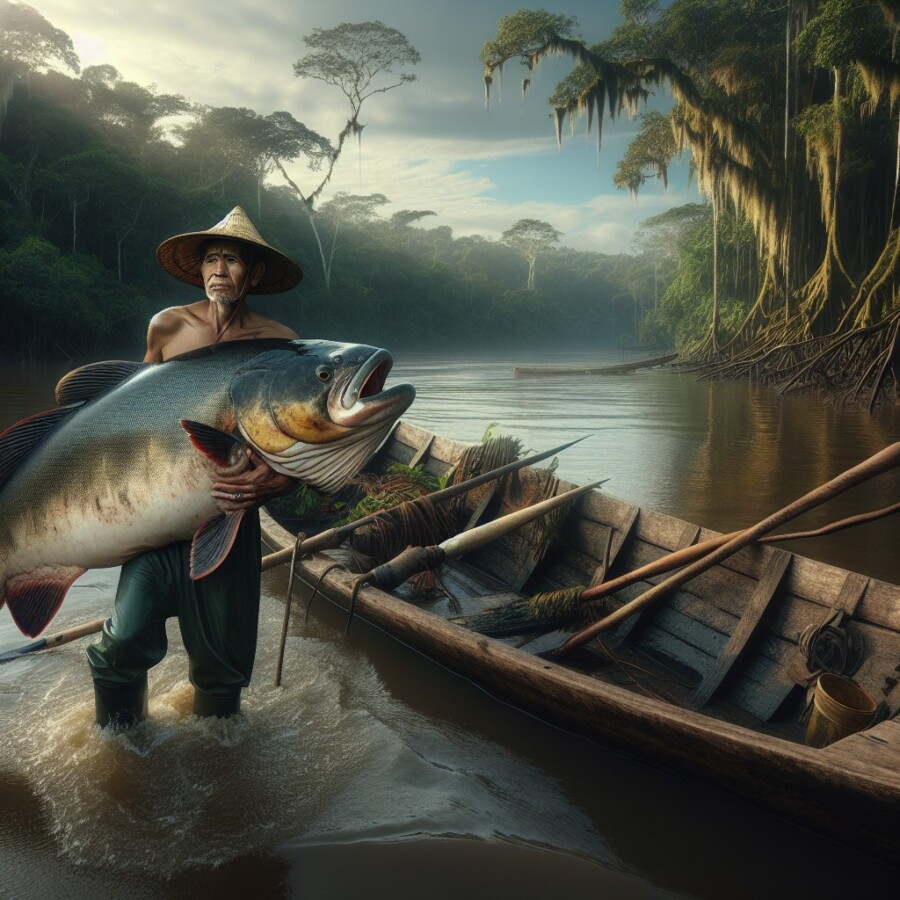
A very big fish called the paiche is causing trouble in rivers in Bolivia. This fish can grow really long and heavy, and it scares away other fish that lived there first. The paiche came from a fish farm in another country when something broke. People who catch fish are seeing fewer of the fish they used to find, and experts are worried that the paiche will keep causing problems for the different kinds of life in the water.
But some people who catch fish are happy because they can sell the paiche. At first, they were scared of the big fish, but then they saw they could make money. In one town, they turn lots of paiche into food every month. Still, it's hard to find the paiche because it likes quiet water and moves around a lot. Some people who lived there first are now catching and selling paiche too, which can lead to arguments.
People who study fish and those who catch them hope that by catching more paiche, they can stop there from being too many. They want to make sure there are still lots of different kinds of fish in the rivers. But it's still a problem that the paiche is in places it shouldn't be and that it's making it hard for other fish to live there.
Original news source: The fish that eats piranhas for breakfast (BBC)
🎧 Listen:
📖 Vocabulary:
Group or Classroom Activities
Warm-up Activities:
– Charades
Instructions: Divide the class into two teams. Give each team a list of vocabulary words related to the article (e.g. paiche, fish farm, catch, sell, arguments). One person from each team will act out a word without speaking, and their team will try to guess the word within a time limit. The team with the most correct guesses wins.
– News Summary
Instructions: In pairs or small groups, have students take turns summarizing the main points of the article. Encourage them to use their own words and focus on the key information. After each summary, the other students can provide feedback and ask questions to ensure understanding.
– Opinion Poll
Instructions: Have students answer the following question individually: "Do you think it is a good thing or a bad thing that people can sell the paiche?" Once they have written their responses, have them share their opinions with a partner and discuss their reasons. Then, have a class discussion where students can share their opinions and listen to different perspectives.
– Vocabulary Pictionary
Instructions: Give each student a vocabulary word from the article (e.g. paiche, fish farm, catch, sell, arguments). Without speaking, each student must draw a picture to represent their word while the rest of the class tries to guess what it is. This activity helps reinforce vocabulary and encourages creativity.
– Pros and Cons
Instructions: Divide the class into two groups. One group will brainstorm the pros (advantages) of having the paiche in the rivers, while the other group will brainstorm the cons (disadvantages). After a few minutes, have each group share their ideas with the class. This activity encourages critical thinking and provides an opportunity for students to consider different perspectives.
🤔 Comprehension Questions:
The name of the big fish causing trouble in Bolivian rivers is the paiche fish.
Some people are happy about the paiche fish because they can sell it and make money.
It is hard to find the paiche fish because it likes quiet water and moves around a lot.
People who study fish and those who catch them hope to catch more paiche fish to make sure there are not too many of them.
The paiche fish is a problem for other fish because it scares them away and makes it hard for them to live in the rivers.
The paiche fish came from a fish farm in another country.
When people catch and sell paiche fish, it can lead to arguments between the people who lived there first and the new people catching and selling paiche fish.
🎧✍️ Listen and Fill in the Gaps:
A very big fish the paiche is causing trouble in rivers in Bolivia. This fish can really long and , and it scares away other fish that lived there first. The paiche came from a fish farm in another country when something broke. People who catch fish are seeing fewer of the fish they used to find, and experts are worried that the paiche will keep causing for the different of life in the water. But some who catch fish are happy because they can sell the paiche. At first, they were scared of the big fish, but then they saw they could make money. In one town, they turn of paiche into food every . Still, it's hard to find the paiche because it likes quiet water and moves around a lot. Some people who lived there first are now catching and selling paiche too, which can to arguments. People who study fish and those who catch them hope that by catching more , they can stop there from being too many. They want to make sure there are still lots of kinds of fish in the rivers. But it's still a problem that the paiche is in places it shouldn't be and that it's making it hard for fish to live there.
💬 Discussion Questions:
1. What is the paiche fish?
2. How do you think the paiche fish is causing trouble in the rivers in Bolivia?
3. How would you feel if you saw a very big fish in the water?
4. Do you think it's good or bad that people can sell the paiche fish? Why or why not?
5. Do you like eating fish? Why or why not?
6. What do you think might happen if there are too many paiche fish in the rivers?
7. How do you think the paiche fish is affecting the other fish that lived there first?
8. What would you do if you caught a paiche fish?
9. Why do you think it's hard to find the paiche fish?
10. How do you think arguments can start when people catch and sell paiche fish?
11. Do you think it's important to have lots of different kinds of fish in the rivers? Why or why not?
12. What can people do to solve the problem of the paiche fish being in places it shouldn't be?
Individual Activities
📖💭 Vocabulary Meanings:
Click a dot next to a word, then click the dot next to its meaning to draw a line connecting them.
Words
Meanings
🔡 Multiple Choice Questions:
🕵️ True or False Questions:
📝 Write a Summary:
Write a summary of this news article in two sentences.
Check your writing now with the best free AI for English writing!