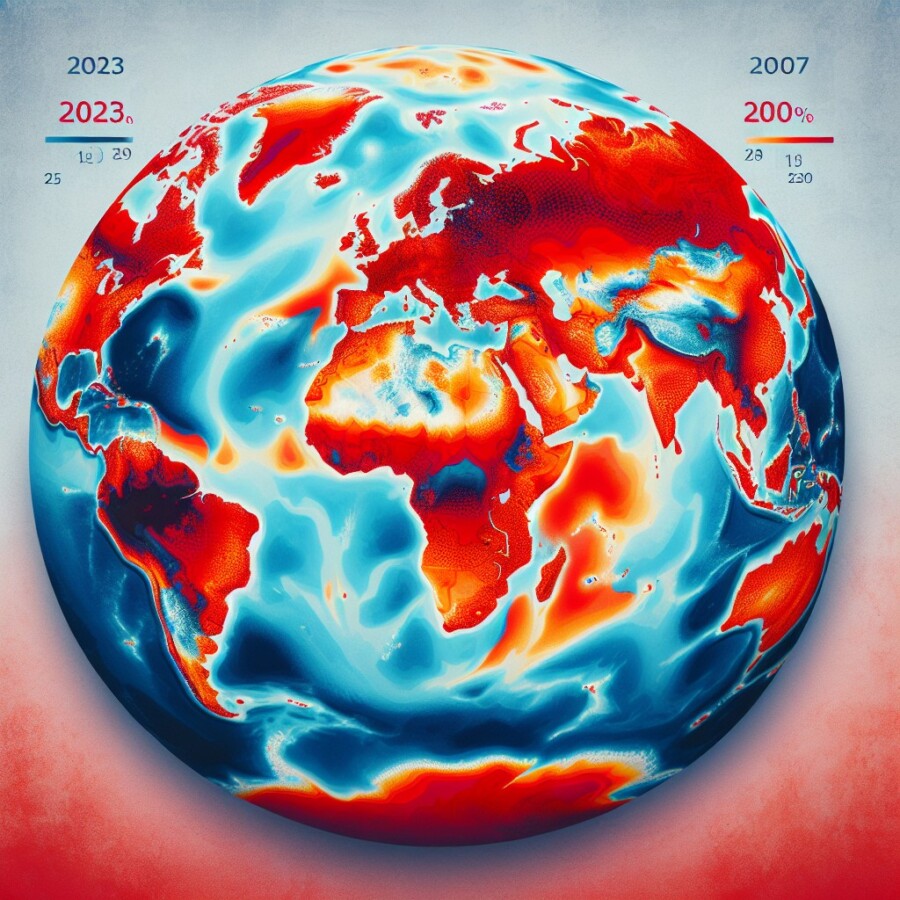
The year 2023 was super hot, like the hottest ever! It beat all the previous records because of climate change caused by humans and this thing called El Niño. The European Union's climate service said that 2023 was about 1.48C hotter than the average temperature before people started burning a lot of fossil fuels. Almost every day since July, the global air temperature has been reaching new highs, and the sea is also getting really warm. Even in the UK, it was the second hottest year ever. These crazy high temperatures are getting us closer to breaking important climate goals.
What's really crazy about 2023 is not just that it broke the old records, but by how much! It was way hotter than anyone expected. The world has been getting warmer over the past hundred years because of greenhouse gases in the air. But scientists didn't predict that 2023 would be the hottest year. It's hard to figure out exactly what the climate is going to do because it's so complicated.
At the beginning of 2023, only a few days were hotter than usual. But in the second half of the year, almost every day set a new record for temperature. More than 200 days had the hottest temperatures ever for that time of year. This happened because of El Niño, which is when the Pacific Ocean gets warmer and releases more heat into the air. But scientists didn't think El Niño would have such a big effect until 2024, so they're not sure why 2023 was so hot.
The whole world felt the heat in 2023. Almost every part of the world was hotter than usual, and that's on top of the fact that the average temperature has already gone up by 0.9C since before people started using a lot of fossil fuels. This crazy heat made extreme weather events like heatwaves, wildfires, droughts, and floods happen more often and in weird times of the year. It caused a lot of damage and even cost lives.
Not only did the air get hotter in 2023, but other signs of climate change also hit record levels. The ice in Antarctica was the lowest it's ever been, glaciers in North America and Europe melted a lot, and the surface of the ocean was the hottest it's ever been. This caused a bunch of marine heatwaves. The ocean has been breaking records since May 4th, 2023.
We don't know for sure if 2024 will be hotter than 2023 because of this El Niño thing. But there's a chance it could be even hotter and go past the important 1.5C warming limit for the whole year.
Original news source: 2023 confirmed as world's hottest year on record (BBC)
🎧 Listen:
📖 Vocabulary:
Group or Classroom Activities
Warm-up Activities:
– News Summary
Instructions: Divide the class into pairs or small groups. Give each group a few minutes to read the article. Then, ask each group to summarize the main points of the article in their own words. Have them write a short news summary, highlighting the key information and events. Afterward, ask each group to share their summary with the class.
– Opinion Poll
Instructions: Divide the class into pairs or small groups. Give each group a few minutes to read the article. Then, ask each group to discuss their opinions on the topic of climate change and the record-breaking temperatures in 2023. Provide prompts such as "Do you think humans are primarily responsible for climate change?" or "What actions can individuals take to combat climate change?" After the discussion, conduct a class-wide opinion poll by asking each group to share their opinions and reasons for their stance.
– Vocabulary Pictionary
Instructions: Select 10-15 key vocabulary words from the article (e.g. climate change, greenhouse gases, El Niño, heatwaves, etc.) Write each word on a separate small piece of paper and place them in a bowl or hat. Divide the class into teams and explain that each team will take turns selecting a word from the bowl. The chosen team member must draw a picture to represent the word, while their team tries to guess the word within a time limit. Encourage teams to use the words in sentences or describe their meanings to help their teammates guess correctly.
– Keyword Hangman
Instructions: Select 5-10 important keywords from the article (e.g. climate change, temperature, El Niño, fossil fuels, etc.) Write a series of dashes on the board to represent each letter in the keyword. Ask the class to guess letters one at a time. If a guessed letter appears in the keyword, write it in the appropriate position. If the letter does not appear in the keyword, draw a body part of a hangman on the board. The class must guess the keyword before the hangman is completed. After each keyword is guessed, discuss its meaning and relevance to the article.
– Future Predictions
Instructions: Divide the class into pairs or small groups. Ask each group to discuss and make predictions about the future impacts of climate change based on the information in the article. Prompt them to consider questions such as "How do you think climate change will affect different parts of the world?", "What are some potential consequences of rising temperatures?", or "What actions can be taken to mitigate the effects of climate change?" After the discussion, ask each group to share their predictions with the class and facilitate a class-wide discussion on the topic.
🤔 Comprehension Questions:
2023 was considered the hottest year ever because the global air temperature reached new highs almost every day since July, and the sea also became extremely warm.
The increase in temperatures in 2023 was caused by climate change caused by humans and a weather pattern called El Niño, which made the Pacific Ocean warmer and released more heat into the air.
Scientists were surprised by how hot 2023 was because they didn't predict that it would be the hottest year. The climate is very complex and difficult to predict accurately.
The hottest temperatures in 2023 occurred in the second half of the year, with more than 200 days setting new records for temperature.
El Niño is a weather pattern that occurs when the Pacific Ocean gets warmer and releases more heat into the air. It contributed to the high temperatures in 2023 by making the global air temperature even hotter than usual.
The extreme heat in 2023 caused extreme weather events such as heatwaves, wildfires, droughts, and floods to occur more frequently and at unusual times of the year. It also caused a lot of damage and even cost lives.
Some other signs of climate change that reached record levels in 2023 were the lowest levels of ice in Antarctica, significant melting of glaciers in North America and Europe, and the hottest surface temperature of the ocean ever recorded.
It is possible that 2024 could be even hotter than 2023 due to the El Niño weather pattern. However, scientists are not certain and more research is needed to make accurate predictions.
🎧✍️ Listen and Fill in the Gaps:
The year 2023 was super hot, like the hottest ever! It beat all the previous records because of change by humans and this thing called El Niño. The European Union's climate service said that 2023 was about 1.48C than the average temperature before people started burning a lot of fossil fuels. Almost every day since July, the air temperature has been reaching new highs, and the sea is also getting really warm. Even in the UK, it was the second hottest year ever. These crazy high temperatures are getting us closer to breaking important climate goals. What's really crazy about 2023 is not just that it broke the old , but by how much! It was way hotter than anyone expected. The world has been getting over the past hundred years because of greenhouse gases in the air. But scientists didn't predict that 2023 would be the hottest year. It's hard to figure out exactly what the climate is to do because it's so complicated. At the of 2023, only a few days were hotter than usual. But in the second half of the year, almost every day set a new record for temperature. More than 200 days had the hottest temperatures ever for that time of year. This happened because of El Niño, which is when the Pacific Ocean gets warmer and releases more heat into the air. But scientists didn't El Niño would have such a big effect until 2024, so they're not sure why 2023 was so hot. The whole world felt the heat in 2023. Almost every part of the world was hotter than usual, and that's on top of the fact that the average temperature has already gone up by 0.9C since before started using a lot of fossil fuels. This crazy heat made extreme events like heatwaves, wildfires, droughts, and floods happen more often and in times of the year. It caused a lot of damage and even cost lives. Not only did the air get hotter in 2023, but other signs of climate change also hit record levels. The ice in Antarctica was the lowest it's ever been, glaciers in North and Europe melted a lot, and the surface of the was the hottest it's ever been. This caused a bunch of marine heatwaves. The ocean has been breaking records since May 4th, 2023. We don't know for sure if 2024 will be hotter than 2023 because of this El Niño thing. But there's a chance it could be even hotter and go past the important 1.5C limit for the year.
💬 Discussion Questions:
1. How would you feel if the year you were living in was the hottest year ever recorded?
2. Do you think humans are responsible for the hot temperatures in 2023? Why or why not?
3. What are some possible consequences of extreme heat and climate change?
4. How do you think the increase in temperature affects the environment and wildlife?
5. Do you like hot weather? Why or why not?
6. What do you think can be done to prevent further increases in temperature?
7. How do you think the record-breaking temperatures in 2023 affected people's daily lives?
8. What is El Niño and how does it impact the climate?
9. How do you think climate change and extreme heat affect agriculture and food production?
10. How do you think the increase in temperature affects human health and well-being?
11. What can individuals do to contribute to reducing climate change and extreme heat?
12. How do you think the record-breaking temperatures in 2023 affected animals and their habitats?
13. How would you feel if the temperature continued to increase every year?
14. Do you think the effects of climate change are reversible? Why or why not?
15. What do you think should be the priority in addressing climate change: reducing greenhouse gas emissions or adapting to the changes? Why?
Individual Activities
📖💭 Vocabulary Meanings:
Click a dot next to a word, then click the dot next to its meaning to draw a line connecting them.
Words
Meanings
🔡 Multiple Choice Questions:
🕵️ True or False Questions:
📝 Write a Summary:
Write a summary of this news article in two sentences.
Check your writing now with the best free AI for English writing!