
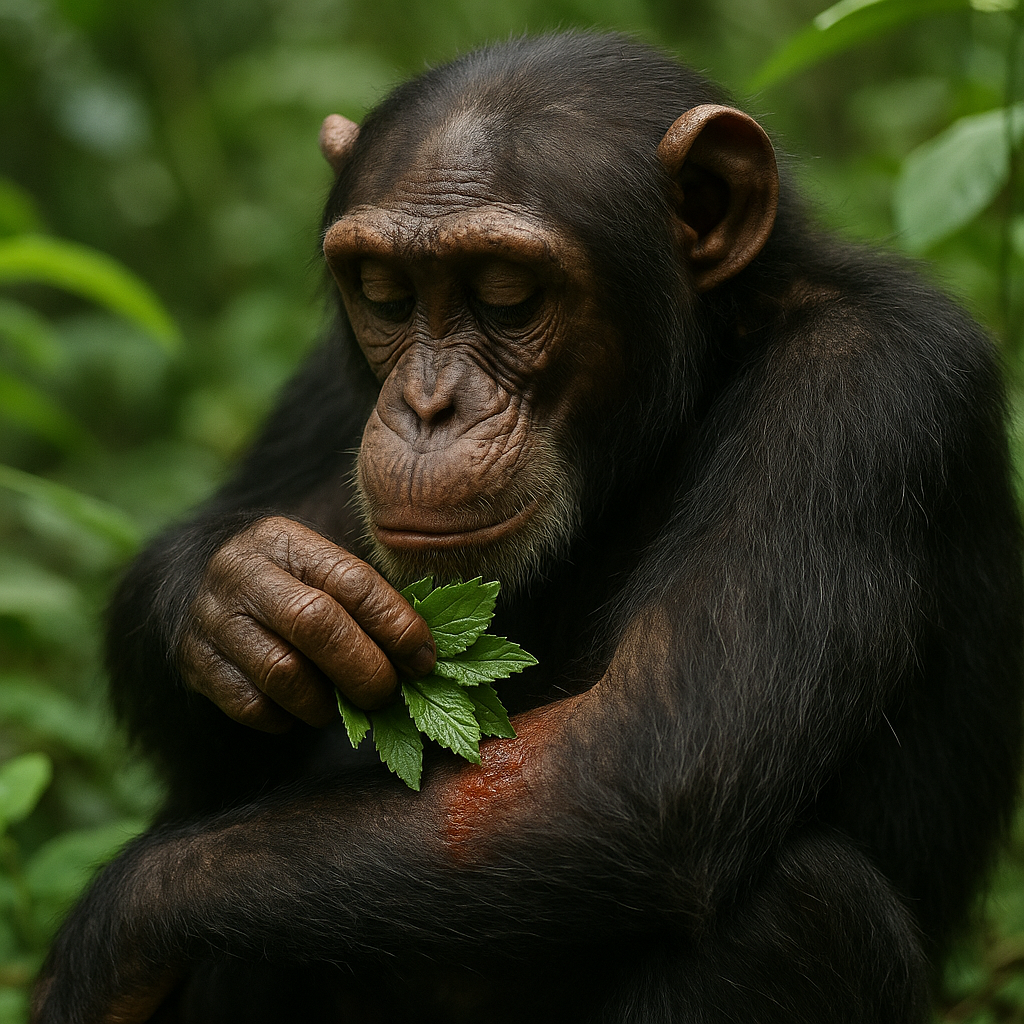
Recent studies in Uganda have shown that wild chimpanzees are using plants to help heal their injuries. Researchers from the University of Oxford, along with a local team in Budongo Forest, observed these chimpanzees using plants as a kind of first aid. This research builds on earlier findings that chimpanzees look for specific plants to treat themselves. By gathering years of observations, scientists have created a detailed list of how chimpanzees practice what can be called "forest first aid."
The study was published in a journal called *Frontiers in Ecology and Evolution*, and it adds to the growing evidence that primates like chimpanzees, orangutans, and gorillas use natural remedies to stay healthy in the wild. Elodie Freymann, the lead researcher, pointed out that chimpanzees show different behaviors when they are sick or hurt, including treating their own injuries and keeping clean. For example, some chimpanzees have been seen putting plants on their wounds or chewing them up before applying the paste to their injuries.
One interesting observation involved a young female chimpanzee who was seen chewing on a plant and then putting it on a wound on her mother. The researchers also noticed that chimpanzees sometimes help each other with injuries, which suggests they might feel empathy. These findings are important because they show that chimpanzees have complex social and emotional behaviors.
The research team also used a lot of notes collected over many years at a field station in Budongo Forest. This logbook includes detailed stories from local staff, researchers, and visitors about what they have seen chimpanzees do. Some notes describe chimpanzees using leaves to treat injuries or helping others get rid of traps. One note even mentions a chimpanzee using leaves for cleaning itself after going to the bathroom, showing behaviors that are similar to humans. The researchers also found that many of the plants chimpanzees use have antibacterial properties, which could lead to new medicines. Dr. Freymann highlighted that studying these wild chimpanzees gives us valuable insights into nature and how these animals survive in their environment.
Original news source: Wild chimpanzees filmed using forest 'first aid' (BBC)
🎧 Listen:
📖 Vocabulary:
Group or Classroom Activities
Warm-up Activities:
– CHARADES
Instructions: Divide the class into small groups. Each group will take turns acting out a specific behavior or action related to chimpanzees and their use of plants for healing (e.g., chewing leaves, applying plants to wounds). The other groups will guess what they are acting out. This will help them engage with the article in a fun way and reinforce vocabulary.
– OPINION POLL
Instructions: Create a series of statements related to the article (e.g., "Chimpanzees are intelligent creatures," "Animals should use natural remedies"). Students will walk around the classroom, find peers who agree or disagree with the statements, and discuss their opinions. This encourages speaking and listening skills while connecting with the article's themes.
– MIND MAP
Instructions: In small groups, students will create a mind map based on the article. They should start with "Chimpanzees and Healing" in the center and branch out with ideas such as "types of plants," "observations," "empathy," and "human similarities." This will help students organize their thoughts and visualize the information from the article.
– HEADLINE CREATION
Instructions: Students will work individually or in pairs to create catchy headlines for the article. They should aim to capture the main ideas and key themes, such as the use of plants by chimpanzees for healing. Afterward, they will share their headlines with the class, promoting creativity and summarization skills.
– SYNONYM CHALLENGE
Instructions: Provide students with a list of vocabulary words from the article (e.g., "observe," "injury," "empathy"). In pairs, they will come up with as many synonyms as they can for each word within a set time limit. This activity will help expand their vocabulary and understanding of nuanced meanings.
🤔 Comprehension Questions:
Chimpanzees show behaviors like treating their own injuries, keeping clean, and using plants to help heal their wounds.
The researchers gathered information by observing chimpanzees over many years in Budongo Forest and by collecting detailed notes from local staff, researchers, and visitors about what they witnessed.
This observation is significant because it suggests that chimpanzees may feel empathy for one another, as the young chimpanzee was helping her mother heal.
The article suggests that chimpanzees have complex emotional behaviors, including empathy, as they help each other with injuries and show concern for one another's well-being.
The findings show that primates like chimpanzees use natural remedies to stay healthy, which indicates they have knowledge of their environment and how to use it for healing.
Chimpanzees have been observed using various plants, many of which have antibacterial properties, which could help prevent infections.
The logbook is important because it contains detailed stories and observations that provide valuable evidence of chimpanzee behaviors and their use of plants for healing.
The research might lead to new medicines because the plants used by chimpanzees have antibacterial properties, which could inspire new treatments for humans.
🎧✍️ Listen and Fill in the Gaps:
Recent studies in Uganda have shown that wild chimpanzees are using plants to help heal their . Researchers from the University of Oxford, along with a local team in Budongo , observed these chimpanzees using plants as a kind of first aid. This research builds on earlier findings that chimpanzees look for specific plants to treat themselves. By gathering years of , scientists have created a detailed list of how chimpanzees practice what can be called "forest first aid." The study was in a journal called *Frontiers in Ecology and Evolution*, and it adds to the growing evidence that primates like chimpanzees, orangutans, and gorillas use natural remedies to stay healthy in the wild. Elodie Freymann, the lead , pointed out that chimpanzees show different behaviors when they are sick or hurt, treating their own injuries and keeping clean. For example, some chimpanzees have been seen putting on their wounds or chewing them up before applying the paste to their injuries. One interesting observation involved a female chimpanzee who was seen chewing on a plant and then putting it on a wound on her . The researchers also noticed that chimpanzees sometimes help each other with injuries, which suggests they might feel . These findings are important because they show that chimpanzees have complex social and emotional behaviors. The research team also used a lot of notes collected over many years at a field station in Budongo Forest. This logbook includes detailed from local staff, researchers, and about what they have seen s do. Some notes describe chimpanzees using leaves to treat injuries or others get rid of traps. One note even mentions a chimpanzee using leaves for itself after going to the bathroom, showing behaviors that are similar to humans. The researchers also found that many of the plants chimpanzees use have antibacterial properties, which could lead to new medicines. Dr. Freymann highlighted that studying these wild chimpanzees gives us insights into nature and how these animals survive in their environment.
💬 Discussion Questions:
1. What is your opinion on the idea that animals can use plants for healing?
2. How would you feel if you saw an animal helping another animal with an injury?
3. Do you think it's important for humans to learn from animals about natural remedies? Why or why not?
4. What is a natural remedy that you know of or have used?
5. How do you think chimpanzees feel when they help each other with injuries?
6. Do you like the idea of using plants for medicine instead of chemicals? Why?
7. How would you react if you found out that a friend was using natural remedies instead of going to the doctor?
8. Do you think empathy is something that only humans have, or do you believe animals can feel it too? Why?
9. What is a time when you helped someone who was hurt or sick?
10. How would you feel if you had to rely on nature to heal yourself?
11. Do you think it’s possible for other animals to have similar healing practices like chimpanzees? Why or why not?
12. What is your favorite plant, and do you think it has any health benefits?
13. How important do you think it is to study animal behavior in the wild?
14. Do you think scientists should spend more time observing animals in their natural habitats? Why?
15. How would you feel if you discovered a new plant that could help treat an illness?
Individual Activities
📖💭 Vocabulary Meanings:
Click a dot next to a word, then click the dot next to its meaning to draw a line connecting them.
Words
Meanings
🔡 Multiple Choice Questions:
🕵️ True or False Questions:
📝 Write a Summary:
Write a summary of this news article in two sentences.
Check your writing now with the best free AI for English writing!