
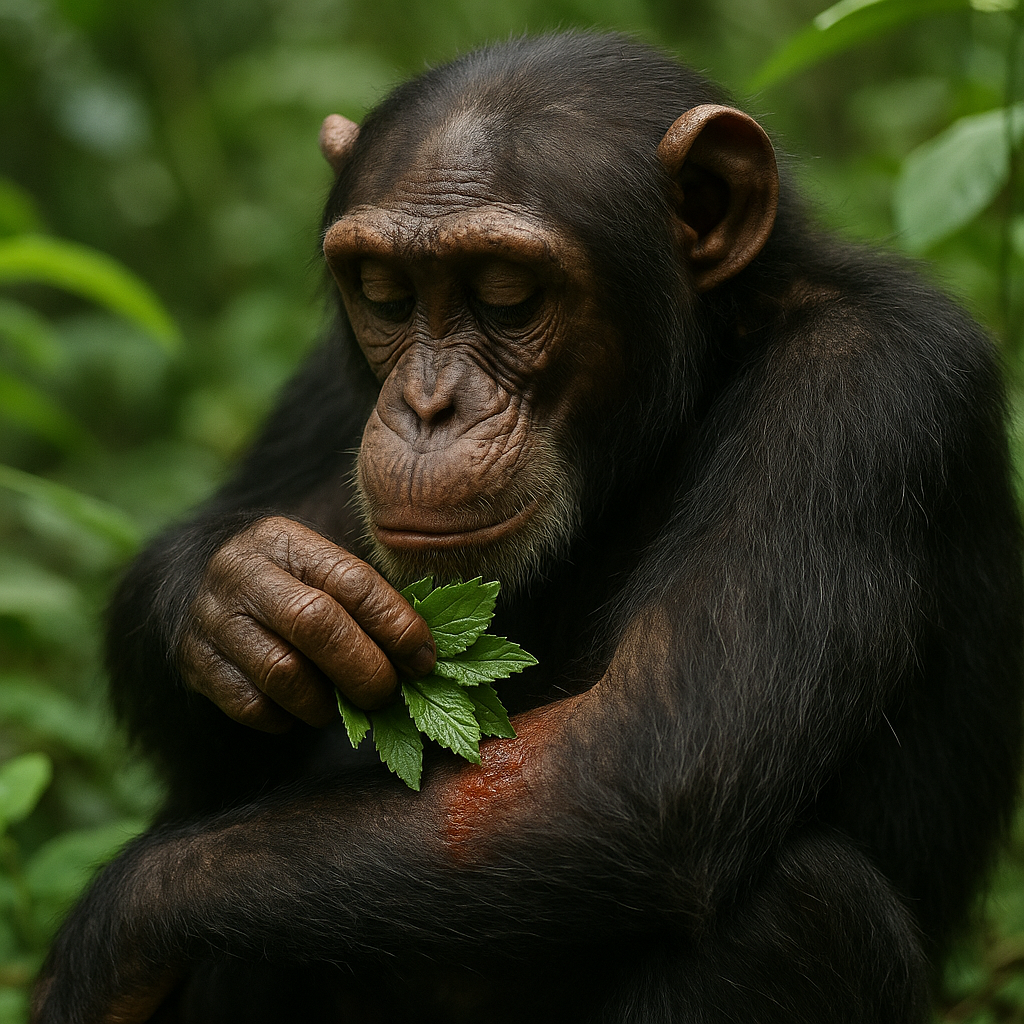
Recent observations in Uganda have revealed that wild chimpanzees are utilizing medicinal plants for self-treatment of injuries. Researchers from the University of Oxford, in collaboration with a local team in the Budongo Forest, documented instances of these primates applying plants as a form of first aid. This research builds upon previous findings that chimpanzees actively seek out specific plants to self-medicate. By compiling decades of observations, the scientists have created a comprehensive catalogue detailing the various methods through which chimpanzees engage in what can be termed "forest first aid."
The study, published in the journal *Frontiers in Ecology and Evolution*, contributes to the growing body of evidence indicating that primates, including chimpanzees, orangutans, and gorillas, employ natural remedies to maintain their health in the wild. Lead researcher Elodie Freymann emphasized that chimpanzees exhibit a range of behaviors when they are sick or injured, which includes self-treatment and hygiene maintenance. For instance, chimpanzees have been observed dabbing plants onto their wounds or chewing them before applying the resulting paste to their injuries.
One particularly noteworthy observation involved a young female chimpanzee who was seen chewing plant material and applying it to a wound on her mother. Additionally, the researchers documented instances where chimpanzees cared for the injuries of unrelated individuals, suggesting a capacity for empathy among these animals. Such findings are significant as they highlight the social and emotional complexities of chimpanzee behavior.
The researchers also drew upon a wealth of anecdotal evidence collected over decades at a field station in the Budongo Forest. This logbook contains detailed accounts from local field staff, researchers, and visitors, documenting various behaviors observed in chimpanzees. Some entries describe instances of chimps using leaves to dab injuries or assisting others in removing snares. Remarkably, one note even details a chimpanzee using leaves for personal hygiene after defecating, showcasing behaviors that resemble human habits.
In addition to documenting these behaviors, the research team has identified specific plants that chimpanzees consume when injured and discovered that many of these plants possess antibacterial properties. This knowledge not only enhances our understanding of chimpanzee behavior but may also contribute to the discovery of new medicinal compounds. Dr. Freymann remarked on the profound insights gained from studying these wild apes, suggesting that there is much we still do not understand about the natural world and the survival strategies employed by chimpanzees in their environment.
Original news source: Wild chimpanzees filmed using forest 'first aid' (BBC)
🎧 Listen:
📖 Vocabulary:
Group or Classroom Activities
Warm-up Activities:
– CHARADES
Instructions: Divide the class into small teams. Each team will take turns acting out different scenarios based on the behaviors of chimpanzees described in the article (e.g., applying medicinal plants, caring for another chimp's injury) without using words. The other teams will guess what scenario is being portrayed.
– OPINION POLL
Instructions: Pose the question, “Do you think animals, like chimpanzees, should be studied for their use of medicinal plants?” Students will walk around the room and ask their classmates for their opinions, tallying responses. Afterward, discuss the varied perspectives as a class.
– MIND MAP
Instructions: On a whiteboard or large paper, create a mind map as a class. Start with the central theme "Chimpanzee Self-Medication" and branch out with ideas from the article, such as behaviors, empathy, specific plants, and implications for human medicine. Encourage students to contribute their thoughts and connections.
– SYNONYM CHALLENGE
Instructions: Write down key vocabulary words from the article (e.g., "self-treatment," "antibacterial," "empathy"). In pairs, students will come up with synonyms for each word. Afterward, groups will share their synonyms and discuss any nuances in meaning.
– NEWS REPORTER ROLE-PLAY
Instructions: In pairs, one student will act as a news reporter and the other as a researcher from the article. The reporter will interview the researcher about the findings on chimpanzee behavior and self-medication. After a few minutes, students will switch roles, allowing everyone to practice speaking and questioning skills.
🤔 Comprehension Questions:
Chimpanzees exhibit a range of behaviors including self-treatment, hygiene maintenance, dabbing plants onto their wounds, and chewing plants to apply the resulting paste to their injuries.
The researchers compiled their observations by drawing upon decades of anecdotal evidence collected at a field station in the Budongo Forest, which included detailed accounts from local field staff, researchers, and visitors.
A noteworthy observation involved a young female chimpanzee who was seen chewing plant material and applying it to a wound on her mother, demonstrating care and concern.
The documented behaviors, such as caring for the injuries of unrelated individuals and exhibiting empathy, highlight the social and emotional complexities of chimpanzee behavior, suggesting they possess a deeper understanding of social bonds.
The researchers utilized anecdotal evidence from a logbook containing detailed accounts of chimpanzee behaviors observed over decades, as well as direct observations of specific self-medication practices.
Many of the identified plants that chimpanzees consume possess antibacterial properties, which suggests they may help in healing injuries and maintaining their health.
The study implies that understanding chimpanzee self-medication practices could contribute to the discovery of new medicinal compounds and enhance our knowledge of natural remedies.
Dr. Freymann suggests that there are profound insights to be gained from studying wild chimpanzees, indicating that much remains to be understood about their survival strategies and the natural world.
🎧✍️ Listen and Fill in the Gaps:
Recent in Uganda have revealed that wild chimpanzees are utilizing medicinal plants for self-treatment of injuries. Researchers from the University of Oxford, in collaboration with a local team in the Budongo Forest, instances of these primates applying plants as a form of first aid. This research builds upon previous findings that chimpanzees actively seek out specific plants to self-medicate. By compiling of observations, the scientists have created a comprehensive catalogue detailing the various methods through which chimpanzees in what can be termed "forest first aid." The study, published in the journal *Frontiers in Ecology and Evolution*, contributes to the growing body of evidence indicating that primates, including chimpanzees, orangutans, and gorillas, employ natural to maintain their health in the wild. Lead researcher Elodie Freymann emphasized that chimpanzees exhibit a range of behaviors when they are sick or injured, which includes self-treatment and hygiene maintenance. For , chimpanzees have been observed dabbing plants onto their wounds or chewing them before the resulting to their injuries. One particularly noteworthy observation involved a young female chimpanzee who was seen chewing plant material and applying it to a wound on her mother. Additionally, the researchers documented instances where s cared for the injuries of unrelated individuals, suggesting a capacity for empathy among these animals. Such findings are significant as they highlight the social and complexities of chimpanzee behavior. The researchers also drew upon a wealth of anecdotal collected over decades at a field station in the Budongo Forest. This logbook contains detailed accounts from local field staff, researchers, and visitors, documenting various observed in chimpanzees. Some entries describe instances of chimps using leaves to dab injuries or assisting others in removing snares. Remarkably, one note even details a chimpanzee using leaves for personal after defecating, showcasing behaviors that resemble human habits. In addition to documenting these behaviors, the team has identified specific plants that chimpanzees consume when injured and discovered that many of these plants possess antibacterial properties. This knowledge not only enhances our understanding of chimpanzee behavior but may also contribute to the discovery of new medicinal . Dr. Freymann remarked on the profound insights gained from studying these wild apes, suggesting that there is much we still do not understand about the natural world and the survival strategies by chimpanzees in their environment.
💬 Discussion Questions:
1. What is your opinion on the idea that animals, like chimpanzees, can use plants for self-medication?
2. How would you feel if you witnessed an animal using natural remedies to treat its injuries?
3. Do you think humans could learn something from observing animal behavior in nature? Why or why not?
4. What is a natural remedy that you or someone you know has used for health issues?
5. How do you think the ability to self-medicate impacts the survival of wild animals?
6. Do you like the idea of using traditional medicine instead of modern medicine? Why or why not?
7. How would you feel if you discovered that a close relative was caring for someone else's injuries, similar to the chimpanzees in the article?
8. Do you think empathy is a trait unique to humans, or do you believe it exists in other species as well? Why?
9. What is a significant lesson you think humans can learn from studying the behavior of chimpanzees?
10. How would you react if you saw someone using a plant as a remedy in your community?
11. Do you think it is important to preserve natural habitats like the Budongo Forest for the sake of wildlife? Why?
12. How would you feel if you were able to identify a plant that could help with a common health issue?
13. Do you think more research should be conducted on animal behavior and their use of natural remedies? Why or why not?
14. What is a way in which you think society could benefit from understanding animal behavior better?
15. How do you think the findings from this research could influence the future of medicine or health practices?
Individual Activities
📖💭 Vocabulary Meanings:
Click a dot next to a word, then click the dot next to its meaning to draw a line connecting them.
Words
Meanings
🔡 Multiple Choice Questions:
🕵️ True or False Questions:
📝 Write a Summary:
Write a summary of this news article in two sentences.
Check your writing now with the best free AI for English writing!