

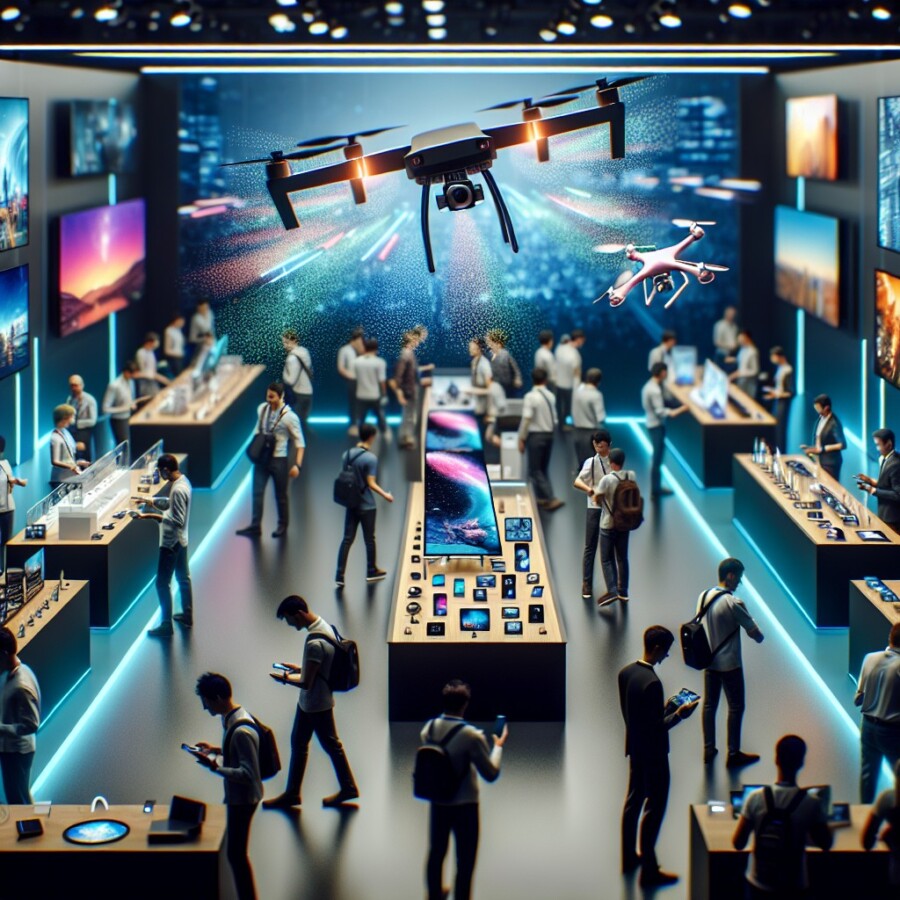
The Consumer Electronics Show (CES) is a big event where tech companies show off their newest gadgets. Some of these gadgets say they have artificial intelligence (AI). For example, there's a pillow that can tell if you're snoring and adjusts to help you stop. Samsung also has some AI devices, like a vacuum cleaner and a washing machine that can figure out what kind of surface or fabric it's dealing with. But the problem is, the definition of AI is kind of fuzzy, and some companies are using the term to get attention and money. This has made people worried about false claims and misleading ads.
The main issue with AI is that there isn't one clear definition that everyone agrees on. This has led to a lot of hype and companies exaggerating what their AI can do. The Federal Trade Commission (FTC) in the US has told companies to be careful about making false claims, but even they admit that AI is a tricky term with lots of different meanings. As a journalist, it's hard to know if these claims are true when companies don't give much evidence.
Some companies are starting to avoid using the term AI and instead talk about specific AI techniques or models. For example, Rabbit's R1 device uses something called generative AI, but they don't make a big deal about it in their ads. Samsung's fridge that can analyze food and suggest recipes is a good example of AI in action. But do people really need their fridge to tell them what to cook?
In the end, there are a lot of products at CES claiming to have AI, but the definition of AI is still unclear. Companies might be stretching the truth to get attention. This makes it hard for consumers and journalists to know if these claims are real. Some companies are already moving away from using the term AI and focusing on specific AI techniques instead. It's up to consumers to decide if they really need AI gadgets or if regular ones are good enough.
Original news source: CES 2024: AI pillows and toothbrushes – is it all getting a bit silly? (BBC)
🎧 Listen:
📖 Vocabulary:
Group or Classroom Activities
Warm-up Activities:
– Headline Creation
Instructions: In pairs or small groups, students will create attention-grabbing headlines for articles about AI gadgets at the Consumer Electronics Show (CES). They should try to use catchy or intriguing language to draw readers in.
– Opinion Spectrum
Instructions: Create a spectrum on the board with "Strongly Agree" on one end and "Strongly Disagree" on the other. Give each student a sticky note and have them write their opinion on whether AI gadgets are necessary or if regular ones are good enough. Then, have them place their sticky note on the spectrum according to their opinion. Allow students to share their reasoning and discuss their placement on the spectrum.
– Synonym Challenge
Instructions: Give each student a piece of paper with a word related to the article written on it (e.g. "exaggerating," "misleading," "claim," etc.). In pairs or small groups, students should take turns giving synonyms or related words for their assigned word. Encourage them to use a variety of vocabulary and discuss the meanings of the words.
– Future Predictions
Instructions: In pairs or small groups, students will take turns making predictions about the future of AI gadgets. They should consider both positive and negative impacts, as well as potential advancements or challenges. After discussing their predictions, they can share their ideas with the class.
– Pass the Story
Instructions: Begin a story related to AI gadgets at CES (e.g. "Once upon a time at CES, a company unveiled a revolutionary AI device…"). Have one student start the story and then pass it on to the next student who adds a sentence. Continue passing the story around the class until everyone has contributed. Encourage creativity and imagination in the story, incorporating elements of AI gadgets.
🤔 Comprehension Questions:
🎧✍️ Listen and Fill in the Gaps:
The Consumer Electronics Show (CES) is a big event where tech companies show off their newest gadgets. Some of these gadgets say they have artificial intelligence (AI). For example, there's a pillow that can tell if you're and to help you stop. also has some AI devices, like a vacuum cleaner and a washing machine that can figure out what kind of surface or it's dealing with. But the problem is, the definition of AI is kind of fuzzy, and some companies are using the term to get attention and money. This has made people worried about false claims and misleading ads. The main with AI is that there isn't one clear definition that everyone agrees on. This has led to a lot of hype and companies what their AI can do. The Federal Trade Commission (FTC) in the US has told companies to be about false claims, but even they admit that AI is a tricky term with lots of different meanings. As a journalist, it's hard to know if these claims are true when don't give much evidence. Some companies are starting to using the term AI and instead talk about specific AI techniques or models. For example, Rabbit's R1 device uses something generative AI, but they don't make a big deal about it in their ads. Samsung's that can analyze food and suggest recipes is a good example of AI in action. But do people really need their fridge to tell them what to cook? In the end, there are a lot of products at CES claiming to have AI, but the of AI is still unclear. Companies might be the truth to get attention. This makes it hard for consumers and journalists to know if these claims are real. Some companies are already moving away from the term AI and focusing on specific AI techniques instead. It's up to consumers to decide if they really need AI or if regular ones are good enough.
💬 Discussion Questions:
1. What is artificial intelligence (AI) and why do you think it's important in technology?
2. How would you feel if you bought a gadget that claimed to have AI but it didn't actually perform the tasks it promised?
3. Do you think it's fair for companies to use the term AI to get attention and money, even if their products don't truly have AI capabilities? Why or why not?
4. What do you think about the Federal Trade Commission's warning to companies about making false claims regarding AI? Do you think it's necessary?
5. How do you think journalists can verify the truthfulness of companies' claims about AI when there is limited evidence?
6. What are some specific AI techniques or models that companies could use instead of using the term AI in their advertisements?
7. Do you think it's useful for a fridge to analyze food and suggest recipes? Why or why not?
8. How do you think consumers can determine if they really need AI gadgets or if regular ones are good enough?
9. Have you ever used a gadget or appliance that claimed to have AI? If so, did it meet your expectations? Why or why not?
10. What are some potential advantages of having AI devices in our homes? Can you think of any disadvantages?
11. Do you think it's important for companies to have a clear and agreed-upon definition of AI? Why or why not?
12. How do you think companies can avoid misleading consumers with false claims about AI?
13. Have you ever been influenced to buy a product because it claimed to have AI capabilities? How did you feel about your purchase afterwards?
14. What do you think the future holds for AI in consumer electronics? Do you think it will become more common or less common? Why?
15. If you were in charge of regulating the use of the term AI in advertisements, what rules or guidelines would you put in place?
Individual Activities
📖💭 Vocabulary Meanings:
Click a dot next to a word, then click the dot next to its meaning to draw a line connecting them.
Words
Meanings
🔡 Multiple Choice Questions:
🕵️ True or False Questions:
📝 Write a Summary:
Write a summary of this news article in two sentences.
Check your writing now with the best free AI for English writing!