Matthew Myerscough, who survived an avalanche, discovered a rare marine fossil in Wales. After recovering from the incident on Snowdon in 2014, he found fossil hunting therapeutic for dealing with his trauma. Moving from the mountains to the beach, he uncovered a jawbone of a 'sea dragon' from the Jurassic period.
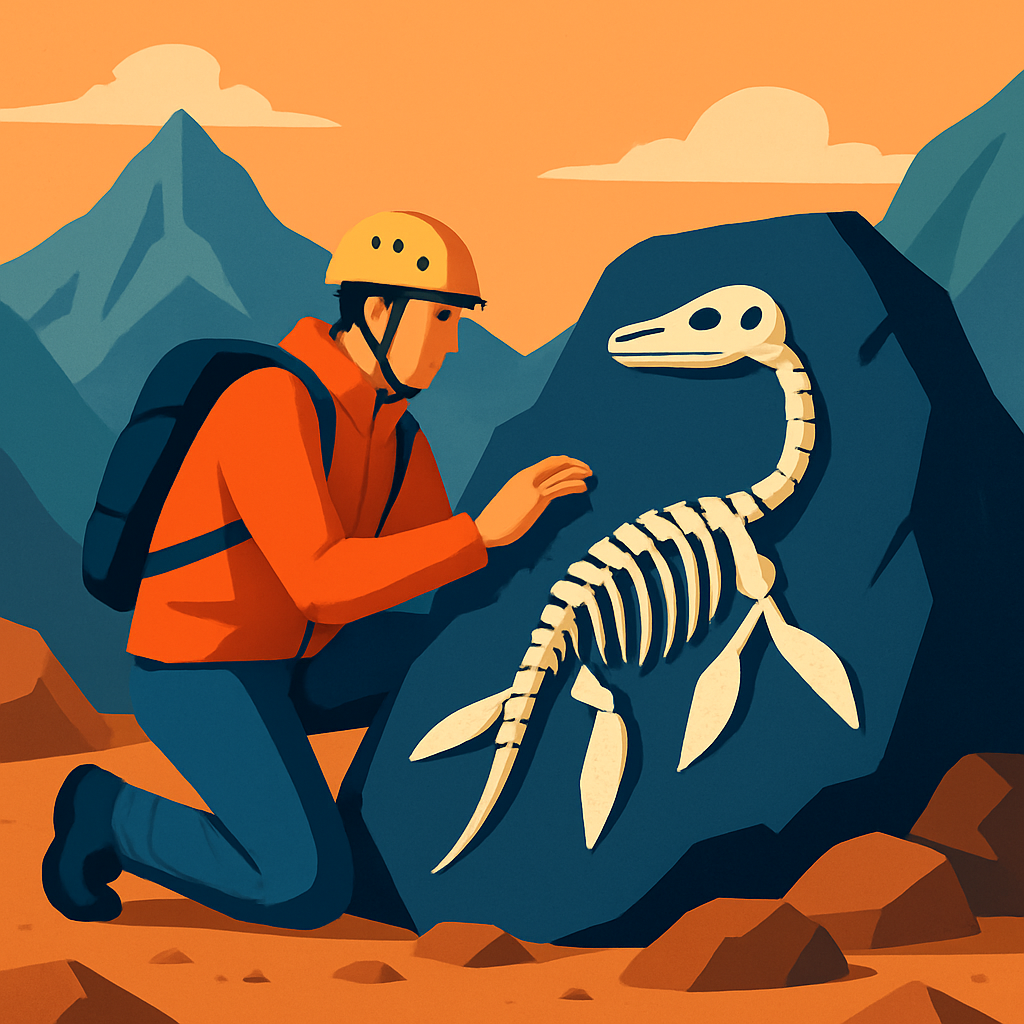
Matthew, a civil engineer by profession, found solace in fossil hunting, comparing it to mindfulness practices. His significant discovery at Lavernock Point was of a type of plesiosaur rare in Wales. This find provided him with peace and a sense of contribution to the scientific community.
On the beach, Matthew noticed a large shape in the rocks, with some assistance from others around him. Experts later confirmed that it was a rhomaleosaurus, a type of marine reptile. This fossil is currently being studied by the National Museum Cardiff, which aims to publish an academic paper about it.
Matthew stresses that fossil hunting requires keen observation and describes it as an enjoyable and rewarding pastime. He encourages families to engage in it, and through his writings, he hopes to inspire a new generation of fossil enthusiasts.
13. pastimea hobby or activity done in one's free time
14. encourageto give support or advice to do something
15. inspireto fill with the urge or ability to do something
Group or Classroom Activities
Warm-up Activities:
1. Have you ever heard of avalanches before? What are they? 2. Can you name any famous fossils or dinosaurs you've learned about? 3. Have you ever visited a museum with fossils? 4. What activities do you find calming or therapeutic? 5. Do you think hobbies can help people recover from traumatic experiences? Why or why not?
🤔 Comprehension Questions:
1. What incident did Matthew survive?
He survived an avalanche.
2. What activity helped Matthew with his trauma?
Fossil hunting helped him with his trauma.
3. Where did Matthew make his significant fossil discovery?
He made his discovery at Lavernock Point.
4. What was the fossil identified as?
It was identified as a rhomaleosaurus.
5. What does Matthew compare fossil hunting to?
He compares it to mindfulness practices.
6. What is Matthew’s profession?
He is a civil engineer.
7. Where is the fossil being studied?
It is being studied at the National Museum Cardiff.
🎧✍️ Listen and Fill in the Gaps:
Matthew , who survived an avalanche, discovered a rare fossil in Wales. After recovering from the incident on Snowdon in 2014, he found fossil hunting for dealing with his trauma. Moving from the mountains to the beach, he a jawbone of a 'sea dragon' from the Jurassic period. Matthew, a civil engineer by , found in hunting, comparing it to mindfulness practices. His significant discovery at Lavernock Point was of a type of plesiosaur rare in . This find provided him with peace and a sense of contribution to the community. On the beach, Matthew noticed a large shape in the rocks, with some assistance from others around him. Experts later that it was a rhomaleosaurus, a type of marine reptile. This fossil is being studied by the Museum , which aims to publish an academic paper about it. Matthew stresses that fossil hunting requires keen observation and describes it as an and . He encourages families to engage in it, and through his writings, he hopes to inspire a new generation of fossil enthusiasts.
💬 Discussion Questions:
1. What would you do if you found a rare fossil? 2. How important do you think it is to study fossils? 3. Do you have any hobbies that help you relax or feel less stressed? 4. Do you think fossil hunting would be an interesting pastime? Why or why not? 5. Why do you think museums are important for preserving history? 6. Have you ever collected anything, like stamps or rocks? Why did you enjoy it? 7. What do you think of the idea of contributing to science through a hobby? 8. Do you think it is easy or difficult to spot fossils? Why? 9. Would you prefer activities in nature or indoor activities? Why? 10. How do you feel about writing down your experiences to inspire others? 11. Do you think it's possible to make a career out of a hobby like fossil hunting? 12. What's the most interesting thing you've learned about the Jurassic period?
Individual Activities
📖💭 Vocabulary Meanings:
Click a dot next to a word, then click the dot next to its meaning to draw a line connecting them.
Words
1. avalanche
2. trauma
3. therapeutic
4. solace
5. significant
6. contribution
7. community
8. assistance
9. confirmed
10. reptile
11. observation
12. rewarding
13. pastime
14. encourage
15. inspire
Meanings
(A) comfort in a time of sadness
(B) a group of people living in the same place or having a particular characteristic in common
(C) a hobby or activity done in one's free time
(D) important or notable
(E) careful watching and listening
(F) verified as correct
(G) a cold-blooded, scaley vertebrate animal
(H) a large mass of snow, ice, and rocks falling rapidly
(I) having a healing or calming effect
(J) a deeply distressing or disturbing experience
(K) giving satisfaction or pleasure
(L) help or support
(M) helping to make something successful
(N) to give support or advice to do something
(O) to fill with the urge or ability to do something
🔡 Multiple Choice Questions:
1. What did Matthew Myerscough discover?
(a) A new dinosaur species
(b) A buried treasure
(c) An ancient city
(d) A rare marine fossil
2. Where did the avalanche incident occur?
(a) Lavernock Point
(b) National Museum Cardiff
(c) Snowdon
(d) Jurassic Park
3. What was the fossil Matthew found identified as?
(a) Tyrannosaurus
(b) Rhomaleosaurus
(c) Allosaurus
(d) Brontosaurus
4. What kind of professional is Matthew?
(a) Civil engineer
(b) Marine biologist
(c) Geologist
(d) Archaeologist
5. Where is Lavernock Point located?
(a) Wales
(b) England
(c) Scotland
(d) Ireland
6. What does Matthew compare fossil hunting to?
(a) Playing sports
(b) Painting
(c) Cooking
(d) Mindfulness practices
7. Where is the fossil being researched?
(a) British Museum
(b) National Museum Cardiff
(c) Smithsonian Institution
(d) Louvre Museum
8. What does Matthew hope to do through his writings?
(a) Start a new museum
(b) Sell fossils for profit
(c) Inspire future fossil enthusiasts
(d) Publish a bestseller
🕵️ True or False Questions:
1. Matthew Myerscough perished in an avalanche.
2. He found a marine fossil in Wales.
3. Matthew is a mechanical engineer.
4. Matthew finds fossil hunting similar to mindfulness practices.
5. The incident happened in 2015.
6. National Museum Cardiff is studying the fossil.
7. His discovery was identified as a rhomaleosaurus.
8. The fossil was a skull of a 'land dinosaur.'
Writing Questions:
1. Describe a time when you found something unexpected during a trip or walk.
2. Do you believe hobbies can be as important as work? Why or why not?
3. Write about an experience that helped you overcome a difficult time.
4. What changes would you make to encourage more people to take up fossil hunting?
5. Imagine finding a new dinosaur species. How would you react and what steps would you take?
Students at Media City’s University Technical College recently participated in a project that required them to give up their smartphones and use basic Nokia handsets instead, highlighting the dependence and reliance that many young people have on their smartphones.
Scientists are using insect surveillance and climate forecasts to fight climate-fuelled diseases, developing prediction tools to understand how changes in climate and land-use impact insect-borne diseases and deliver early warning systems to help communities prepare and prevent the spread of diseases.
Nearly half a billion small electrical items, known as “Fast Tech,” were thrown away in the UK last year, making them the fastest-growing type of e-waste.