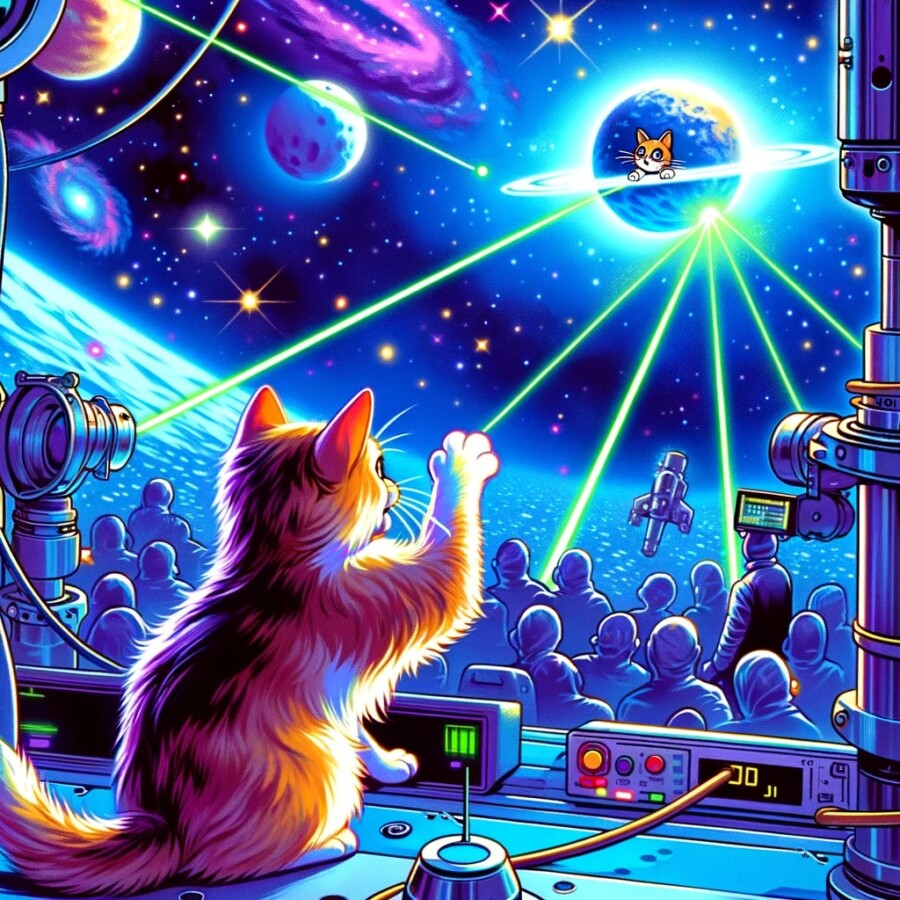
Nasa recently did something really cool – they streamed a high-definition video of a cat from space back to Earth! The video showed a cat named Taters chasing a laser beam. What's even more amazing is that the video traveled a whopping 19 million miles, which is like going to the Moon and back 80 times! Nasa did this to test a new laser technology that could help us communicate better with faraway parts of our solar system. Taters, the star of the video, belongs to someone who works at Nasa's Jet Propulsion Laboratory in California. The video was uploaded to a spacecraft launched by SpaceX and was streamed on 11 December.
Even though the video had to travel such a long distance, it was actually transmitted faster than most internet connections we have on Earth! It was received by a telescope at the Palomar observatory and then downloaded. From there, it was streamed to the Jet Propulsion Laboratory and played in real-time. The connection between the observatory and the laboratory was slower than the signal sending the video from space. Nasa's DesignLab played a big role in showing off this technology, and everyone involved was really happy that the experiment was a success.
You can find the video on YouTube, and it's pretty cool. They made it special by adding information about the mission and details about Taters, like what breed he is, his heart rate, and his age. This project is part of Nasa's mission to explore communication in deep space. They're trying to find ways to send more data from faraway places to Earth. Radio frequencies have a hard time sending high-quality images and videos over long distances, so Nasa is working on using lasers to make communication better. They want to have more bandwidth to achieve their future exploration and science goals.
Nasa's achievement in sending a cat video from space using lasers is a big deal. It could change how we communicate during missions to other planets and help us send more data during space exploration. By pushing the limits of laser communication, Nasa is making it easier to talk to faraway parts of our solar system.
Original news source: Nasa beams cat video from deep space with laser (BBC)
🎧 Listen:
📖 Vocabulary:
Group or Classroom Activities
Warm-up Activities:
– News Summary
Instructions:
1. Divide the class into pairs or small groups.
2. Provide each group with a copy of the article.
3. Instruct the groups to read the article and summarize it in their own words.
4. Each group should then present their summary to the class.
5. Encourage discussion and ask follow-up questions to check comprehension.
– Vocabulary Pictionary
Instructions:
1. Write down key vocabulary words from the article on separate pieces of paper and put them in a hat or bowl.
2. Divide the class into teams.
3. One student from each team will take turns picking a word from the hat and drawing it on the board.
4. The team members must guess the word within a time limit.
5. The team with the most correct guesses wins.
– Think-Pair-Share
Instructions:
1. Ask the students to think about and write down their thoughts on the following question: "How do you think the use of laser technology in space communication could benefit future space exploration?"
2. Pair the students up and give them a few minutes to discuss their ideas with their partner.
3. After the discussion, ask each pair to share their thoughts with the rest of the class.
4. Encourage further discussion and ask follow-up questions to promote critical thinking and analysis.
– Charades
Instructions:
1. Write down key words or phrases related to the article on separate pieces of paper and put them in a hat or bowl.
2. Divide the class into teams.
3. One student from each team will take turns picking a word or phrase from the hat and acting it out without speaking.
4. The team members must guess the word or phrase within a time limit.
5. The team with the most correct guesses wins.
– Future Predictions
Instructions:
1. Instruct the students to brainstorm and write down their predictions for how communication in space will evolve in the future.
2. Divide the class into small groups and have them discuss their predictions.
3. Each group should choose a spokesperson to present their predictions to the class.
4. Encourage discussion and ask follow-up questions to promote critical thinking and creativity.
🤔 Comprehension Questions:
NASA streamed a high-definition video of a cat from space back to Earth.
The star of the video was a cat named Taters.
The video traveled a whopping 19 million miles.
NASA streamed the video to test a new laser technology that could help us communicate better with faraway parts of our solar system.
The video was transmitted faster because it was sent using laser technology, which is faster than radio frequencies.
The video was received and downloaded at the Palomar observatory.
Information about the mission and details about Taters, like his breed, heart rate, and age, were added to the video on YouTube.
NASA is working on using lasers because radio frequencies have a hard time sending high-quality images and videos over long distances, and lasers could provide more bandwidth for better communication during space exploration.
🎧✍️ Listen and Fill in the Gaps:
Nasa recently did something really cool – they a high-definition video of a cat from space back to Earth! The video showed a cat named Taters a laser beam. What's even more amazing is that the video traveled a whopping 19 million miles, which is like to the Moon and back 80 times! Nasa did this to test a new laser technology that could help us communicate better with faraway parts of our solar . Taters, the star of the video, belongs to someone who works at Nasa's Jet Propulsion Laboratory in California. The video was uploaded to a launched by SpaceX and was streamed on 11 December. Even though the video had to such a long distance, it was actually transmitted faster than most internet we have on Earth! It was received by a telescope at the Palomar observatory and then downloaded. From there, it was streamed to the Jet Propulsion and played in real-time. The connection between the observatory and the laboratory was slower than the signal sending the video from space. Nasa's DesignLab played a big role in showing off this technology, and everyone involved was really happy that the experiment was a success. You can find the video on YouTube, and it's pretty cool. They made it by adding information about the and about Taters, like what breed he is, his heart rate, and his age. This project is part of Nasa's mission to explore communication in deep space. They're trying to find ways to send more data from faraway places to Earth. Radio have a hard time sending high-quality and videos over long distances, so Nasa is working on using lasers to make communication better. They want to have more bandwidth to achieve their future exploration and science . Nasa's achievement in sending a cat video from space using lasers is a big deal. It could how we communicate during missions to other planets and help us send more data during space exploration. By pushing the of laser communication, Nasa is making it easier to talk to faraway parts of our solar system.
💬 Discussion Questions:
1. What do you think about Nasa streaming a video of a cat from space?
2. How would you feel if you could communicate with someone on another planet?
3. Do you like watching videos of animals? Why or why not?
4. Do you think it's important for Nasa to find better ways to communicate with faraway parts of our solar system? Why or why not?
5. How do you think the new laser technology could be useful in space exploration?
6. Have you ever seen a laser beam? What was your experience like?
7. What do you think it would be like to work at Nasa's Jet Propulsion Laboratory in California?
8. How do you think the cat, Taters, felt when he was chasing the laser beam in space?
9. Do you think it's impressive that the video traveled a distance equivalent to going to the Moon and back 80 times? Why or why not?
10. How do you think the technology used to transmit the video from space is different from our internet connections on Earth?
11. Do you think it's important for Nasa to share their experiments and achievements with the public? Why or why not?
12. What other types of information do you think could be added to a video like this to make it more interesting?
13. How do you think laser communication could impact future space missions?
14. Have you ever used a telescope? What did you see?
15. Do you think it's possible to communicate with intelligent life on other planets? Why or why not?
Individual Activities
📖💭 Vocabulary Meanings:
Click a dot next to a word, then click the dot next to its meaning to draw a line connecting them.
Words
Meanings
🔡 Multiple Choice Questions:
🕵️ True or False Questions:
📝 Write a Summary:
Write a summary of this news article in two sentences.
Check your writing now with the best free AI for English writing!