
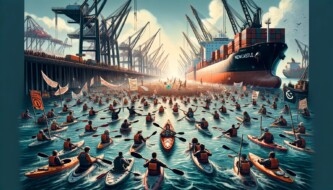
The Port of Newcastle is the most important terminal for coal shipments in Australia. Around 3,000 people from all over the country took part in the 30-hour protest, which the police had approved. However, after the protest was supposed to end, some protesters stayed in the water. This led to 109 arrests, including five minors who were later released. On Monday, 104 people were charged for not leaving the harbour channel.
The protest was organized by a group called Rising Tide. They said it was the "biggest act of civil disobedience for climate in Australia's history." The protest happened right before the global climate change summit. Rising Tide wants the government to tax thermal coal exports and stop new fossil fuel projects. Australia has been criticized for not doing enough about climate change, but the Prime Minister has promised to work with other countries to reduce emissions. However, the government has also approved new coal mines and has more projects waiting for approval.
One of the protesters, a 17-year-old named Anjali Beams, said she was willing to get arrested because young people's concerns about climate change are being ignored. She doesn't want her future to be sacrificed for the profit of the fossil fuel industry.
In summary, more than 100 people were arrested during a protest at the Port of Newcastle in Australia. They were upset about the lack of action on climate change and the country's reliance on coal. The protest happened right before the global climate change summit. The protesters want the government to tax thermal coal exports and stop new fossil fuel projects. The government has set a goal to reduce emissions, but has also approved new coal mines. Young people are taking a stand against the fossil fuel industry because they feel their voices are being ignored.
Original news source: Climate protest: More than 100 arrested at world's largest coal port (BBC)
📖 Vocabulary:
Group or Classroom Activities
Warm-up Activities:
– News Summary
Instructions: Divide the class into pairs or small groups. Give each group a copy of the article. Instruct them to read the article together and then write a concise summary of the main points. After a few minutes, have each group share their summary with the class.
– Opinion Poll
Instructions: Create a list of questions related to the article, such as "Do you agree with the protesters' actions? Why or why not?" or "Should the government tax thermal coal exports?" Have the students individually answer the questions and then pair up to discuss their answers. After the discussion, conduct a class poll by asking students to raise their hands or using a polling app to see how many students agree or disagree with each statement.
– Vocabulary Pictionary
Instructions: Choose 10 vocabulary words from the article, such as "protest," "disobedience," or "emissions." Write each word on a separate piece of paper or index card. Divide the class into teams. One student from each team will come to the front of the class and pick a word without showing it to their team. They must then draw a picture to represent the word while their team tries to guess what it is. The first team to correctly guess the word gets a point.
– Sketch It
Instructions: Divide the class into pairs. Give each pair a copy of the article and a blank piece of paper. Instruct one student in each pair to describe a scene or event from the article while the other student sketches it based on their description. After a few minutes, have the pairs switch roles. Allow time for students to share and compare their sketches with the class.
– Think-Pair-Share
Instructions: Pose a question related to the article, such as "What are some potential solutions to reducing dependence on coal?" or "How can young people effectively advocate for action on climate change?" Have the students individually think about their answer to the question. Then, have them pair up with a partner and discuss their answers. After the discussion, bring the class back together and ask a few pairs to share their ideas with the whole class.
🤔 Comprehension Questions:
The protesters were upset about the lack of action on climate change and the country's dependence on coal.
The protesters blocked the port's shipping lane by swimming or using kayaks.
The protesters believe their actions stopped coal from being exported because they blocked the shipping lane, preventing the coal from being loaded onto ships.
The Port of Newcastle is important for coal shipments in Australia because it is the most important terminal for coal shipments in the country.
Around 3,000 people from all over the country participated in the 30-hour protest.
Some protesters were arrested after the protest was supposed to end because they stayed in the water, refusing to leave the harbour channel.
The protest was organized by a group called Rising Tide. They called it the "biggest act of civil disobedience for climate in Australia's history."
One of the protesters, Anjali Beams, said she was willing to get arrested because young people's concerns about climate change are being ignored and she doesn't want her future to be sacrificed for the profit of the fossil fuel industry.
🎧✍️ Listen and Fill in the Gaps:
More than 100 people were arrested during a protest at the Port of Newcastle in Australia. The protesters were upset about the lack of action on climate change and the country's dependence on coal. They blocked the port's shipping lane by swimming or using . They believe their actions over half a million tonnes of coal from being exported. Australia is the second coal exporter in the world and relies on coal for its energy. The Port of Newcastle is the most important terminal for coal in Australia. Around 3,000 people from all over the country took part in the 30-hour protest, which the police had approved. However, after the protest was supposed to end, some protesters stayed in the water. This led to 109 arrests, including five minors who were later released. On Monday, 104 people were charged for not leaving the harbour channel. The protest was organized by a called Rising Tide. They said it was the "biggest act of civil disobedience for in Australia's ." The protest right before the global climate change summit. Rising Tide wants the government to tax thermal coal exports and stop new fossil fuel projects. Australia has been criticized for not enough about climate change, but the Minister has promised to work with other countries to reduce emissions. However, the government has also approved new coal mines and has more projects waiting for approval. One of the protesters, a 17-year-old named Anjali Beams, said she was to get arrested because young people's concerns about climate change are being ignored. She doesn't want her future to be for the profit of the fossil fuel industry. In summary, more than 100 were arrested during a at the Port of Newcastle in . They were upset about the lack of action on climate change and the country's reliance on coal. The protest happened right before the global climate change . The protesters want the government to tax thermal coal exports and stop new fossil fuel projects. The government has set a goal to reduce emissions, but has also approved new coal mines. Young people are taking a stand against the fossil fuel industry because they feel their voices are being ignored.
💬 Discussion Questions:
1. What is a protest?
2. How would you feel if your concerns about climate change were ignored?
3. Do you think it is important for young people to take a stand on important issues? Why or why not?
4. Why do you think the protesters want the government to tax thermal coal exports?
5. How do you think the protesters feel about the government approving new coal mines?
6. What is civil disobedience? Give an example.
7. Do you think the government should prioritize reducing emissions over the profit of the fossil fuel industry? Why or why not?
8. How do you think the fossil fuel industry impacts the environment?
9. Have you ever participated in a protest or demonstration? If so, what was it about?
10. Do you think the government should listen to the concerns of young people? Why or why not?
11. How do you think the protesters felt when they were arrested?
12. What do you think is the role of young people in addressing climate change?
13. How would you feel if your future was being sacrificed for the profit of an industry?
14. Do you think the government should prioritize renewable energy sources over coal? Why or why not?
15. How do you think the global climate change summit can help address the concerns of the protesters?
Individual Activities
📖💭 Vocabulary Meanings:
Click a dot next to a word, then click the dot next to its meaning to draw a line connecting them.
Words
Meanings
🔡 Multiple Choice Questions:
🕵️ True or False Questions:
📝 Write a Summary:
Write a summary of this news article in two sentences.
Check your writing now with the best free AI for English writing!