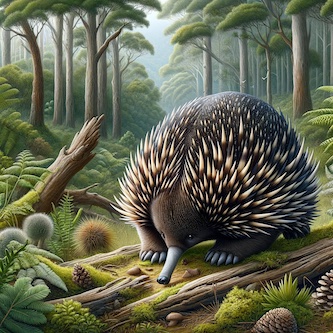
The Attenborough echidna and the western echidna are in danger of disappearing, and previous expeditions had found signs of their existence in the Cyclops Mountains. But it was hard to get to the most remote parts of the mountains to prove that they were there. Finding the echidna and other new species in the area shows that we need to work on protecting the Cyclops Mountains because it's not currently a protected area even though it has a lot of different kinds of plants and animals.
The Cyclops Mountains are really tough to explore because they have steep cliffs, dangerous animals, and lots of earthquakes. But the scientists were able to confirm that there are dozens of new insect species and they found a new type of shrimp that lives in trees and a cave system that no one knew about. The team worked with local villages and respected their traditions and hopes that finding the echidna will help make the case for protecting the area.
The Attenborough echidna has been part of resolving conflicts between people in the area, and the discovery of this species and other new things shows why it's so important to protect the Cyclops Mountains and all the different kinds of plants and animals that live there. The team believes that the Attenborough long-beaked echidna is a symbol of why we need to protect and take care of the region to make sure we can keep finding and saving its diverse wildlife.
Original news source: First-ever images prove 'lost echidna' not extinct (BBC)
📖 Vocabulary:
Group or Classroom Activities
Warm-up Activities:
– News Summary
Instructions: Students will work individually to summarize the article in their own words, focusing on the main points: the discovery of the Attenborough's long-beaked echidna, the importance of the Cyclops Mountains' biodiversity, and the need for conservation efforts. They will then share their summaries with a partner, who will provide feedback on clarity and completeness.
– Sketch It
Instructions: In pairs, one student will describe a scene or aspect from the article (e.g., the Attenborough's long-beaked echidna, the Cyclops Mountains, the new species discovered) without naming it, while their partner tries to sketch it based on the given description. Afterwards, they discuss the challenges and compare the sketches with images from the Internet or the article if available.
– Keyword Taboo
Instructions: Students will play a game where they must describe the article’s content to their partner without using a list of keywords (e.g., echidna, extinct, Indonesia, Cyclops Mountains, biodiversity). This will encourage them to use synonyms and explain concepts in different ways, which can expand their vocabulary and speaking skills.
– Opinion Spectrum
Instructions: The class will form a line or spectrum based on their opinions about a statement related to the article. For example, "It is crucial to prioritize the conservation of the Cyclops Mountains over other natural areas." Students will then discuss their position with those nearby and the class will engage in a group discussion, allowing students to express and justify their opinions, and to practice persuasive language.
– Future Predictions
Instructions: Students will write down their own predictions about the future of the Attenborough's long-beaked echidna and the Cyclops Mountains, based on the information from the article. They will then form small groups to share and discuss their predictions, practicing future tense structures and discussing environmental issues.
🤔 Comprehension Questions:
The researchers captured the first-ever footage of the Attenborough's long-beaked echidna, a species that was thought to be extinct.
It is named after Sir David Attenborough, a famous broadcaster and natural historian.
They found new types of insects and frogs, as well as healthy populations of tree kangaroos and birds of paradise.
The discovery is significant because it proves the species is not extinct and highlights the need to protect the Cyclops Mountains, which is home to a diverse range of species.
The researchers faced steep cliffs, dangerous animals, and frequent earthquakes, making the exploration of the Cyclops Mountains very difficult.
The scientists discovered dozens of new insect species, a new type of shrimp that lives in trees, and a previously unknown cave system.
The team worked with local villages, respected their traditions, and involved them in their research to maintain good relations and support.
The Attenborough echidna has been part of resolving local conflicts, and its discovery underscores the importance of protecting the Cyclops Mountains and its diverse wildlife for future discoveries and conservation.
🎧✍️ Listen and Fill in the Gaps:
A team of researchers from Oxford University went on an expedition in Indonesia and captured the first-ever footage of the Attenborough's long-beaked echidna. This is important because people thought this species was extinct. The echidna is an ancient that lays eggs and is after Sir David Attenborough. The team also found new types of insects and frogs, as well as healthy populations of tree kangaroos and of paradise during their month-long expedition in the . The Attenborough echidna and the western echidna are in danger of disappearing, and previous expeditions had signs of their existence in the Cyclops Mountains. But it was hard to get to the most remote parts of the mountains to prove that they were there. Finding the echidna and other new species in the area shows that we need to work on the Cyclops Mountains because it's not currently a protected area even though it has a lot of different kinds of and animals. The Cyclops Mountains are really tough to because they have cliffs, dangerous animals, and lots of earthquakes. But the scientists were able to confirm that there are dozens of new insect species and they found a new type of shrimp that lives in trees and a cave system that no one knew about. The team with local villages and respected their traditions and hopes that finding the echidna will help make the case for protecting the area. The Attenborough echidna has been part of resolving conflicts between people in the area, and the discovery of this species and other new things shows why it's so important to the Cyclops Mountains and all the kinds of plants and animals that live there. The team believes that the Attenborough long-beaked echidna is a of why we need to protect and take care of the to make sure we can keep finding and saving its diverse wildlife.
💬 Discussion Questions:
1. What is an animal you thought was extinct but later found out it's still around? How did you feel when you learned it was still alive?
2. How would you feel if you discovered a new animal species? Would you be excited or scared, and why?
3. Do you think it's important to protect areas like the Cyclops Mountains? Why or why not?
4. Have you ever been on a hike or an expedition? What was the coolest thing you found or saw?
5. What's the most dangerous animal in your country? Are you afraid of it?
6. Do you like watching documentaries about animals and nature? Why or why not?
7. How do you think scientists should work with local communities when they explore new areas?
8. Do you think new species are still being discovered where you live? Why do you think that?
9. Have you ever heard of tree kangaroos or birds of paradise? What do you imagine they look like?
10. Do you believe that every species, even the small insects, are important? Why or why not?
11. What is your favorite animal and why?
12. Do you think animals like the echidna should be named after famous people? Would you like to have an animal named after you?
13. Have you ever seen a cave or explored one? What was it like?
14. Do you think areas with lots of earthquakes should be avoided or explored more carefully?
15. If you could join a team of researchers on an expedition, would you want to go? What kind of adventure would you be hoping for?
Individual Activities
📖💭 Vocabulary Meanings:
Click a dot next to a word, then click the dot next to its meaning to draw a line connecting them.
Words
Meanings
🔡 Multiple Choice Questions:
🕵️ True or False Questions:
📝 Write a Summary:
Write a summary of this news article in two sentences.
Check your writing now with the best free AI for English writing!