

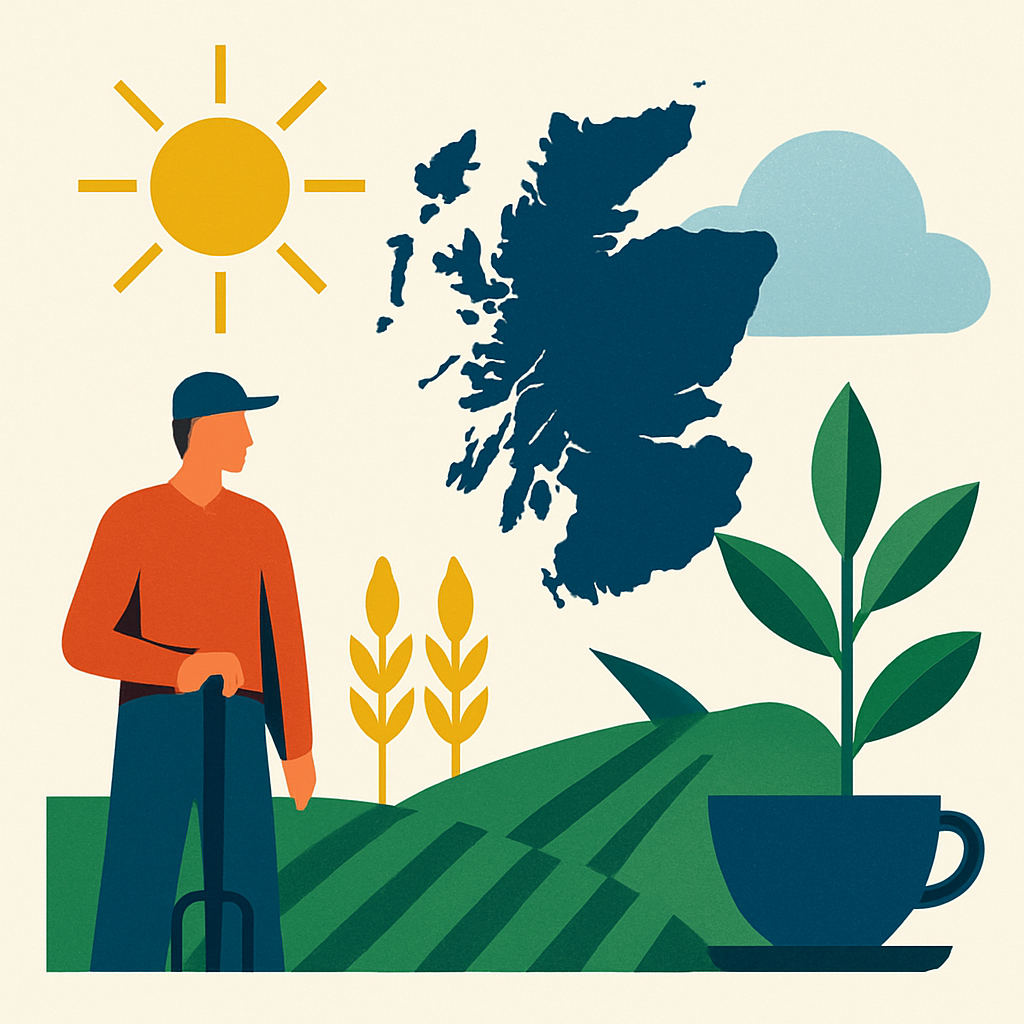
Susie Walker-Munro has been cultivating tea on her family’s farm in Scotland, finding the unique soil there perfect for her brand Kinnettles Gold. Despite her tea costing about £40 a packet, it won't replace supermarket options. With global climates changing, tea farmers face challenges like altered rainfall patterns. However, some believe Scotland’s steady climate could be beneficial for successful tea production.
Struggling with the 57-degree north latitude, Susie's farm isn't suited for year-round crops. Yet, she sees potential benefits in Scotland’s climate changes, particularly rainy seasons aiding tea growth. She remains cautious though, thinking tea won't become a major crop in the nation. Meanwhile, modern farming ideas suggest diversifying crops, possibly using greenhouses to expand the range of produce, including Mediterranean vegetables.
Experts argue greenhouses in Scotland could help safeguard farming against climate shifts. The James Hutton Institute is actively testing various crops under predicted future conditions in their advanced plant growth center. There, plants undergo stress tests to select those resilient to new climate challenges. This research can guide how Scotland adapts its farming techniques.
According to Dr. Robert Hancock from the Institute, Scottish farmers need to plan for climate-resilient crops now. Technology and traditional skills both play roles in preparing for future farming's demands. This forward-thinking approach could see Scotland expand its crop diversity beyond tea, incorporating methods that rise to environmental challenges.
Original news source: More tea? How Scotland's crops of the future could be set to change – BBC News (BBC)
🎧 Listen:
📖 Vocabulary:
Group or Classroom Activities
Warm-up Activities:
1. Discuss how climate change is affecting farming in general.
2. Share if you have ever tried growing something; what was it?
3. Talk about the types of weather generally experienced in Scotland.
4. Consider why some regions are better for certain types of farming.
5. What are the advantages of using greenhouses for farming?
🤔 Comprehension Questions:
Kinnettles Gold.
They face challenges like altered rainfall patterns.
She remains cautious and thinks the climate challenges are too great.
Using greenhouses to grow a wider range of produce.
To test crops under future climate conditions to find resilient plants.
Dr. Hancock is from the James Hutton Institute, and he advises planning for climate-resilient crops.
They both are important in preparing for the demands of future farming.
🎧✍️ Listen and Fill in the Gaps:
Susie Walker-Munro has been cultivating tea on her family’s farm in , the unique soil there perfect for her brand Kinnettles Gold. Despite her tea about £40 a packet, it won't replace supermarket options. With global climates changing, tea farmers face challenges like altered rainfall patterns. , some believe Scotland’s steady climate could be beneficial for successful tea production. with the 57- north latitude, Susie's farm suited for year-round crops. Yet, she sees potential benefits in Scotland’s climate changes, particularly rainy seasons aiding tea growth. She remains cautious though, thinking tea won't become a major crop in the nation. , modern farming ideas suggest diversifying crops, possibly greenhouses to expand the of produce, including Mediterranean vegetables. Experts argue greenhouses in Scotland could help safeguard farming climate shifts. The James Hutton Institute is actively testing various crops under predicted future conditions in their advanced plant growth center. There, plants undergo stress tests to select those to new climate challenges. This research can how Scotland its farming techniques. According to Dr. Robert from the Institute, Scottish farmers need to plan for climate-resilient crops now. and traditional skills both play roles in preparing for future farming's demands. This forward-thinking approach could see Scotland expand its crop diversity beyond tea, incorporating methods that rise to environmental challenges.
💬 Discussion Questions:
1. What are your thoughts on the impact of climate change on agriculture?
2. Do you think greenhouses are a good solution for farming? Why or why not?
3. How can technology play a role in modern farming?
4. What kinds of crops do you think should be prioritized in Scotland's agriculture?
5. Is it important for a country to be self-sufficient in food production? Why?
6. How does local farming impact the environment differently than importing food?
7. Should farmers focus on traditional crops or experiment with new ones? Why?
8. What are the benefits and drawbacks of diversifying crops?
9. How important is sustainability in agriculture today?
10. How could farming methods adapt to better cope with climate changes?
11. What are the potential risks of not preparing for future climate changes in farming?
12. How can young people be encouraged to pursue a career in agriculture?
Individual Activities
📖💭 Vocabulary Meanings:
Click a dot next to a word, then click the dot next to its meaning to draw a line connecting them.