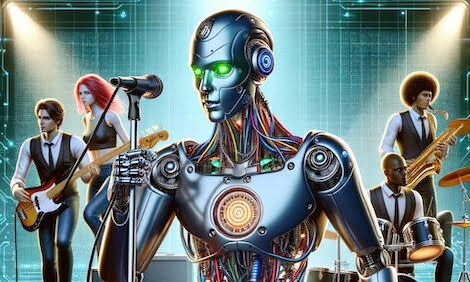

Linden Jay, who helped write Doja Cat's hit song "Woman," thinks AI is an exciting tool for coming up with ideas, but not a replacement for the skill of writing a good song. He uses AI to make his own voice sound like a famous artist, so he can see if a song is going in the right direction. Aaron Horn, Linden's co-writer, agrees that AI is a tool that can help with the creative process. He compares it to a rhyming dictionary, which suggests rhymes for poems and lyrics.
Jessica Agombar, who wrote "What a Man Gotta Do" for the Jonas Brothers, finds inspiration in AI's abilities, especially in copying voices. But she believes that real artistry will always be found in natural songwriting and producing, with imperfect vocals and rough drafts. Kamille, who has worked with Little Mix, Mabel, and Kylie Minogue, tries not to rely too much on AI. She thinks that the most important thing in songwriting is expressing emotions from the heart, and that shouldn't be lost as technology gets better.
While AI has its good points, these songwriters tell aspiring musicians not to depend too much on AI and to embrace their own experiences and humanity. They think that machines can't make music on their own and that AI can't copy the depth of human emotion. In conclusion, AI can be a helpful tool in the music industry, but it shouldn't take the place of the artistry and personal touch that comes from human songwriting.
Original news source: Doja Cat and Jonas Brothers songwriters say AI is not to be feared (BBC)
📖 Vocabulary:
Group or Classroom Activities
Warm-up Activities:
– News Summary
Instructions:
1. Divide the class into small groups.
2. Ask each group to read the article and summarize the main points in a news article format.
3. Each group should present their news summary to the class.
4. Encourage discussions and questions about the topic.
– Sketch It
Instructions:
1. Divide the class into pairs.
2. Give each pair a piece of paper and a pen/pencil.
3. One student from each pair will describe a scene or concept related to the article, while the other student sketches it.
4. After a few minutes, have the pairs switch roles.
5. Each pair can present their sketches to the class and explain the connection to the article.
– Vocabulary Pictionary
Instructions:
1. Create a list of key vocabulary words from the article.
2. Divide the class into teams.
3. One student from each team will come to the front of the class.
4. Show the selected student a vocabulary word from the list.
5. The student must draw a picture to represent the word, while their team tries to guess the word.
6. The team that guesses correctly earns a point.
7. Repeat with different students and vocabulary words.
– Pros and Cons
Instructions:
1. Divide the class into small groups.
2. Assign each group to discuss the pros and cons of using AI in the music industry, based on the information from the article.
3. Each group should come up with a list of at least three pros and three cons.
4. After the discussion, groups can share their lists and compare their ideas.
5. Encourage respectful debate and discussion.
– Two Truths and a Lie
Instructions:
1. Have each student come up with two true statements and one false statement related to the topic of AI in the music industry.
2. Divide the class into small groups.
3. Each student takes turns sharing their three statements with their group.
4. The group must guess which statement is the lie.
5. After guessing, the student reveals the lie and explains the truth behind each statement.
6. Encourage discussion and questions about the topic.
🤔 Comprehension Questions:
Top songwriters think that AI can be useful in the music industry, but it can't recreate the art and human emotion that goes into making music.
Some songwriters use AI to copy the voice of the artist they are writing for, to check how a track sounds, or to get over writer's block.
According to Linden Jay, AI is useful for coming up with ideas and making his own voice sound like a famous artist.
Aaron Horn compares AI to a rhyming dictionary because both are tools that can help with the creative process. A rhyming dictionary suggests rhymes for poems and lyrics, while AI can help with songwriting ideas.
Jessica Agombar finds inspiration in AI's abilities, especially in copying voices. However, she believes that real artistry will always be found in natural songwriting and producing, with imperfect vocals and rough drafts.
Kamille believes that expressing emotions from the heart is important in songwriting because it adds depth and authenticity to the music. She thinks that this shouldn't be lost as technology gets better.
These songwriters advise aspiring musicians not to depend too much on AI and to embrace their own experiences and humanity in their music. They think that machines can't make music on their own and that AI can't copy the depth of human emotion.
The overall message is that AI can be a helpful tool in the music industry, but it shouldn't take the place of the artistry and personal touch that comes from human songwriting.
🎧✍️ Listen and Fill in the Gaps:
Artificial intelligence (AI) is a big topic among top songwriters who have worked with popular artists like Doja Cat, Brothers, and BTS. They all agree that AI can be useful in the industry. Some songwriters use AI to copy the voice of the artist they are writing for, to how a track sounds, or to get over writer's block. But even though it's helpful, they think that AI can't recreate the art and human that goes into making music. Linden Jay, who helped write Doja Cat's hit song "Woman," thinks AI is an exciting tool for up with ideas, but not a replacement for the skill of writing a good song. He uses AI to make his own voice sound like a famous artist, so he can see if a song is going in the right . Aaron Horn, Linden's co-writer, agrees that AI is a tool that can help with the process. He it to a rhyming dictionary, which suggests rhymes for poems and lyrics. Jessica Agombar, who "What a Man Gotta Do" for the Jonas , inspiration in AI's abilities, especially in copying voices. But she believes that real artistry will always be found in natural songwriting and producing, with imperfect vocals and rough drafts. Kamille, who has worked with Little Mix, Mabel, and Kylie Minogue, tries not to rely too much on AI. She thinks that the most thing in songwriting is expressing emotions from the heart, and that shouldn't be lost as gets better. While AI has its good points, these songwriters tell aspiring not to depend too much on AI and to embrace their own experiences and humanity. They think that machines can't make music on their own and that AI can't copy the depth of human emotion. In conclusion, AI can be a helpful tool in the music , but it shouldn't take the place of the artistry and personal that comes from human songwriting.
💬 Discussion Questions:
1. What is artificial intelligence and how is it used in the music industry?
2. How do songwriters use AI to help them in their creative process?
3. Do you think AI can accurately recreate the art and human emotion in music? Why or why not?
4. How would you feel if a song you loved was created entirely by AI, without any human involvement?
5. Do you like the idea of using AI to copy the voice of an artist? Why or why not?
6. What do you think is the most important skill in writing a good song? Is it something that AI can do?
7. How do the songwriters in the article feel about AI as a tool for coming up with ideas? Do you agree with them? Why or why not?
8. How does Jessica Agombar feel about AI's abilities in copying voices? Do you agree with her? Why or why not?
9. Why does Kamille think it's important not to rely too much on AI in songwriting?
10. What do the songwriters in the article think is the most important thing in songwriting? Do you agree with them? Why or why not?
11. How would you feel if you discovered that one of your favorite songs was written with the help of AI? Would it change your opinion of the song? Why or why not?
12. Do you think AI has the potential to replace human songwriting? Why or why not?
13. What do you think are the limitations of AI in the music industry?
14. How do the songwriters in the article advise aspiring musicians to approach AI? Do you agree with their advice? Why or why not?
15. In your opinion, what role should AI play in the music industry?
Individual Activities
📖💭 Vocabulary Meanings:
Click a dot next to a word, then click the dot next to its meaning to draw a line connecting them.
Words
Meanings
🔡 Multiple Choice Questions:
🕵️ True or False Questions:
📝 Write a Summary:
Write a summary of this news article in two sentences.
Check your writing now with the best free AI for English writing!