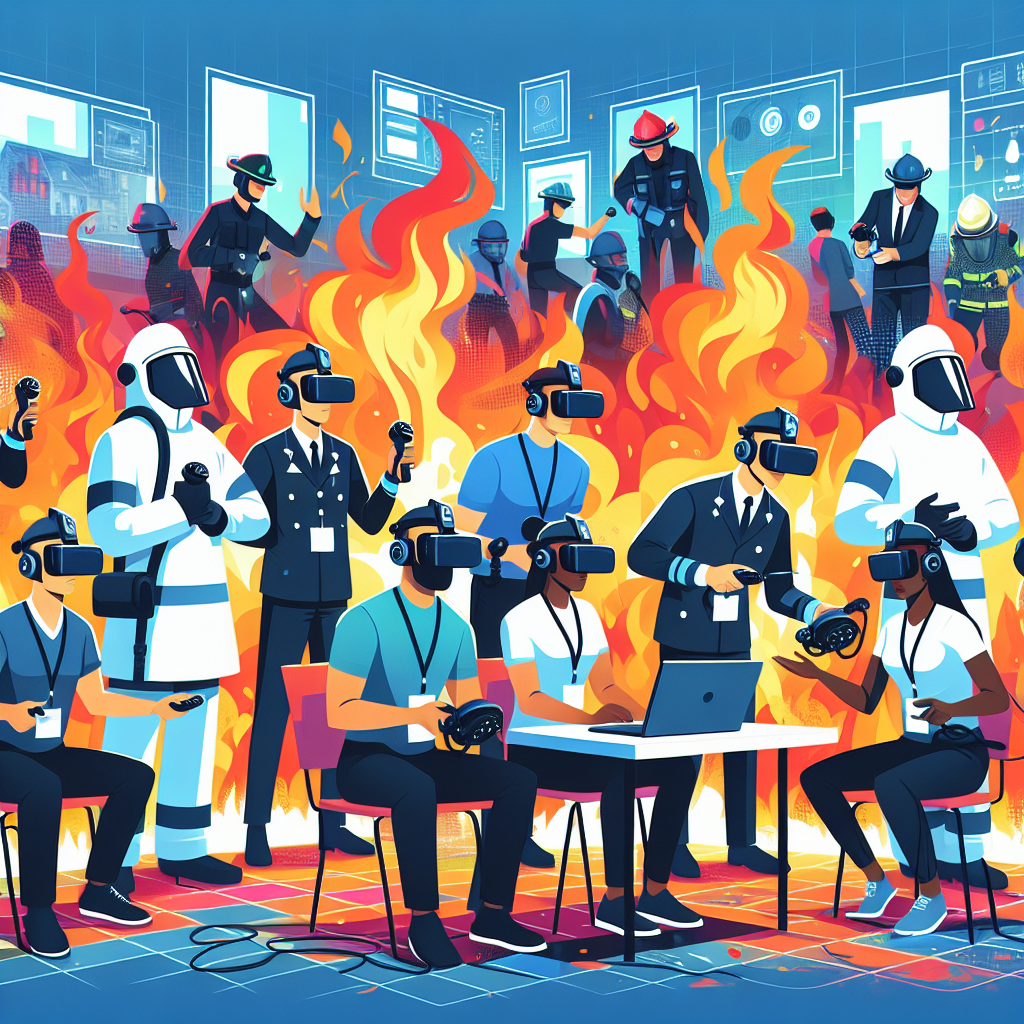
Virtual reality (VR) technology is becoming a useful tool for training fire investigators. Researchers at the University of Dundee, along with emergency services, have created a way to build fake crime scenes that mimic real fire situations. They conduct controlled burns and carefully measure the results to collect important data that helps with investigations. This new method allows them to recreate fire scenes in a virtual world, giving investigators a special chance to train and analyze different scenarios.
Using VR for fire investigation training has shown great promise. Studies suggest that investigators who use this technology are better at figuring out where fires started and how they spread. The immersive experience of virtual reality lets trainees interact with the scene in a way that traditional training can't match. By experiencing the behavior of fire in a safe virtual setting, investigators can sharpen their skills and gain a deeper understanding of how fires work.
The team at the University of Dundee hopes that one day, virtual reality will be a regular part of training for new fire investigators. This technology not only helps with hands-on learning but also encourages teamwork among different emergency services. By sharing information and experiences in a virtual space, investigators can learn from each other and develop a better grasp of fire investigation methods.
Additionally, VR can be used for sharing data, making it easier for investigators to present their findings in a virtual setting. This can improve communication and teamwork with colleagues and other important people involved in fire investigations. Overall, using virtual reality in fire investigation training is a big step forward. As researchers keep exploring its possibilities, there is hope that VR will not only help new investigators improve their skills but also promote teamwork and knowledge sharing among emergency services, leading to better fire investigations and increased public safety.
Original news source: Investigating crime scenes in virtual reality (BBC)
🎧 Listen:
📖 Vocabulary:
Group or Classroom Activities
Warm-up Activities:
– CHARADES
Instructions: Divide the class into two teams. Each team takes turns sending one member to act out a word or phrase related to virtual reality and fire investigation (e.g., "fire scene," "training," "investigator"). The acting student cannot speak and must rely on gestures. Their team has one minute to guess the word or phrase.
– OPINION POLL
Instructions: Present a statement related to the article, such as "Virtual reality will revolutionize training for emergency services." Have students walk to different corners of the classroom to indicate whether they strongly agree, agree, disagree, or strongly disagree. Afterward, facilitate a discussion where students share their reasons for their opinions.
– MIND MAP
Instructions: On a whiteboard or large paper, write "Virtual Reality in Fire Investigation" in the center. In small groups, students brainstorm and add related ideas, concepts, and vocabulary around the central theme. Encourage them to think of benefits, challenges, and applications of VR in training.
– HEADLINE CREATION
Instructions: Ask students to create catchy headlines for the article. They should focus on summarizing the main idea in an engaging way, using vocabulary from the article. After they create their headlines, students can share them with the class, and the group can vote on the most effective one.
– SPEED SUMMARIZING
Instructions: Pair students up and give them two minutes to summarize the article to each other. After two minutes, they switch partners and repeat the process. Encourage them to use different vocabulary and phrasing each time to enhance their summarization skills.
🤔 Comprehension Questions:
The main purpose is to provide a realistic and immersive training experience for fire investigators, allowing them to practice and analyze fire scenes in a safe virtual environment.
They conduct controlled burns and carefully measure the results to gather important data, which helps them build fake crime scenes that mimic real fire situations.
Investigators become better at determining where fires started and how they spread, thanks to the immersive experience that allows them to interact with the fire scene more effectively than traditional methods.
VR allows investigators from various emergency services to share information and experiences in a virtual space, promoting collaboration and a better understanding of fire investigation methods.
It helps them sharpen their skills and gain a deeper understanding of how fires work by allowing them to observe and interact with fire behavior in a safe environment.
Sharing information and experiences in a virtual space enhances learning and helps investigators develop a better grasp of fire investigation techniques, leading to improved outcomes.
VR can improve communication and teamwork among colleagues and other stakeholders involved in fire investigations, making it easier to present findings and collaborate effectively.
They hope that virtual reality will become a regular part of training for new fire investigators, enhancing hands-on learning, teamwork, and overall fire investigation methods.
🎧✍️ Listen and Fill in the Gaps:
Virtual reality (VR) technology is becoming a useful tool for training fire investigators. Researchers at the University of Dundee, along with emergency services, have created a way to build fake crime that real fire situations. They conduct controlled burns and carefully measure the results to collect important data that helps with investigations. This new method them to recreate fire scenes in a world, giving investigators a special chance to train and analyze different scenarios. Using VR for fire training has shown great promise. Studies suggest that investigators who use this technology are better at out where started and how they . The immersive experience of virtual reality lets trainees interact with the scene in a way that traditional training can't match. By experiencing the behavior of fire in a safe virtual setting, investigators can sharpen their skills and gain a deeper understanding of how fires work. The team at the University of Dundee hopes that one day, virtual reality will be a regular part of training for new fire . This technology not only helps with hands-on learning but also encourages teamwork among different services. By information and experiences in a virtual space, investigators can learn from each other and develop a better grasp of fire investigation methods. Additionally, VR can be used for sharing data, making it for investigators to present their findings in a virtual setting. This can communication and with colleagues and other important people involved in fire investigations. Overall, using virtual reality in fire investigation training is a big step forward. As researchers keep exploring its possibilities, there is hope that VR will not only help new investigators improve their skills but also promote teamwork and sharing among emergency , leading to better fire investigations and increased public safety.
💬 Discussion Questions:
1. What is your opinion on using virtual reality for training in different professions?
2. How would you feel if you had to train for a job using virtual reality technology?
3. Do you think virtual reality can improve skills in other fields, like medicine or education? Why or why not?
4. Have you ever tried virtual reality? If yes, what was your experience like? If no, would you want to try it?
5. What is a benefit of using virtual reality that you think is the most important?
6. How do you think teamwork can be improved through virtual reality training?
7. Do you like the idea of learning in a virtual world rather than in a real-life setting? Why or why not?
8. What do you think could be some challenges of using virtual reality in training?
9. How would you feel if you were part of a team that used virtual reality to solve problems?
10. Do you think virtual reality could help with public safety? Why or why not?
11. What is a situation where you think virtual reality training would be especially useful?
12. How do you think the use of technology, like virtual reality, will change the way we learn in the future?
13. Do you believe that virtual reality can replace traditional training methods completely? Why or why not?
14. What is a skill you would like to improve using virtual reality if you had the chance?
15. How would you feel about sharing your learning experiences with others in a virtual setting?
Individual Activities
📖💭 Vocabulary Meanings:
Click a dot next to a word, then click the dot next to its meaning to draw a line connecting them.
Words
Meanings
🔡 Multiple Choice Questions:
🕵️ True or False Questions:
📝 Write a Summary:
Write a summary of this news article in two sentences.
Check your writing now with the best free AI for English writing!