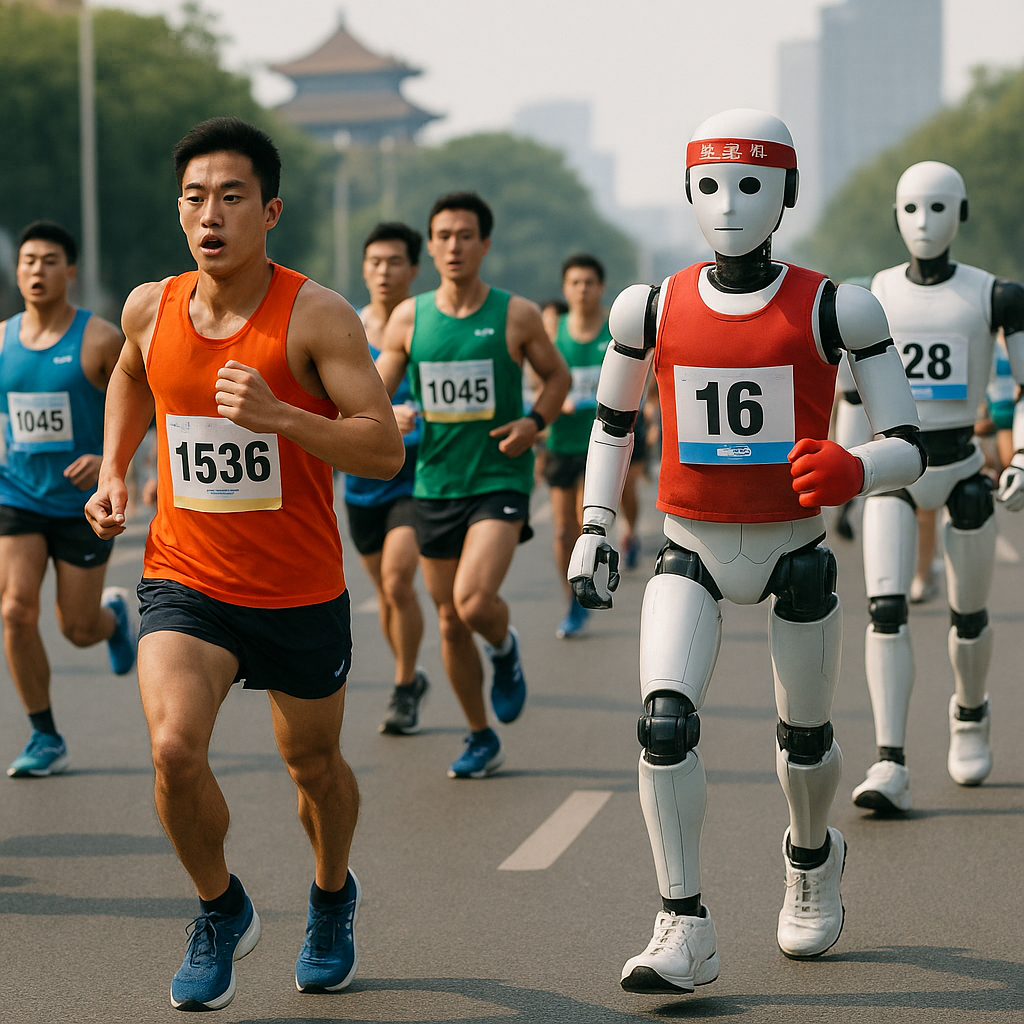
On April 19, 2025, Beijing, China, made history by hosting the first-ever half-marathon race with both humans and humanoid robots. This special event drew thousands of runners who raced alongside 21 humanoid robots on a tough 21-kilometer (13-mile) course. The robots came in different heights, with some as short as 3 feet 9 inches and others as tall as 5 feet 9 inches. They were designed to look like humans and could run or walk without using wheels.
The robot that stood out the most was Tiangong Ultra, which finished the race in an impressive time of two hours and 40 minutes. In comparison, the fastest human runner completed the race in just one hour and two minutes. Tang Jian, the chief technology officer at the Beijing Innovation Centre of Human Robotics, said that Tiangong's success was due to its long legs and a smart program that copied human running styles. He felt proud of what the robot achieved and mentioned that no other robotics companies in the West have done anything like this.
During the race, the robots faced some challenges. One robot tripped at the starting line and had to take a moment to get back up before it could continue. Another robot ran into a railing, causing its human operator to fall. These incidents showed how tricky it can be for robots to perform well in a competitive setting, where even small mistakes can lead to problems.
Human trainers were there to help the robots during the race, giving them physical support when needed. Some robots wore running shoes, while others had fun accessories like boxing gloves and a red headband that said "Bound to Win" in Chinese. These extra touches not only made the robots look cool but also added a fun element to the competition. China's progress in robotics is impressive, with many companies working on humanoid robots and robotic dogs, showing the country's leadership in this exciting field.
Original news source: China hosts world's first half-marathon race between humans and robots (Sky News)
🎧 Listen:
📖 Vocabulary:
Group or Classroom Activities
Warm-up Activities:
– CHARADES
Instructions: Divide the class into small groups. Each group will take turns acting out key terms from the article without speaking, while the other groups guess the terms. Words can include "humanoid robot," "marathon," "Beijing," "running shoes," and "challenges."
– OPINION POLL
Instructions: Create a list of statements related to robots in sports. For example, "Humanoid robots should compete in human sports." Students will walk around the classroom, asking their classmates to agree or disagree with the statements and explain their reasons.
– MIND MAP
Instructions: In pairs, students will create a mind map based on the article. They will brainstorm and visually organize key themes such as "humanoid robots," "marathon," "technology," and "challenges." Each pair will then present their mind map to the class.
– HEADLINE CREATION
Instructions: Ask students to come up with a catchy headline for the article. They should think about the most significant aspects of the event and try to convey the excitement and uniqueness of the half-marathon with humans and robots in just a few words.
– TWO TRUTHS AND A LIE
Instructions: Each student will write down two true statements and one false statement related to the article. They will then take turns sharing their statements with a partner, who will guess which one is the lie. This encourages critical thinking and comprehension of the article's content.
🤔 Comprehension Questions:
It was the first-ever half-marathon race where both humans and humanoid robots competed together.
The robots varied in height, with some as short as 3 feet 9 inches and others as tall as 5 feet 9 inches.
The standout robot was Tiangong Ultra, which finished the race in two hours and 40 minutes.
Tang Jian attributed Tiangong Ultra's success to its long legs and a smart program that copied human running styles.
One robot tripped at the starting line and had to get back up, while another robot ran into a railing, causing its human operator to fall.
Human trainers helped the robots by giving them physical support when needed during the race.
Some robots wore running shoes and had fun accessories like boxing gloves and a red headband that said "Bound to Win" in Chinese.
The article suggests that China is a leader in robotics, with many companies working on advanced humanoid robots and robotic dogs.
🎧✍️ Listen and Fill in the Gaps:
On April 19, 2025, Beijing, China, made history by hosting the first-ever half-marathon race with both and humanoid robots. This event drew thousands of runners who raced alongside 21 humanoid robots on a 21-kilometer (13-mile) course. The robots came in different heights, with some as short as 3 feet 9 and others as tall as 5 feet 9 inches. They were designed to look like humans and could run or walk without using wheels. The robot that stood out the most was Tiangong , which finished the race in an impressive time of two hours and 40 minutes. In comparison, the fastest runner completed the race in just one hour and two minutes. Tang Jian, the chief technology officer at the Beijing Innovation of Human Robotics, said that Tiangong's success was due to its long legs and a smart program that copied human running styles. He felt proud of what the achieved and mentioned that no other robotics companies in the West have done anything like this. During the race, the robots faced some . One robot tripped at the starting line and had to take a moment to get back up before it could . Another robot ran into a railing, causing its human to fall. These incidents showed how it can be for robots to perform well in a competitive setting, where even small mistakes can lead to problems. Human trainers were there to help the robots during the race, giving them physical support when . Some wore running , while others had fun accessories like boxing gloves and a red headband that said "Bound to Win" in Chinese. These extra touches not only made the robots look cool but also added a fun element to the competition. China's in robotics is impressive, with many companies working on humanoid robots and robotic dogs, showing the country's leadership in this exciting field.
💬 Discussion Questions:
1. What is your opinion about the idea of robots competing in races against humans?
2. How would you feel if you were running in a race with humanoid robots?
3. Do you think robots will ever be able to run faster than humans? Why or why not?
4. What is a humanoid robot, and how do you think they could change our lives in the future?
5. Have you ever participated in a running event or marathon? What was that experience like for you?
6. Do you like the idea of robots having fun accessories, like boxing gloves or headbands? Why or why not?
7. How do you think people would react if robots started winning races more often than humans?
8. What is your opinion on the challenges robots face in competitions, like tripping or running into things?
9. Do you think it’s important for robots to look like humans? Why or why not?
10. How would you feel if you had to train a robot to run? Would it be fun or frustrating?
11. Do you think the advancements in robotics are exciting or scary? Why?
12. What is a major benefit of having humanoid robots in sports?
13. How do you think the development of robots might affect jobs in the future?
14. Do you think competitions like this half-marathon will become more popular around the world? Why or why not?
15. What is your favorite sport, and would you want to see robots compete in it? Why?
Individual Activities
📖💭 Vocabulary Meanings:
Click a dot next to a word, then click the dot next to its meaning to draw a line connecting them.
Words
Meanings
🔡 Multiple Choice Questions:
🕵️ True or False Questions:
📝 Write a Summary:
Write a summary of this news article in two sentences.
Check your writing now with the best free AI for English writing!