

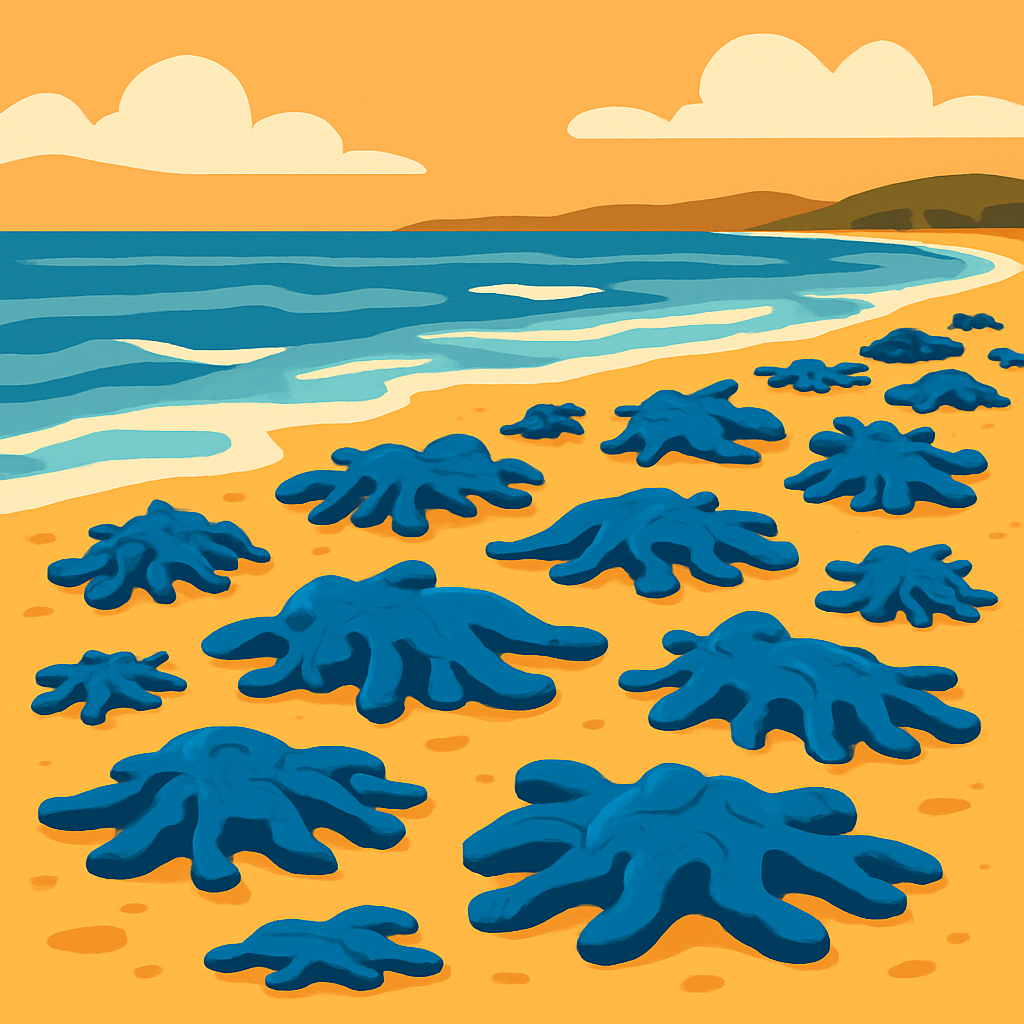
Recently, hundreds of unusual blue sea creatures called by-the-wind sailors have been washing up on the shores of St Bees beach in Cumbria. Known for their striking blue hue and small sails, these creatures can float on the ocean’s surface by catching the wind. Despite their jellyfish-like appearance, they are actually colonial hydrozoans and should be handled carefully due to their mild sting.
Louise Nicholson, a local resident, initially mistook them for seaweed and nearly picked one up before deciding to take photos of the fascinating sight. The beach became a popular spot for visitors eager to capture images of the intriguing phenomenon. Each by-the-wind sailor, although small in size, can cover vast distances due to their unique sailing ability.
Georgia de Jong Cleyndert, Head of Marine at the Cumbria Wildlife Trust, explained that these organisms are made up of hundreds of tiny animals working together. Their presence on the beach is often a result of persistent onshore winds that bring them ashore. While enchanting to observe, beachgoers are advised not to touch them to avoid skin irritation from their sting.
These creatures' presence highlights an intriguing aspect of marine biology, revealing the complex and interconnected nature of the ocean's ecosystems. People visiting St Bees beach are encouraged to continue enjoying the spectacle while respecting the safety guidelines.
Original news source: Hundreds of by-the-wind-sailors wash up on St Bees beach – BBC News (BBC)
🎧 Listen:
📖 Vocabulary:
Group or Classroom Activities
Warm-up Activities:
1. Have you ever seen a unique sea creature? Share your experience.
2. Describe the most unusual natural event you've witnessed.
3. Discuss how you would react if you mistook something in nature for something else.
4. Share what you know about marine life and its diversity.
5. How do you think weather affects life along the coast?
🤔 Comprehension Questions:
By-the-wind sailors have been washing up on the shores.
She mistook them for seaweed because of their appearance.
Their unique sailing ability allows them to cover vast distances.
They are made up of hundreds of tiny animals working together.
Persistent onshore winds cause them to be brought ashore.
Beachgoers are advised not to touch them to avoid skin irritation.
Their presence highlights the complex and interconnected nature of ocean ecosystems.
🎧✍️ Listen and Fill in the Gaps:
Recently, hundreds of unusual blue sea creatures called by-the-wind have been up on the shores of St Bees beach in Cumbria. Known for their blue hue and small sails, these creatures can float on the ocean’s by catching the wind. Despite their jellyfish-like appearance, they are actually colonial hydrozoans and should be handled due to their mild . Louise Nicholson, a local resident, mistook them for seaweed and nearly picked one up before deciding to take photos of the sight. The beach became a popular spot for visitors eager to capture images of the intriguing phenomenon. Each by-the-wind sailor, although small in size, can cover vast due to their unique sailing ability. de Jong Cleyndert, Head of Marine at the Cumbria Wildlife , explained that these organisms are made up of hundreds of tiny animals working together. Their presence on the beach is often a result of persistent onshore that bring them ashore. While enchanting to , beachgoers are advised not to touch them to avoid skin irritation from their sting. These creatures' presence highlights an intriguing aspect of marine biology, revealing the and interconnected nature of the ocean's ecosystems. People visiting St Bees are encouraged to enjoying the spectacle while respecting the safety guidelines.
💬 Discussion Questions:
1. Why do you think people are fascinated by unusual natural phenomena?
2. Have you ever taken photos of something rare in nature? What was it?
3. Discuss how social media influences our interest in natural curiosities.
4. Why is it important to follow guidelines when observing wildlife?
5. Would you visit a place just because of a temporary natural event? Why or why not?
6. How should people be educated about handling marine life safely?
7. What other unusual sea creatures do you know about?
8. Discuss a time when you planned an outing around a natural event.
9. How can observing nature enhance our understanding of ecosystems?
10. What precautions do you take when visiting natural settings?
11. How do tides and winds affect coastal environments?
12. Do you think people respect nature enough when visiting beaches and other natural areas?
Individual Activities
📖💭 Vocabulary Meanings:
Click a dot next to a word, then click the dot next to its meaning to draw a line connecting them.