


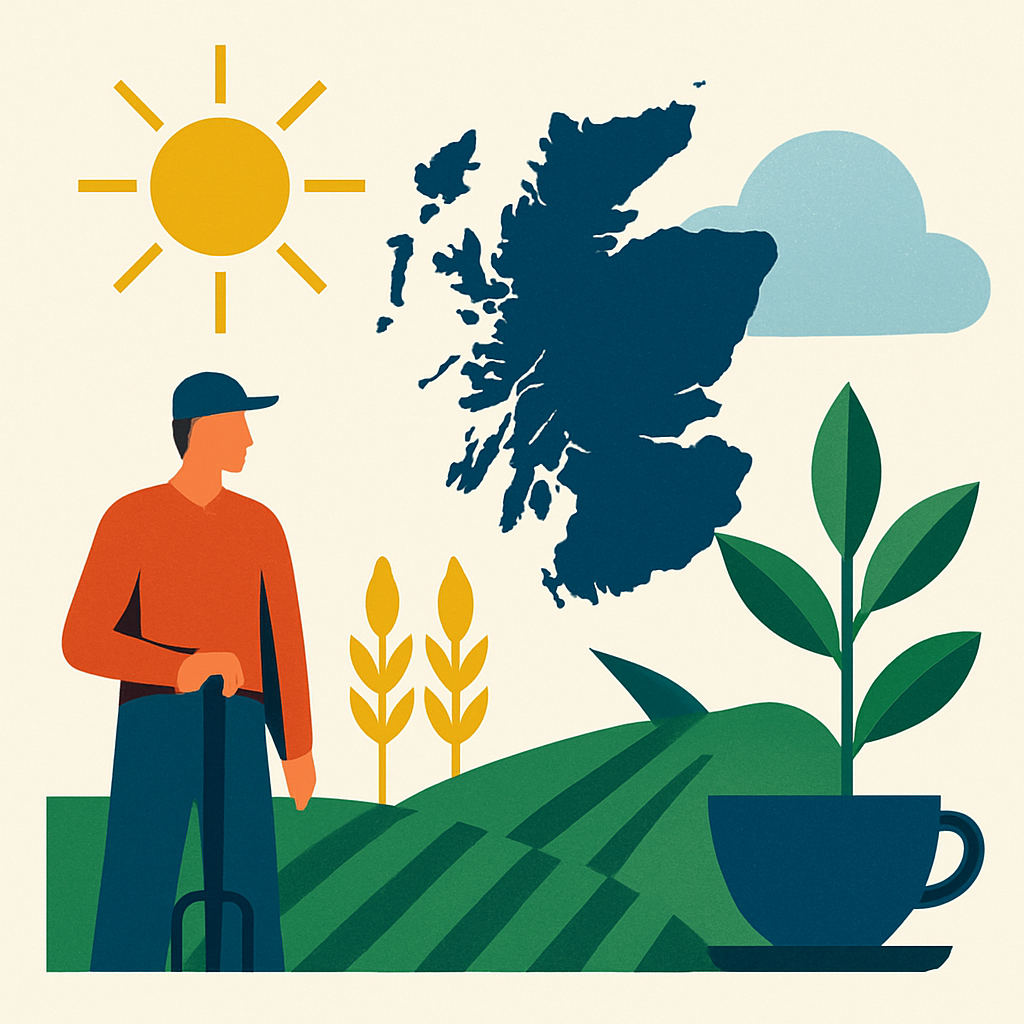
Susie Walker-Munro’s venture into tea production in Scotland leans into utilizing Angus’ unique acidic soil, yielding her esteemed Kinnettles Gold. Despite its premium pricing at roughly £40 a pack, it won’t easily rival conventional supermarket teas. Climate change poses significant challenges for global tea farmers, with its impact on rainfall and soil conditions. Nonetheless, a few experts speculate that Scotland’s relatively stable climate conditions could potentially aid in carving a niche for tea agriculture.
Considering Scotland's geographical positioning at 57-degrees north, a year-round tea farming endeavor remains unlikely. Yet, Susie speculates that potential shifts to wetter weather could incrementally enhance yield. While not expectant of tea becoming a dominant Scottish crop, she acknowledges potential within diversification strategies suggested by agricultural experts. Glasshouses might expand crop versatility and facilitate growing Mediterranean vegetables like tomatoes and cucumbers, essential for adapting to shifting climate paradigms.
Scientific endeavors, like those at the James Hutton Institute, aim to anticipate these changes by stress-testing crops under conceivable future climates. Their strategies involve developing crop varieties more resilient to various climate adversities. Dr. Robert Hancock affirms the necessity for preemptively altering breeding strategies to prepare farmers for evolving environmental conditions. This forward-looking innovation ensures farmers make informed decisions tailored to expected environmental shifts.
Moreover, Scotland’s potential green energy resources, predominantly from wind farms, entice a vision of lower-cost greenhouse cultivation. This strategy aligns with reducing carbon footprints while broadening the crop range sustainably. As Europe undergoes climate reformation, Scotland’s agrarian landscape could transform significantly, aligning agricultural practices with eco-friendly and economically sound frameworks.
Thus, pioneering agricultural research and innovation in Scotland pave the way for meaningful adaptation strategies. Focusing both on ecological and technological advancements, Scotland is positioning itself not only as a potential leader in niche crop production but also as a model for sustainable agricultural practices in Europe.
Original news source: More tea? How Scotland's crops of the future could be set to change – BBC News (BBC)
🎧 Listen:
📖 Vocabulary:
Group or Classroom Activities
Warm-up Activities:
1. Have you ever thought about how climate change affects agriculture?
2. What are some unique crops grown in your country?
3. How does your country utilize its natural resources for farming?
4. Can you think of any innovative farming techniques used internationally?
5. How important is agricultural research for future food security?
🤔 Comprehension Questions:
– Kinnettles Gold.
– It impacts rainfall and soil conditions, posing challenges.
– Due to Scotland's geographical positioning at 57-degrees north.
– The James Hutton Institute.
– Developing resilient crop varieties and altering breeding strategies.
– By enabling lower-cost greenhouse cultivation.
– Mediterranean vegetables like tomatoes and cucumbers.
🎧✍️ Listen and Fill in the Gaps:
Susie Walker-Munro’s venture into tea production in Scotland leans into utilizing Angus’ unique acidic soil, yielding her esteemed Kinnettles Gold. Despite its pricing at roughly £40 a pack, it won’t easily rival supermarket teas. Climate change poses significant challenges for global tea farmers, with its impact on rainfall and soil conditions. Nonetheless, a few experts speculate that Scotland’s relatively stable climate conditions could aid in carving a niche for tea agriculture. Scotland's geographical positioning at 57-degrees north, a year-round tea farming remains . Yet, Susie speculates that potential shifts to wetter weather could incrementally enhance yield. While not expectant of tea becoming a dominant Scottish crop, she acknowledges potential within strategies by agricultural experts. Glasshouses might expand crop versatility and facilitate growing Mediterranean vegetables like tomatoes and cucumbers, essential for adapting to shifting climate paradigms. Scientific endeavors, like those at the James Hutton Institute, aim to anticipate these changes by stress-testing crops under conceivable future climates. Their strategies involve developing crop varieties more to various climate adversities. Dr. Robert Hancock affirms the necessity for preemptively altering breeding strategies to prepare farmers for evolving environmental . This innovation ensures farmers make informed tailored to expected environmental shifts. Moreover, Scotland’s potential green energy resources, predominantly from wind farms, entice a vision of lower-cost greenhouse cultivation. This strategy aligns with reducing carbon footprints while broadening the crop range sustainably. As Europe undergoes reformation, Scotland’s agrarian landscape could transform , aligning agricultural practices with eco-friendly and economically sound frameworks. Thus, pioneering agricultural research and innovation in Scotland pave the way for adaptation strategies. Focusing both on ecological and technological advancements, Scotland is positioning itself not only as a potential leader in crop production but also as a model for sustainable agricultural practices in Europe.
💬 Discussion Questions:
1. Do you think climate change could have a positive impact on any aspect of agriculture?
2. How does the availability of natural resources in a region influence its agricultural practices?
3. What role do you think technology plays in modern agriculture?
4. How viable is sustainable farming in tackling climate change?
5. What are some challenges of growing Mediterranean vegetables in non-Mediterranean climates?
6. How important is it for a country to diversify its agricultural products?
7. What are the advantages of using green energy in agriculture?
8. Do you think Scotland can become a leader in niche crop production?
9. How could other countries benefit from Scotland's agricultural innovations?
10. What impact does globalization have on local agricultural practices?
11. How might consumer preferences shape the future of agriculture?
12. What would be your strategy for coping with unpredictable weather patterns as a farmer?
Individual Activities
📖💭 Vocabulary Meanings:
Click a dot next to a word, then click the dot next to its meaning to draw a line connecting them.