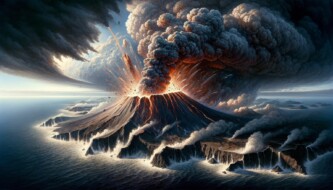
The island is part of a place where the earth shakes and has many fire mountains, called the "Ring of Fire." This boom did not hurt people because no one lives close to the island. But it shows that people need to keep watching the fire mountains. Japan has many fire mountains that can go boom. Scientists like to learn about new islands like this one because they help us understand the earth better. Japan is always watching its fire mountains to keep people safe.
Original news source: Watch: Volcano in Japan spews ash, rock 200m into sky (BBC)
📖 Vocabulary:
Group or Classroom Activities
Warm-up Activities:
– Charades
Instructions: Divide the class into two teams. Choose keywords from the article (e.g. volcano, island, boom, smoke, rocks) and write them on separate pieces of paper. One student from each team will come to the front of the class and act out the keyword without speaking. The team members must guess the keyword within a certain time limit (e.g. 1 minute). The team with the most correct guesses wins.
– News Summary
Instructions: In pairs, students will take turns summarizing the article to their partner. They should try to include the main points of the article in their summary. After each student has finished, they can compare their summaries and discuss any differences or similarities.
– Vocabulary Pictionary
Instructions: Divide the class into pairs. Give each pair a list of vocabulary words from the article (e.g. volcano, island, boom, smoke, rocks). One student will choose a word and draw a picture to represent it, while the other student tries to guess the word. They can switch roles after each word. The pair with the most correct guesses wins.
– Pros and Cons
Instructions: Divide the class into two groups. One group will brainstorm the pros of living near a volcano (e.g. beautiful scenery, natural hot springs), while the other group will brainstorm the cons (e.g. risk of eruptions, air pollution). Each group will then present their ideas to the class and have a discussion about which group's arguments were most convincing.
– Think-Pair-Share
Instructions: Ask the students to think about the following question: "Why is it important for scientists to study and monitor volcanoes?" Give them a few minutes to think about their answer, then pair them up with a partner to discuss their ideas. After discussing, each pair will share their thoughts with the rest of the class. Encourage students to use new vocabulary from the article in their discussions.
🤔 Comprehension Questions:
The volcano on the island in Japan went boom.
The boom sent rocks into the air and water.
The island is 10 years old.
The name of the island means "new island."
People who watch the ocean in Japan took a video of the big boom.
The video showed a lot of smoke and rocks flying up and then falling down into the sea.
Scientists like to learn about new islands like this one because they help us understand the earth better.
🎧✍️ Listen and Fill in the Gaps:
A big that spits fire, called a volcano, went on an island in Japan. The boom sent rocks high into the air and into the water. This island is very young, only 10 years old, and its name means "new island." People who watch the ocean in Japan took a video of the big boom. The video shows a lot of smoke and flying up and then falling down into the sea. The island is part of a where the earth shakes and has many fire mountains, called the "Ring of Fire." This boom did not hurt people because no one lives close to the . But it shows that people need to keep the fire mountains. Japan has many fire mountains that can go boom. like to learn about new islands like this one because they help us the earth better. Japan is always watching its fire mountains to keep people safe.
💬 Discussion Questions:
1. What is a volcano?
2. How would you feel if you saw a big boom from a volcano?
3. Do you like watching videos of volcanoes? Why or why not?
4. What do you think happens when rocks fly up and then fall down into the sea?
5. Have you ever seen a fire mountain? What did it look like?
6. How do you think scientists learn about new islands like the one in Japan?
7. Do you think it's important to watch fire mountains to keep people safe? Why or why not?
8. What do you think the "Ring of Fire" is?
9. Have you ever felt the earth shake? How did it feel?
10. Why do you think Japan has many fire mountains?
11. What can we learn about the earth by studying new islands?
12. How do you think people in Japan feel when they see a volcano go boom?
Individual Activities
📖💭 Vocabulary Meanings:
Click a dot next to a word, then click the dot next to its meaning to draw a line connecting them.
Words
Meanings
🔡 Multiple Choice Questions:
🕵️ True or False Questions:
📝 Write a Summary:
Write a summary of this news article in two sentences.
Check your writing now with the best free AI for English writing!