

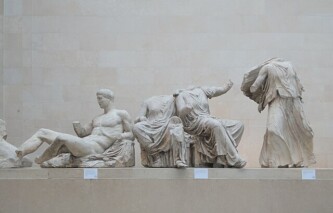
People have been talking for a long time about who should keep the old statues. Greece says they belong to them and should be at home. But the big museum in London says the statues are okay where they are. They say many people can see them in London. Both sides can't agree, and they both really want to keep the statues.
Original news source: Elgin Marbles in UK 'like cutting Mona Lisa in half' (BBC)
📖 Vocabulary:
Group or Classroom Activities
Warm-up Activities:
– Charades
Instructions: Divide the class into two teams. One student from each team will come to the front and act out a statue-related word or phrase without speaking. The team members will have to guess what the word or phrase is. The team that guesses correctly gets a point. Repeat with different students acting out different words or phrases.
– Vocabulary Pictionary
Instructions: Divide the class into pairs. Each pair will be given a statue-related word or phrase. One student will have to draw a picture of the word or phrase while the other student guesses what it is. The pair that guesses correctly gets a point. Repeat with different pairs and different words or phrases.
– Keyword Taboo
Instructions: Write down a list of keywords related to the article on the board. Divide the class into teams. One student from each team will come to the front and try to explain the keyword without saying the word itself or any of the taboo words listed below it. The team members will have to guess what the keyword is. The team that guesses correctly gets a point. Repeat with different students and different keywords.
– Synonym Challenge
Instructions: Write down a list of words from the article on the board. Divide the class into pairs. Each pair will be given a word and they have to come up with as many synonyms for that word as possible within a time limit. The pair with the most synonyms gets a point. Repeat with different pairs and different words.
– Think-Pair-Share
Instructions: Ask the students to think about whether they think the statues should be returned to Greece or stay in the museum in London. Then, pair up the students and ask them to discuss their opinions with their partner. Finally, have a class discussion where students share their opinions and reasons for their choices.
🤔 Comprehension Questions:
He wants the old statues to come back home to Greece.
He thinks it's like having only half of a famous painting because some of the statues are still in Greece and he wants all of them to be together.
A man from Britain took the statues to London a long time ago.
Some of the statues are still in Greece and some are in London.
The man from Greece thinks the statues should be at home in Greece.
The people at the big museum in London think the statues should stay in London.
No, both sides do not agree about where the statues should be.
🎧✍️ Listen and Fill in the Gaps:
A man from Greece who run the country says he wants some very old statues to come back home from a big museum in . He thinks it's like having only half of a very famous . A long ago, a man from Britain took these statues and brought them to London. Some of the statues are still in Greece. The man from Greece wants all the statues to be together again. have been for a long time about who should keep the old statues. Greece says they belong to them and should be at home. But the big in London the statues are okay where they are. They say many people can see them in London. Both sides can't agree, and they both really want to keep the statues.
💬 Discussion Questions:
1. What is a statue?
2. How would you feel if someone took something important from your country?
3. Do you think the statues should go back to Greece? Why or why not?
4. Have you ever seen a statue before? Where was it?
5. How do you think the people in Greece feel about the statues being in London?
6. Do you like going to museums? Why or why not?
7. What do you think the statues in Greece look like?
8. How would you feel if you saw the statues in person?
9. Do you think the statues should be kept in a museum? Why or why not?
10. Have you ever been to London? What did you see there?
11. What do you think is more important, having the statues in Greece or in London? Why?
12. If you could decide where the statues should be, where would you put them? Why?
Individual Activities
📖💭 Vocabulary Meanings:
Click a dot next to a word, then click the dot next to its meaning to draw a line connecting them.
Words
Meanings
🔡 Multiple Choice Questions:
🕵️ True or False Questions:
📝 Write a Summary:
Write a summary of this news article in two sentences.
Check your writing now with the best free AI for English writing!