


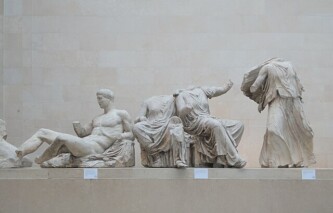
People have been arguing about these statues for many years. Greece says they belong to them and should be back in Greece. People who agree with Greece say these statues are a special part of their history. They want all the statues to be together again.
The museum in London says the statues should stay there. They say more people from all over the world can see them in London. The museum also says they take good care of the statues. Both sides really believe they are right, so they keep arguing.
Original news source: Elgin Marbles in UK 'like cutting Mona Lisa in half' (BBC)
📖 Vocabulary:
Group or Classroom Activities
Warm-up Activities:
– Headline Creation
Instructions: In pairs or small groups, students will create catchy and informative headlines for an article about the Greek statues. They should try to capture the main points and arguments of both sides. After creating the headlines, students can share and discuss their choices with the class.
– Vocabulary Pictionary
Instructions: Provide a list of key vocabulary words from the article related to the topic of the Greek statues. In pairs or small groups, students take turns choosing a word and drawing a quick sketch to represent it. The other students must guess the word based on the sketch. This activity helps reinforce vocabulary and promotes communication and collaboration.
– Think-Pair-Share
Instructions: Students individually read the article about the Greek statues. Then, in pairs, they discuss their thoughts and opinions on the topic. After sharing their ideas with their partner, they can share with the whole class in a group discussion. Encourage students to use new vocabulary and express their opinions clearly.
– Speed Summarizing
Instructions: Divide the class into pairs. One partner reads the article about the Greek statues and has one minute to summarize it to their partner. After one minute, the roles switch and the other partner summarizes the article. This activity helps develop reading comprehension and speaking skills, as students must quickly identify the main points and communicate them effectively.
– Future Predictions
Instructions: In small groups, students discuss and make predictions about the future of the Greek statues. They can consider questions such as: Will they be returned to Greece? Will the museum in London keep them? How will the situation be resolved? After discussing their predictions, groups can share their ideas with the class. This activity encourages critical thinking and the use of future tenses.
🤔 Comprehension Questions:
The leader of Greece wants the old Greek statues to be brought back to Greece because he believes they belong to Greece and should be part of their history.
The problem with the statues being in two different places is that they are not all together. It's like having only half of a famous painting.
Some people think the statues should be back in Greece because they are a special part of Greece's history and should be with the rest of their historical artifacts.
The museum in London says that the statues should stay there because more people from all over the world can see them in London and they take good care of the statues.
Both sides keep arguing about the statues because they both believe they are right. Greece thinks the statues should be back in their country, while the museum in London thinks they should stay there.
People think the statues are a special part of Greece's history because they were made a long time ago in Greece and they represent their culture and heritage.
One reason the museum in London gives for keeping the statues there is that more people from all over the world can see them in London and learn about Greek history and art.
🎧✍️ Listen and Fill in the Gaps:
The leader of Greece wants some very old statues that are in a in London to be brought back to Greece. He says it's like having only half of a painting. A British man took the statues to London a time ago. Now, some of the statues are in London and some are in Greece. People have been arguing about these statues for years. Greece says they to them and should be back in . People who with Greece say these statues are a part of their history. They want all the statues to be together again. The museum in London says the statues should stay there. They say more from all over the world can see them in . The museum also says they take good care of the . Both sides really believe they are right, so they keep arguing.
💬 Discussion Questions:
1. What is a statue?
2. How would you feel if you saw a famous statue in a museum?
3. Do you think the statues should be brought back to Greece? Why or why not?
4. Why do you think the leader of Greece wants the statues back?
5. Do you think the statues are an important part of Greece's history? Why or why not?
6. How do you think the people in Greece feel about the statues being in London?
7. Do you like visiting museums? Why or why not?
8. How do you think the people in London feel about the statues staying there?
9. Do you think it's fair that more people can see the statues in London? Why or why not?
10. How do you think the statues feel being separated from each other?
11. What do you think the museum in London should do with the statues?
12. If you were in charge, what would you do with the statues? Why?
Individual Activities
📖💭 Vocabulary Meanings:
Click a dot next to a word, then click the dot next to its meaning to draw a line connecting them.
Words
Meanings
🔡 Multiple Choice Questions:
🕵️ True or False Questions:
📝 Write a Summary:
Write a summary of this news article in two sentences.
Check your writing now with the best free AI for English writing!