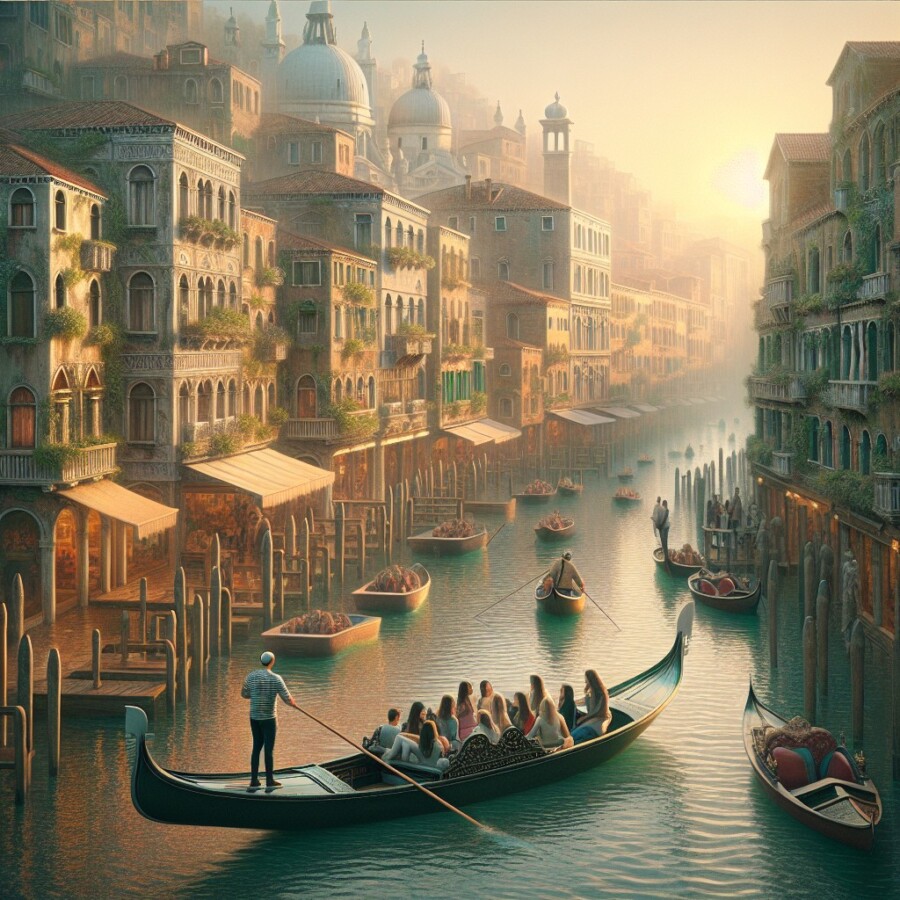
Venice, a city in Italy, is making new rules because there are too many tourists. Loudspeakers will not be allowed starting in June because they are noisy and confusing. Also, groups of more than 25 tourists will not be allowed. The city is small but many tourists come to visit, and this is causing problems.
The city also wants tourists to pay €5 to visit for the day. Many people who live in Venice are moving away because there are too many tourists. There are more places for tourists to sleep than for people who live there. Big ships can't go into the center of Venice anymore, and the city might be put on a list of places that are in danger.
Other cities in Europe also have too many tourists and are trying to fix this. Florence won't let people rent out new Airbnbs in the center of the city. Rome will make tourists pay money if they do things like not wear a shirt or put locks on bridges. Portofino doesn't want tourists to wait too long to take pictures, and Athens won't let too many people visit an old building called the Acropolis.
Original news source: Venice to ban large tourist groups and loudspeakers (BBC)
🎧 Listen:
📖 Vocabulary:
Group or Classroom Activities
Warm-up Activities:
– News Summary
Instructions:
1. Divide the class into pairs or small groups.
2. Give each group a copy of the article.
3. Instruct the groups to read the article and summarize the main points in their own words.
4. After a designated amount of time, have each group share their summary with the class.
– Opinion Poll
Instructions:
1. Divide the class into pairs or small groups.
2. Ask each group to discuss their opinions on the new rules in Venice.
3. Provide a list of discussion questions such as: "Do you agree with the new rules? Why or why not?" or "What other measures could Venice take to manage the tourism problem?"
4. After the discussion, have each group present their opinions to the class and facilitate a class-wide discussion.
– Vocabulary Pictionary
Instructions:
1. Write a list of vocabulary words from the article on the board, such as "tourists," "Venice," "rules," "problems," etc.
2. Divide the class into pairs.
3. Give each pair a whiteboard or a piece of paper.
4. Instruct one student from each pair to choose a vocabulary word and draw a picture representing that word.
5. The other student must guess the word based on the drawing.
6. Rotate roles and continue until all the vocabulary words have been used.
– Keyword Taboo
Instructions:
1. Write a list of keywords from the article on the board, such as "tourists," "Venice," "rules," "problems," etc.
2. Divide the class into pairs.
3. Instruct one student from each pair to choose a keyword from the board without telling their partner.
4. The student must describe the keyword to their partner without using the word itself or any derivatives of it.
5. The partner must guess the keyword based on the description.
6. Rotate roles and continue until all the keywords have been used.
– Think-Pair-Share
Instructions:
1. Ask the class the following question: "What are some potential consequences of having too many tourists in a city?"
2. Give the students a few minutes to think about their answers individually.
3. Pair up the students and ask them to share their ideas with their partner.
4. After a designated amount of time, have pairs share their ideas with the class and facilitate a class-wide discussion.
🤔 Comprehension Questions:
Venice is making new rules because there are too many tourists causing problems.
Starting in June, tourists will not be allowed to use loudspeakers and groups of more than 25 tourists will not be allowed.
Many people who live in Venice are moving away because there are too many tourists.
One problem caused by the large number of tourists in Venice is that there are more places for tourists to sleep than for people who live there.
Other cities in Europe are fixing the problem of too many tourists by not allowing new Airbnbs in the center of the city, making tourists pay money for certain actions, and limiting the number of tourists in certain places.
If tourists in Rome do things like not wear a shirt or put locks on bridges, they will have to pay money.
Athens won't let too many people visit the Acropolis.
🎧✍️ Listen and Fill in the Gaps:
Venice, a city in Italy, is new rules because there are too many tourists. will not be starting in June because they are noisy and confusing. Also, groups of more than 25 tourists will not be allowed. The city is small but many tourists come to visit, and this is causing problems. The city also wants tourists to pay €5 to visit for the day. Many people who in are moving away because there are too many tourists. There are more for tourists to sleep than for people who live there. Big ships can't go into the center of Venice anymore, and the city might be put on a list of places that are in danger. Other cities in also too tourists and are trying to fix this. Florence won't let people rent out new Airbnbs in the center of the city. Rome will make tourists pay if they do things like not wear a shirt or put locks on bridges. Portofino doesn't want tourists to wait too long to take pictures, and Athens won't let too many visit an old called the Acropolis.
💬 Discussion Questions:
1. What is Venice?
2. How would you feel if there were too many tourists in your city?
3. Do you like visiting crowded places? Why or why not?
4. What do you think about the new rules in Venice?
5. How do you think the loudspeakers can be noisy and confusing?
6. Do you think it's fair for tourists to pay €5 to visit Venice for the day? Why or why not?
7. Have you ever visited a place with too many tourists? How was it?
8. What do you think will happen if more people keep moving away from Venice?
9. Do you think other cities in Europe should also make new rules for tourists? Why or why not?
10. How do you think the city of Florence is trying to fix the problem with too many tourists?
11. Have you ever visited a place where you had to wait a long time to take pictures? How did you feel?
12. Do you think it's important to protect old buildings like the Acropolis in Athens? Why or why not?
Individual Activities
📖💭 Vocabulary Meanings:
Click a dot next to a word, then click the dot next to its meaning to draw a line connecting them.
Words
Meanings
🔡 Multiple Choice Questions:
🕵️ True or False Questions:
📝 Write a Summary:
Write a summary of this news article in two sentences.
Check your writing now with the best free AI for English writing!